Event Published ResearchPerplexity AI
Small Nepali Legal Language Model NepLEGiT Trained From Scratch on Legal Corpus
Researchers built NepLEGiT, a compact Nepali legal language model, a project relevant to how Perplexity and other answer engines might one day serve underserved languages.
What happened
Published here
A paper submitted on 8 August 2026 and indexed on arXiv on 16 September 2026 describes NepLEGiT, a small language model pre-trained from scratch on a curated corpus of Nepali legal text covering constitutional law, civil and criminal codes, and administrative regulations. The authors, working independently of any major AI lab, built a decoder based transformer with a 6 layer, 6 head, 384 dimensional architecture and trained it with warmup cosine decay scheduling, gradient accumulation, and mixed precision arithmetic. (arXiv paper abstract page, NepLEGiT (submitted 8 August 2026, this version 16 September 2026))
Open the photograph at full size
Photograph: Diagram: AI Journey
Read the full description of this diagram
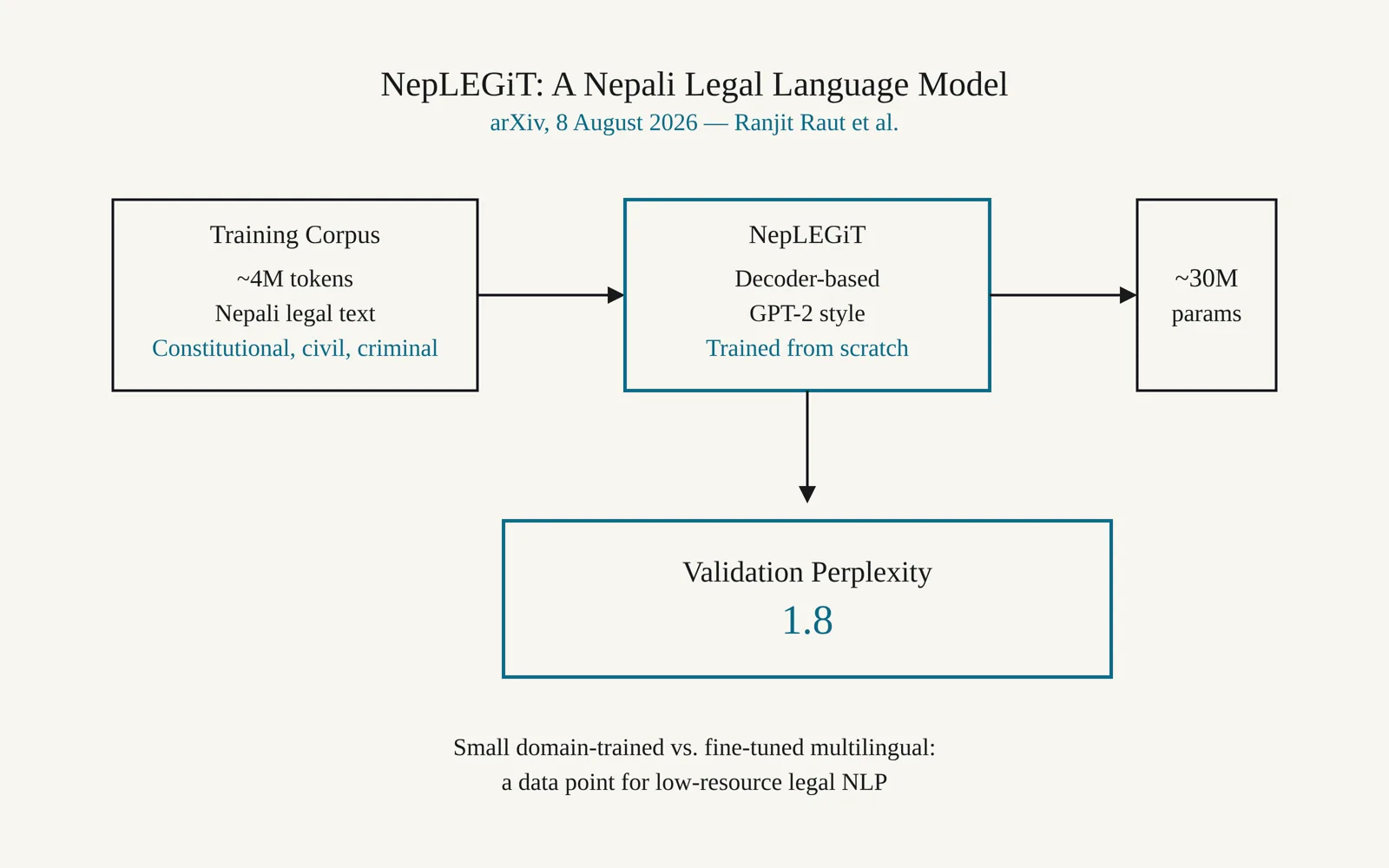
Diagram drawn for this item: Small Nepali Legal Language Model NepLEGiT Trained From Scratch on Legal Corpus. A paper submitted on 8 August 2026 and indexed on arXiv on 16 September 2026 describes NepLEGiT, a small language model pre-trained from scratch on a curated corpus of Nepali legal text covering constitutional law, civil and criminal... The work is a reminder that useful language coverage does not always require a frontier lab or a general purpose model.
The numbers
Corpus size
~4 million tokens
Curated Nepali legal text used for pre-training
Parameters
~30 million
Decoder-based GPT-2 style architecture
Validation perplexity
1.8
On the held-out validation split
Next-token accuracy
82.9%
On the held-out validation split
Read from arXiv paper abstract page, NepLEGiT (submitted 8 August 2026, this version 16 September 2026)
What it means for you
The work is a reminder that useful language coverage does not always require a frontier lab or a general purpose model. Answer engines such as Perplexity route queries to whichever model or index answers best, and a narrow, well curated legal model in an underserved language is the kind of component that could plug into that routing rather than compete with it, since a small model trained on domain text can outperform a general model on that domain without the cost of a large pretraining run.
In more detail
Researchers from Kathmandu University published NepLEGiT on 8 August 2026, with the current version indexed on arXiv on 16 September 2026. The paper addresses a plain problem: legal information in Nepal is written in dense, formal Nepali, and legal expertise is scarce outside cities, which leaves many citizens unable to read or interpret the laws that govern them. Rather than adapting an existing large multilingual model, the authors trained a small language model from nothing on legal text alone.
The model is a decoder-based transformer built on the GPT-2 architecture, with 6 layers, 6 attention heads, and a hidden dimension of 384. Training used warmup cosine decay scheduling, gradient accumulation, and mixed precision arithmetic, all standard techniques for fitting a useful model onto limited compute. The training corpus was assembled specifically for the task, drawing on constitutional law, civil and criminal codes, and administrative regulations written in Nepali.
The authors also ran a comparison against two existing multilingual encoder models, mBERT and MuRIL, continuing their pre-training on the same legal corpus rather than training from scratch. mBERT reached a lower validation perplexity than MuRIL on this domain-specific data, which the paper reports as a useful encoder-side baseline that complements NepLEGiT’s own generative design.
The numbers
NepLEGiT was trained on roughly 4 million tokens of curated legal text and has about 30 million parameters, a fraction of the size of the general-purpose models that dominate most public discussion. On the held-out validation split it reached a cross-entropy loss of 0.5684, a perplexity of 1.8, and next-token prediction accuracy of 82.9 percent. Those figures describe how well the model predicts Nepali legal language specifically, not general reasoning or fluency, and they are not directly comparable to benchmarks reported for large multilingual systems.
The paper does not test the model against any deployed product, and no company has adopted it. It is included here as a research signal rather than a product announcement: a demonstration that a narrowly scoped, cheaply trained model can perform competently on a specialized task where large models have little tailored training data. For an answer engine business like Perplexity, whose value depends on routing a query to whatever source answers it best, small specialist models built for a single language and domain are exactly the kind of building block that could sit behind a general interface without needing to be trained by the interface’s own operator.
Sources
Sources read
Cite this
AI Journey, "Small Nepali Legal Language Model NepLEGiT Trained From Scratch on Legal Corpus", 16 Sep 2026, https://aijourney.space/updates/2026-09-16-nepali-legal-expertise-through-generative-and-extractive-pre-trained-tra/ (source: arXiv, verified 16 Sep 2026)
Next in the stream
Researchers Publish Bias-Variance Theory For Guided Reasoning Training
A paper relevant to reasoning methods used across the field, including by vendors such as MiniMax, sets out a bias-variance theory for guidance-augmented reinforcement learning.
Previous
Paper Maps Which Token-Saving Tricks Actually Cut Costs for Claude Code
A new paper instruments a production gateway sitting between Anthropic's Claude Code and frontier models to measure which compression levers actually lower a session's token bill.
Next
More in Perplexity AI
Perplexity AI Researchers Detail LoRA Recipe For Converting Four Language Models To Diffusion
A paper associated with Perplexity AI describes BYOD, a LoRA-only method that converts standard autoregressive language models into diffusion language models without full retraining.
Paper Proposes Message-Passing Method For Compressing LLM Weights
A new arXiv paper proposes a message-passing method for compressing large language model weights, the kind of efficiency work that underlies answer engines like Perplexity AI.
Researchers Publish S-SALAAD Framework For Sparse Large Model Inference
A new paper on compressing large models for edge devices matters to Perplexity AI and any company whose answer engine has to run inference away from a data center.