Event Published ResearchPerplexity AI
Paper Proposes Reversible Tokenizer That Cuts Vocabulary Bloat
A new arXiv paper details a reversible subword tokenizer that could interest search tools like Perplexity, which parses messy web text into answers.
What happened
Published here
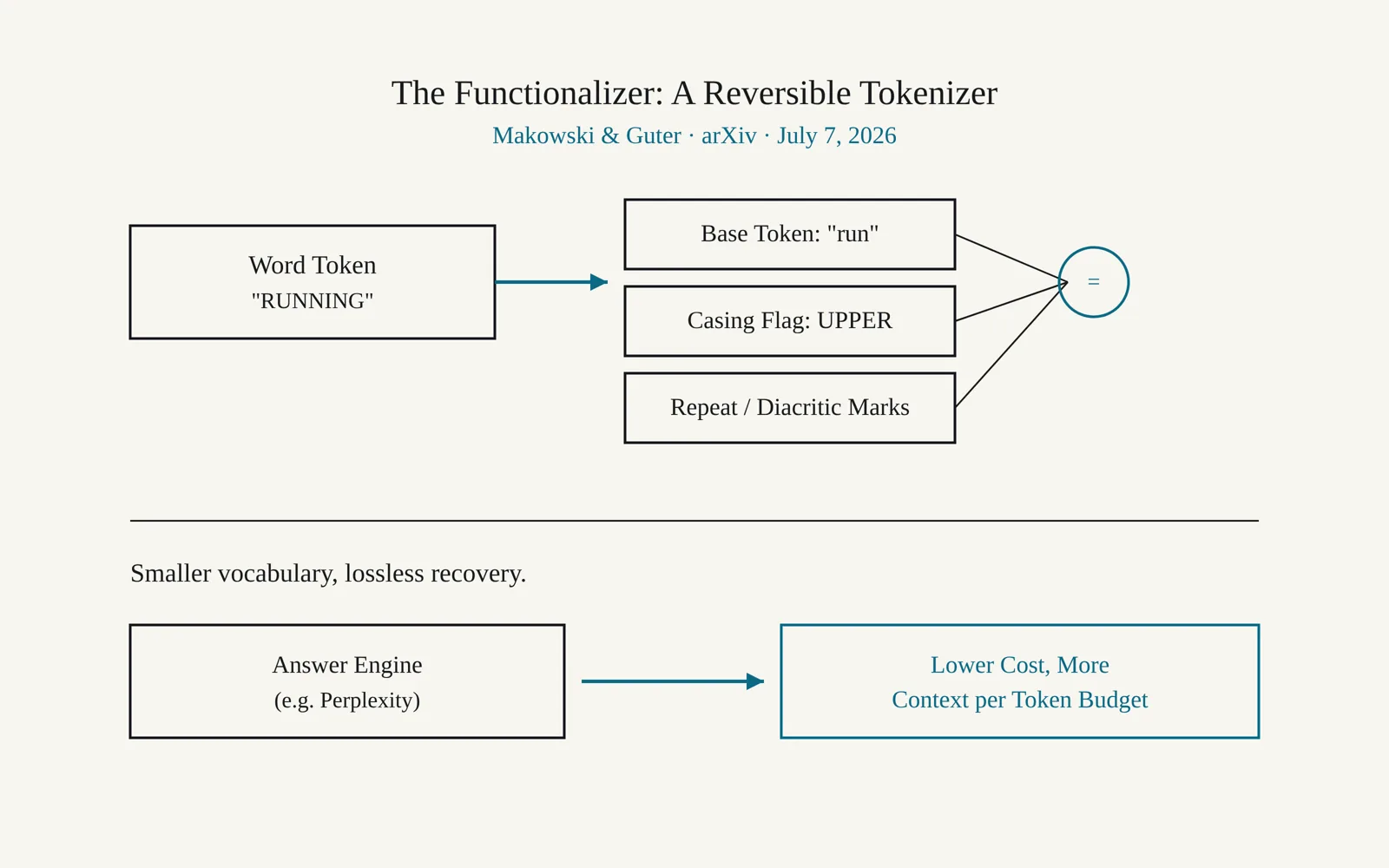
Researchers Connor Makowski and Willem Guter posted the Functionalizer paper to arXiv, submitted July 7, 2026, describing a lossless pre-tokenizer that separates casing, diacritics and repeated characters from a word's base token using reversible opcodes. (arXiv preprint, The Functionalizer paper)
Open the photograph at full size
Photograph: Diagram: AI Journey
Read the full description of this diagram
Diagram drawn for this item: Paper Proposes Reversible Tokenizer That Cuts Vocabulary Bloat. Researchers Connor Makowski and Willem Guter posted the Functionalizer paper to arXiv, submitted July 7, 2026, describing a lossless pre-tokenizer that separates casing, diacritics and repeated characters from a word's base token using... For any company running an answer engine such as Perplexity, tokenizer vocabulary size directly shapes model cost and context budget, so a scheme claiming smaller vocabularies without losing text coverage is a lever worth testing before it...
The numbers
Vocabulary cut
16%
Peak reduction in vocabulary slot requirements versus standard subword tokenizers
Diacritic opcodes
13
Dedicated reversible opcodes covering diacritic marks
Test corpora
six
Natural language and code corpora used to measure coverage
Test model size
25M
Parameter count of the GPT-2 scale model used for downstream evaluation
Read from arXiv preprint, The Functionalizer paper
What it means for you
For any company running an answer engine such as Perplexity, tokenizer vocabulary size directly shapes model cost and context budget, so a scheme claiming smaller vocabularies without losing text coverage is a lever worth testing before it reaches production.
In more detail
The Functionalizer, described in an arXiv paper submitted July 7, 2026, tackles a problem every subword tokenizer inherits: hello, Hello, HELLO and Héllo end up as separate vocabulary entries, or the differences between them get normalized away and lost entirely. Authors Connor Makowski and Willem Guter propose splitting a word into a canonical base token plus a stream of reversible transformation opcodes, stored in the Unicode Private Use Area, that record casing, diacritics and character repetition separately from the base spelling.
The scheme adds a CAPITALIZE opcode, thirteen dedicated diacritic opcodes, and repeated-character operators called REPEAT and MULTIREPEAT, all fully reversible so the original text can be reconstructed exactly. Because the transformation is factored out rather than baked into separate vocabulary slots, the tokenizer needs fewer distinct tokens to cover the same text.
The numbers
Tested across six natural language and code corpora, the Functionalizer achieved complete coverage while cutting actual vocabulary slot requirements by up to 16 percent under unconstrained conditions. The paper also reports a domain split: the scheme compresses indentation-heavy code sequences but produces longer sequences for natural-language prose, because prose carries less of the repeated structure the opcodes capture. In preliminary downstream tests on a 25M-parameter GPT-2-scale model, the approach improved code syntax validity and reduced code character perplexity, while text coherence on prose stayed roughly comparable to a standard tokenizer.
Why this matters beyond the lab bench comes down to cost and context budget. Every token a model processes costs compute and eats into the context window, so a smaller vocabulary that still covers a corpus completely is a direct lever on both. Perplexity AI runs an answer engine that indexes and reasons over live web text, exactly the kind of mixed-case, code-and-prose corpus this paper tests against, which makes tokenizer efficiency a practical operating question rather than an academic one, even though the paper’s authors are not affiliated with Perplexity. The tradeoff the researchers flag, better for code and worse for prose sequence length, is the kind of detail a team would need to weigh before swapping a production tokenizer, since prose inflation could offset the vocabulary savings depending on how much of a system’s traffic is prose rather than code.
The authors describe the results as preliminary, run at a research scale well below production language models, and call for further validation at production scale before drawing firm conclusions about how the approach holds up once vocabulary size, corpus diversity and model scale all grow together.
Sources
Sources read
arXiv preprint, The Functionalizer paper (arxiv.org)
Paper read
Cite this
AI Journey, "Paper Proposes Reversible Tokenizer That Cuts Vocabulary Bloat", 16 Sep 2026, https://aijourney.space/updates/2026-09-16-the-functionalizer-lossless-functional-decomposition-for-subword-tokeniz/ (source: arXiv, verified 16 Sep 2026)
Next in the stream
Paper Proposes Header-Only Framework for Table Quality Checks
A new paper describes a header-centric framework that scores table quality and assigns data types without reading any cell values, ahead of knowledge graph building.
Previous
Researchers Publish Bias-Variance Theory For Guided Reasoning Training
A paper relevant to reasoning methods used across the field, including by vendors such as MiniMax, sets out a bias-variance theory for guidance-augmented reinforcement learning.
Next
More in Perplexity AI
Perplexity AI Researchers Detail LoRA Recipe For Converting Four Language Models To Diffusion
A paper associated with Perplexity AI describes BYOD, a LoRA-only method that converts standard autoregressive language models into diffusion language models without full retraining.
Paper Proposes Message-Passing Method For Compressing LLM Weights
A new arXiv paper proposes a message-passing method for compressing large language model weights, the kind of efficiency work that underlies answer engines like Perplexity AI.
Researchers Publish S-SALAAD Framework For Sparse Large Model Inference
A new paper on compressing large models for edge devices matters to Perplexity AI and any company whose answer engine has to run inference away from a data center.