Event Published ResearchResearch
Paper Proposes Header-Only Framework for Table Quality Checks
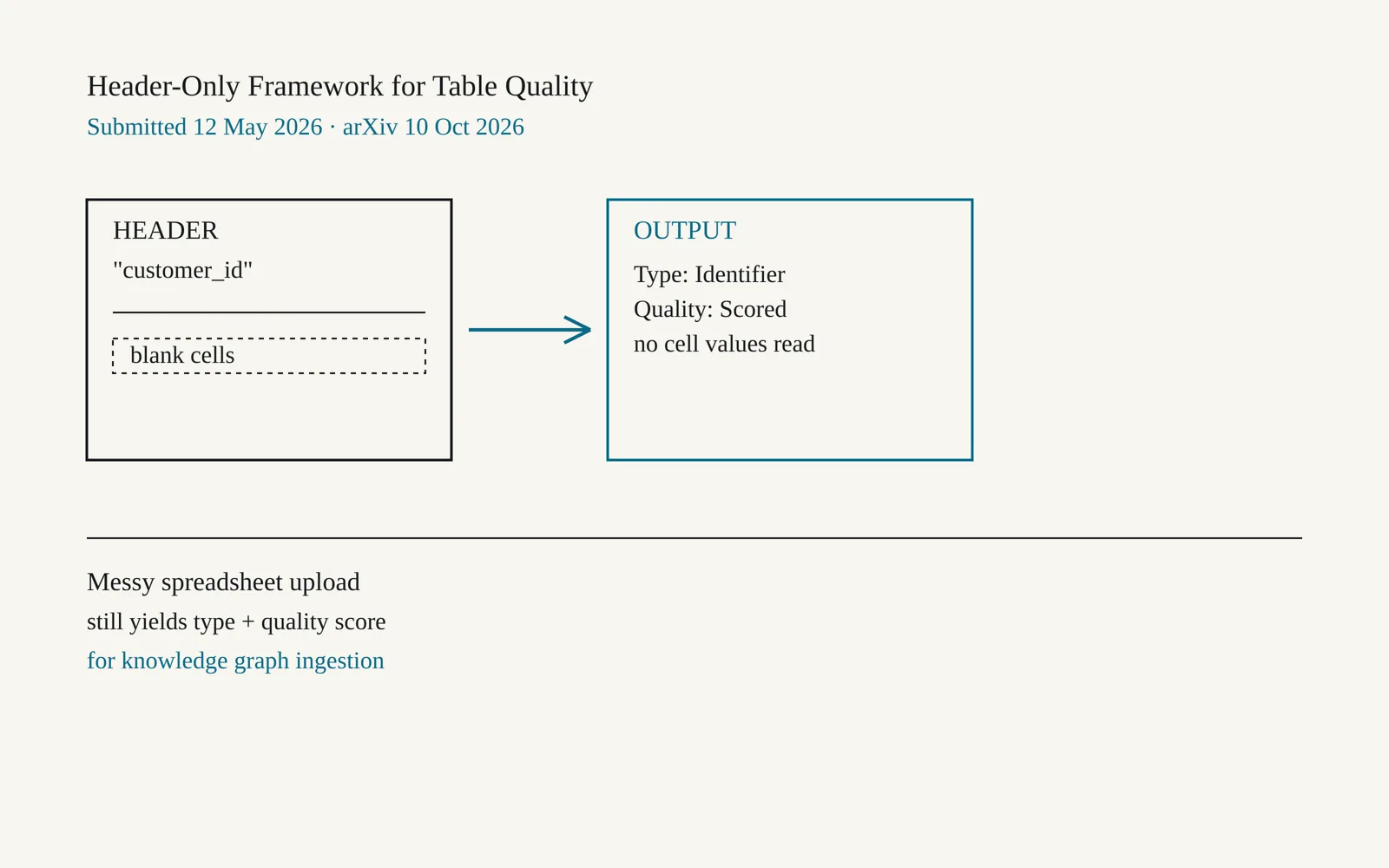
A new paper describes a header-centric framework that scores table quality and assigns data types without reading any cell values, ahead of knowledge graph building.
What happened
Published here
Submitted on 12 May 2026 and listed on arXiv on 10 October 2026, the paper presents an explainable, header-centric framework for metadata-only Column Type Annotation and Data Quality Assessment, built for cases where cell values are missing, noisy or unusable before a table is folded into a knowledge graph. (arXiv preprint 2610.10541, submitted 12 May 2026)
Open the photograph at full size
Photograph: Diagram: AI Journey
Read the full description of this diagram
Diagram drawn for this item: Paper Proposes Header-Only Framework for Table Quality Checks. Submitted on 12 May 2026 and listed on arXiv on 10 October 2026, the paper presents an explainable, header-centric framework for metadata-only Column Type Annotation and Data Quality Assessment, built for cases where cell values are... For anyone building a knowledge graph from scraped or inherited spreadsheets, a method that judges a column from its header alone changes what a messy upload costs: a table with blank or garbled cells still gets a type and a quality score...
The numbers
FinalFormat types
39
Interpretable type categories headers are mapped to
Header columns evaluated
120,000
Approximate total across the benchmark set
Paper length
18 pages
What it means for you
For anyone building a knowledge graph from scraped or inherited spreadsheets, a method that judges a column from its header alone changes what a messy upload costs: a table with blank or garbled cells still gets a type and a quality score instead of being discarded, which shifts the bottleneck from manual cleaning toward reviewing the explanations the tool already attaches to each decision.
In more detail
A table with missing or unreliable cell values is normally treated as a dead end for automated knowledge graph work: there is nothing in the rows to classify. The paper submitted on 12 May 2026 by Marcelo Valentim Silva, Hannes Herrmann and Valerie Maxville argues the header row alone carries enough signal to keep going. Their system maps column headers to a set of interpretable FinalFormat types using curated lexical resources, while keeping a record of exactly which header tokens, called SourceKeywords, drove each assignment. That traceability is the paper’s central claim: a reviewer can see why a column was labelled “postal code” or “currency amount” rather than trusting a black box score.
Each assigned type then triggers validation rules drawn from a taxonomy of Data Quality Issues, flagging missing data, duplicate columns, domain violations, wrong data types and temporal mismatches. The authors roll these detections into a single unweighted metric they call HeadersIQ, meant as a quick read on how trustworthy a data source is before it reaches integration work, not a replacement for full downstream graph validation.
The numbers
The framework was tested against a mix of established benchmarks, including UCI, Prague, Kaggle, VizNet/Sato, SOTAB, T2Dv2 and the SemTab 2024 Metadata-to-KG track, together spanning around 120,000 header columns. Headers are sorted into 39 interpretable FinalFormat types, and the write-up itself runs 18 pages with four figures, presented at the Workshop on Quality of Knowledge Graphs at ESWC 2026 in Dubrovnik on 11 May 2026.
On the SemTab 2024 track specifically, the paper reports that strict ground-truth scoring came out modest. Rather than stop there, the authors ran a separate blinded diagnostic audit and found that many of the mismatches traced back to how the benchmark itself draws category boundaries, aliasing between near-synonym labels and ontology choices, not to implausible header readings from the system. They are careful to present that audit as evidence about disagreement patterns rather than a revised score, which keeps the strict benchmark result standing even while it argues the number understates the method in practice.
A parallel pathway in the framework also supports mapping results onto DBpedia and Wikidata, positioning the work as a preprocessing step that sits ahead of, rather than inside, the graph construction pipeline itself.
Sources
Sources read
arXiv preprint 2610.10541, submitted 12 May 2026 (arxiv.org)
Paper read
Cite this
AI Journey, "Paper Proposes Header-Only Framework for Table Quality Checks", 10 Oct 2026, https://aijourney.space/updates/2026-10-10-an-explainable-header-centric-framework-for-large-scale-semantic-table-i/ (source: arXiv, verified 10 Oct 2026)
Next in the stream
Paper Proposes Reversible Tokenizer That Cuts Vocabulary Bloat
A new arXiv paper details a reversible subword tokenizer that could interest search tools like Perplexity, which parses messy web text into answers.
Next
More in Research
Study Finds Precedent Labels Sway Claude Haiku Approval Calls
A new paper tests Claude Haiku 5.5 alongside other models on refund and claim decisions, showing that past case labels shift approvals sharply.
Paper Tests Claude Opus 4.8 Agents on Conflicting Code Edits
A new paper benchmarks Claude Code running Claude Opus 4.8 against other coding agents on tasks where two agents edit the same shared codebase at once.
Perplexity AI Researchers Detail LoRA Recipe For Converting Four Language Models To Diffusion
A paper associated with Perplexity AI describes BYOD, a LoRA-only method that converts standard autoregressive language models into diffusion language models without full retraining.