What happened
Published here
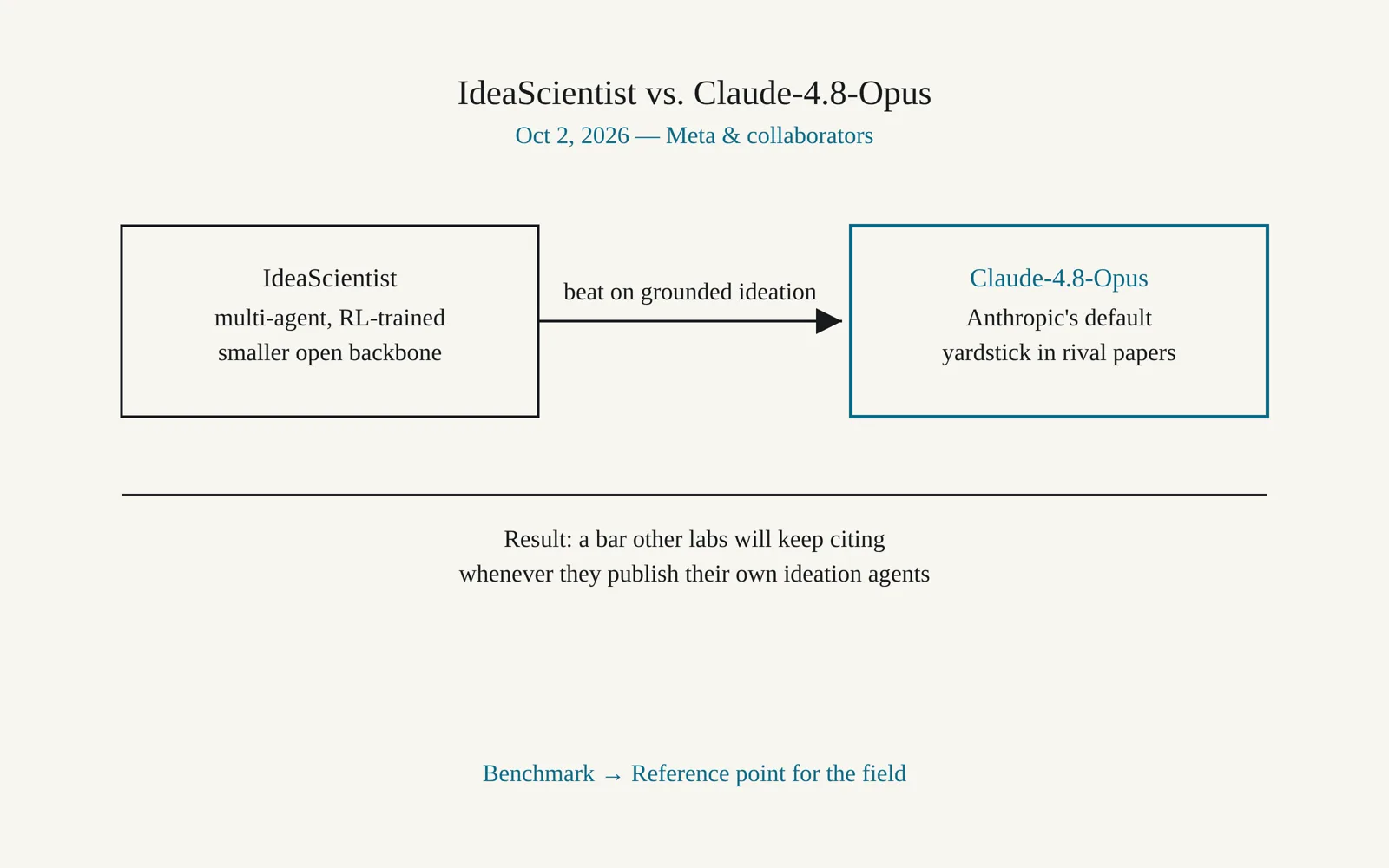
On October 2, 2026, a group of researchers from Meta and collaborating institutions posted a paper describing IdeaScientist, a multi-agent system trained with reinforcement learning to generate grounded research ideas, and reported that on a 27B open backbone it outperforms a baseline pairing Claude Code SDK with Claude-4.8-Opus by up to 5.9 percent on a held-out evaluation measured against 15K papers later published by human researchers. (arXiv paper, IdeaScientist: Orchestrating Agents for Grounded Scientific Ideation, submitted October 2, 2026)
Open the photograph at full size
Photograph: Diagram: AI Journey
Read the full description of this diagram
Diagram drawn for this item: IdeaScientist Paper Benchmarks Ideation Agents Against Claude-4.8-Opus. On October 2, 2026, a group of researchers from Meta and collaborating institutions posted a paper describing IdeaScientist, a multi-agent system trained with reinforcement learning to generate grounded research ideas, and reported that on... For a lab such as Anthropic, whose Claude models are the default yardstick cited in rival papers, having Claude-4.8-Opus named as the system a smaller open backbone beat sets a bar other teams will keep citing whenever they publish their...
The numbers
Idea corpus size
2.77M
Decomposed research ideas in the Svalbard Idea Vault
Gain over open baseline
14.0%
Margin over the strongest open-source autoresearch baseline on Qwen3.6-27B
Gain over Claude baseline
5.9%
Margin by which IdeaScientist beats Claude Code SDK with Claude-4.8-Opus
Evaluation paper set
15K
Human-authored papers used to score alignment of proposed directions
What it means for you
For a lab such as Anthropic, whose Claude models are the default yardstick cited in rival papers, having Claude-4.8-Opus named as the system a smaller open backbone beat sets a bar other teams will keep citing whenever they publish their own ideation results, even though the comparison used one academic benchmark rather than a production coding or writing task a paying customer would run.
In more detail
A paper posted to arXiv on October 2, 2026 treats research ideation, the step of proposing a promising, well grounded study direction, as a task worth automating on its own rather than folding it into a broader autoresearch pipeline. The authors, working across Meta and several collaborating institutions, built a system called IdeaScientist that splits the job into three roles: finding gaps in existing work, drawing an innovation from an analogous problem in another field, and writing that intuition up as a full proposal. Each role is trained separately with reinforcement learning rather than prompted once and left alone.
To give the roles something to learn from, and something to be checked against, the team built the Svalbard Idea Vault, a corpus of 2.77M decomposed research ideas used for retrieval, training and what the paper calls temporally controlled evaluation. That control matters here: the evaluation withholds literature published after a cutoff date, then scores how closely the system’s proposed directions match the directions that 15,000 human researchers actually pursued afterward, so the system is judged on foresight rather than on matching known answers.
On a 27B parameter open backbone, IdeaScientist beat the strongest open-source autoresearch baseline by 14.0 percent, which the authors attribute mainly to gains in novelty rather than feasibility. The comparison that will draw more attention outside the paper is the one against commercial tooling: on that same open backbone, IdeaScientist also outperformed Claude Code SDK running Claude-4.8-Opus, and Codex SDK running GPT-5.4, by up to 5.9 percent.
The numbers
- 2.77M decomposed research ideas make up the Svalbard Idea Vault built for training and evaluation.
- IdeaScientist beats the strongest open-source autoresearch baseline by 14.0 percent on a 27B backbone.
- It beats Claude Code SDK paired with Claude-4.8-Opus, and Codex SDK paired with GPT-5.4, by up to 5.9 percent.
- The evaluation checks proposed directions against 15K papers later authored by human researchers.
The headline claim is narrow: one open 27B model, wrapped in a trained three-role pipeline, edged out a frontier model used through a coding harness on one ideation benchmark. It says nothing about writing quality, code generation or the dozens of other tasks where Claude-4.8-Opus is deployed daily, and the paper does not claim otherwise.
Sources
Sources read
Cite this
AI Journey, "IdeaScientist Paper Benchmarks Ideation Agents Against Claude-4.8-Opus", 7 Oct 2026, https://aijourney.space/updates/2026-10-07-ideascientist-orchestrating-agents-for-grounded-scientific-ideation/ (source: arXiv, verified 7 Oct 2026)
Next in the stream
Nvidia B300 GPUs Run New NVFP4 Fix for Robot Video Model Quantization
A new paper tested NVFP4 quantization on Nvidia B300 GPUs for robot world action models, after direct quantization caused a sharp collapse in task control.
Previous
Paper Splits Conformal Reliability From Frequency Calibration After a Break
A Columbia University paper on arXiv separates two audits of conformal prediction, a method relevant to pay-per-token vendors such as MiniMax.
Next
More in Anthropic
Study Finds Precedent Labels Sway Claude Haiku Approval Calls
A new paper tests Claude Haiku 5.5 alongside other models on refund and claim decisions, showing that past case labels shift approvals sharply.
Paper Tests Claude Opus 4.8 Agents on Conflicting Code Edits
A new paper benchmarks Claude Code running Claude Opus 4.8 against other coding agents on tasks where two agents edit the same shared codebase at once.
Paper Finds Claude Opus 5.5 Agent Beats Automated CT Labeling Harness
A new paper testing CT scan labeling finds a free-form agent running Claude Opus 5.5 outscored an automated review harness on most of six public datasets.