What happened
Published here
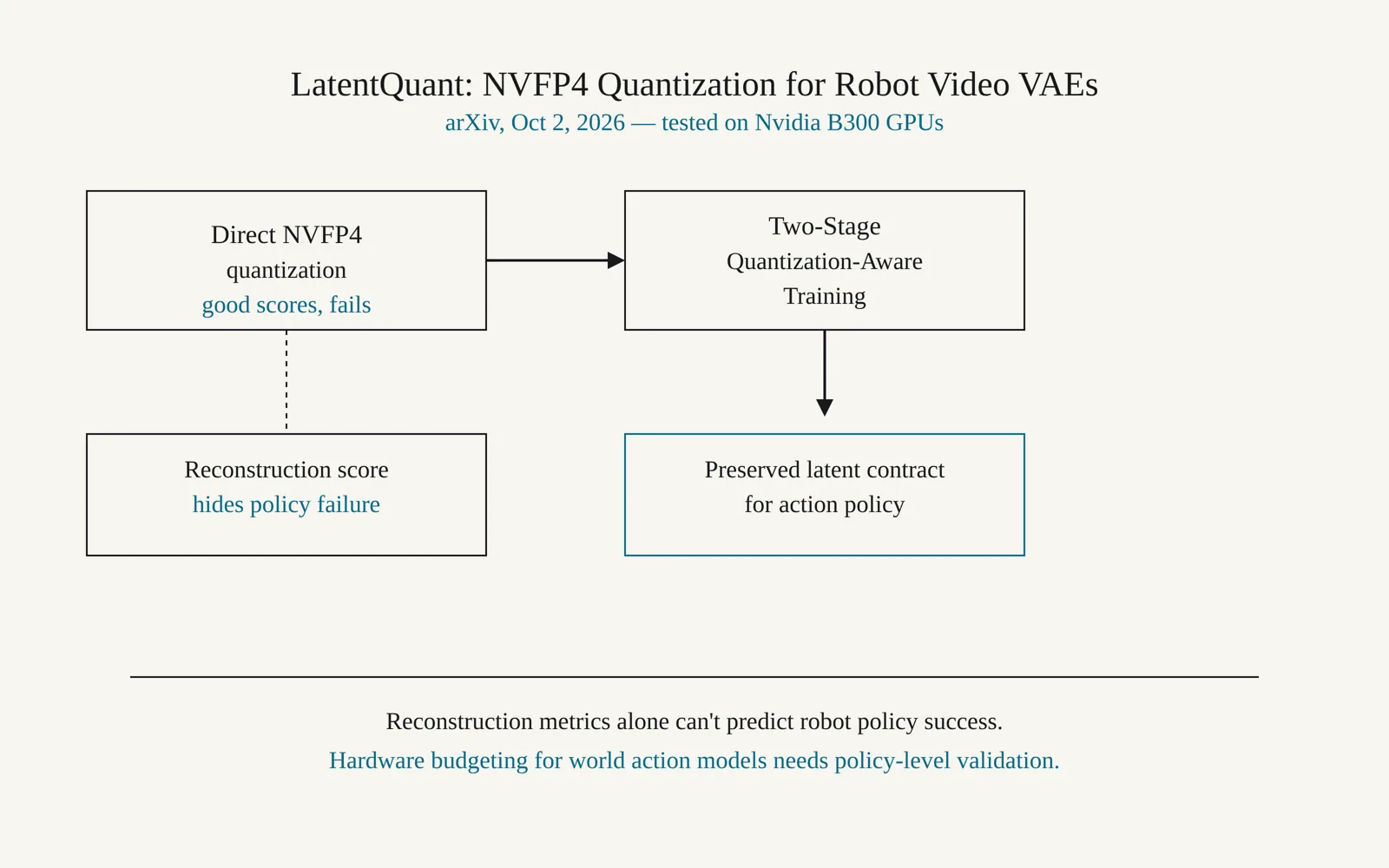
On October 2, 2026, researchers posted a paper on arXiv describing LatentQuant, a two-stage NVFP4 quantization-aware training method for the video VAEs that condition robot action policies in world action models, after finding that direct NVFP4 quantization on Nvidia hardware left LIBERO task success collapsing from 95.5 percent to 10.5 percent even though image reconstruction barely changed. (arXiv paper 2610.03959, LatentQuant, submitted 2 October 2026)
Open the photograph at full size
Photograph: Diagram: AI Journey
Read the full description of this diagram
Diagram drawn for this item: Nvidia B300 GPUs Run New NVFP4 Fix for Robot Video Model Quantization. On October 2, 2026, researchers posted a paper on arXiv describing LatentQuant, a two-stage NVFP4 quantization-aware training method for the video VAEs that condition robot action policies in world action models, after finding that direct... For anyone budgeting inference hardware for robot foundation models, this work shows that a quantization scheme judged only on reconstruction scores can hide a policy failure that only shows up once a robot actually tries to act, so a team...
The numbers
LIBERO success, direct NVFP4
10.5%
Task success after direct W4A4 quantization of the video VAE
LIBERO success, LatentQuant
95.75%
Task success after the two-stage LatentQuant fix on Wan2.1 and Wan2.2
RoboTwin success
68.8%
Task success with LatentQuant on the RoboTwin benchmark
B300 VAE speedup
1.17x-1.26x
End-to-end speedup over BF16 cuDNN on Nvidia B300 GPUs
Read from arXiv paper 2610.03959, LatentQuant, submitted 2 October 2026
What it means for you
For anyone budgeting inference hardware for robot foundation models, this work shows that a quantization scheme judged only on reconstruction scores can hide a policy failure that only shows up once a robot actually tries to act, so a team choosing NVFP4 on Nvidia B300 GPUs for cost reasons needs its own task-level check, not just a video quality number, before trusting the control loop that sits downstream of the encoder.
In more detail
World action models, the systems that let a robot watch video and decide what to do next, typically reuse a pretrained video VAE whose compressed latents feed a frozen action policy. The paper argues that squeezing that VAE down to Nvidia’s NVFP4 format is not a simple accuracy tradeoff, because the policy depends on the exact shape of the latent space, not just on how good the reconstructed video looks. Researchers found that running the VAE’s Wan2.1 model straight through NVFP4 left its video quality score on VBench-7 almost untouched against the full precision version, yet the downstream LIBERO robot benchmark fell apart.
The authors trace the failure to how quantizing and dequantizing activations change the decoder’s gradient signal. That altered signal gets sent back to the encoder during joint training, nudging the latent space away from where the frozen policy expects it to sit, a drift that keeps compounding rather than settling down. Their fix, called LatentQuant, splits training into two stages: it first lines up the quantized encoder with its full precision counterpart, then locks the encoder and lets only the decoder adapt around it. Tested across both Wan2.1 and Wan2.2, the method holds task success close to the unquantized baseline on two separate robot benchmarks, while still running the lower precision format on Nvidia B300 hardware.
The numbers
- Direct NVFP4 quantization dropped LIBERO task success from a 95.5 percent baseline to 10.5 percent.
- LatentQuant recovered LIBERO success to 95.75 percent across the two tested Wan models.
- On the separate RoboTwin benchmark, LatentQuant reached 68.8 percent success.
- NVFP4 execution on Nvidia B300 GPUs ran 1.17x to 1.26x faster end to end than BF16 cuDNN.
The result is a caution for anyone reading quantization papers purely through video or image fidelity metrics. A model can keep looking almost unchanged to a human or to a reconstruction score while the information a downstream policy actually reads has shifted enough to break the system it feeds. For teams weighing Nvidia’s NVFP4 path for robotics inference specifically to capture the B300 speedup, the paper’s own comparison suggests that a reconstruction-only sign-off is not sufficient evidence that a quantized checkpoint is safe to deploy in a closed control loop.
Sources
Sources read
arXiv paper 2610.03959, LatentQuant, submitted 2 October 2026 (arxiv.org)
Paper read
Cite this
AI Journey, "Nvidia B300 GPUs Run New NVFP4 Fix for Robot Video Model Quantization", 7 Oct 2026, https://aijourney.space/updates/2026-10-07-latentquant-preserving-the-policy-facing-latent-contract-under-nvfp4-vae/ (source: arXiv, verified 7 Oct 2026)
Next in the stream
OncoNoteBERT Encoder Trained From Scratch On UK Oncology Notes
A UK research team built OncoNoteBERT for oncology notes, a reminder that general tools like Perplexity's answer engine are not tuned for clinical text.
Previous
IdeaScientist Paper Benchmarks Ideation Agents Against Claude-4.8-Opus
A new paper benchmarks the IdeaScientist agent system against Claude Code SDK running Claude-4.8-Opus for generating research ideas.
Next
More in Nvidia
Nvidia RTX Spark Laptops Add Transcription Model and New Game Support
Nvidia detailed new RTX Spark laptop updates, including a transcription model from its Nemotron line and support for Liquid AI's LFM3 models.
Nvidia Launches Minerva Platform for AI Factory Observability
Nvidia introduced Minerva, an AIOps platform that merges infrastructure and workload telemetry to flag problems across AI factories before they spread.
Nvidia Expands Agent Toolkit With Data Grounding Tools
Nvidia expanded its open source Agent Toolkit on October 21, 2026, adding an Agent Knowledge Foundation that grounds enterprise agents in company data without moving it.