Event Published ResearchPerplexity AI
OncoNoteBERT Encoder Trained From Scratch On UK Oncology Notes
A UK research team built OncoNoteBERT for oncology notes, a reminder that general tools like Perplexity's answer engine are not tuned for clinical text.
What happened
Published here
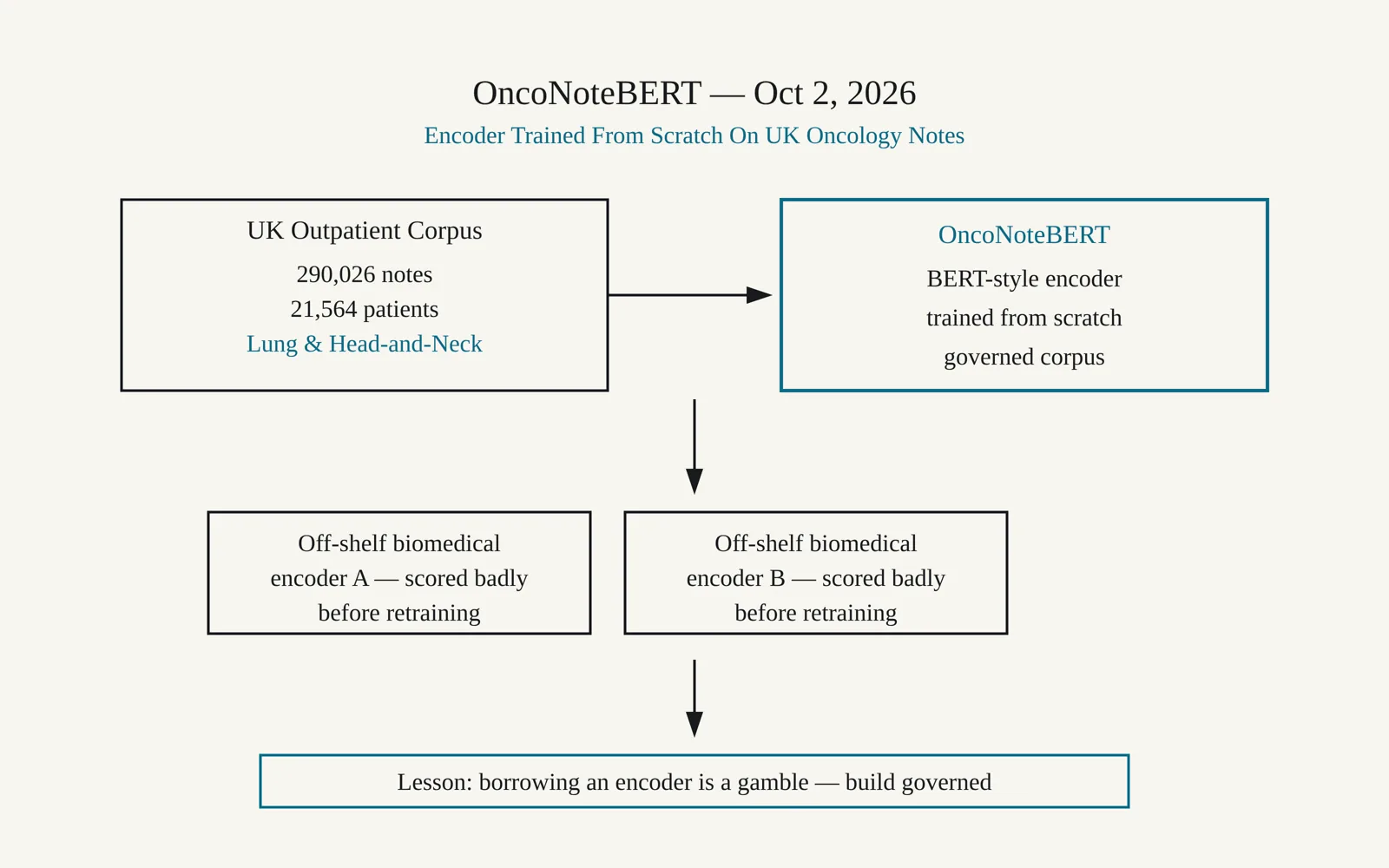
On October 2, 2026, researchers posted a paper describing OncoNoteBERT, an oncology-specific BERT-style encoder trained from scratch on a governed UK outpatient corpus of 290,026 notes from 21,564 patients treated for lung and head-and-neck cancer, and compared it against RadBERT, PathologyBERT and a continued-pretraining variant called OncoNote-RadBERT. (OncoNoteBERT paper on arXiv, submitted October 2, 2026)
Open the photograph at full size
Photograph: Diagram: AI Journey
Read the full description of this diagram
Diagram drawn for this item: OncoNoteBERT Encoder Trained From Scratch On UK Oncology Notes. On October 2, 2026, researchers posted a paper describing OncoNoteBERT, an oncology-specific BERT-style encoder trained from scratch on a governed UK outpatient corpus of 290,026 notes from 21,564 patients treated for lung and... The result tells a hospital IT team shopping for a clinical note reader that borrowing a biomedical encoder off the shelf is a real gamble, since two existing tools scored badly on this corpus before any retraining happened, and building a...
The numbers
Notes in corpus
290,026
Outpatient oncology notes used to train and evaluate the encoders
Patients covered
21,564
Patients treated for lung and head-and-neck cancer whose notes were used
RadBERT perplexity
113.04
Zero-shot perplexity on the oncology corpus before any local training
PathologyBERT perplexity
2035.03
Zero-shot perplexity on the same corpus, far worse than RadBERT
Read from OncoNoteBERT paper on arXiv, submitted October 2, 2026
What it means for you
The result tells a hospital IT team shopping for a clinical note reader that borrowing a biomedical encoder off the shelf is a real gamble, since two existing tools scored badly on this corpus before any retraining happened, and building a bespoke tokenizer changed what the model got right in ways a loss curve alone did not show. For anyone weighing whether to buy a general answer engine or fund a narrower in-house model, the paper is evidence that the choice of vocabulary matters as much as the choice of architecture, and that a cheaper continued-pretraining route can win on one metric while a from-scratch model wins on another.
In more detail
A team led by Wuraola Oyewusi, with co-authors from the University of Manchester and The Christie, built two oncology-specific language encoders and tested them against two existing clinical models nobody had retrained for this setting. The corpus was a governed set of UK outpatient notes covering lung and head-and-neck cancer care, full of staging language, treatment names, toxicity descriptions and site-specific de-identification markers that a general biomedical model has no reason to have seen.
The headline comparison is between adaptation and rebuilding. RadBERT and PathologyBERT, both trained elsewhere, were tested on the oncology notes with no further training at all, and both fit the text poorly. Continuing to train RadBERT on the oncology corpus, the approach the authors call OncoNote-RadBERT, produced the best raw fit of any model tested. Building a new encoder from scratch, OncoNoteBERT, with its own oncology WordPiece tokenizer, scored worse on that same measure but tokenised clinical terms more efficiently and answered masked-word probes correctly far more often than the continued-pretraining model did.
That split is the paper’s real finding. A model can look weaker by one yardstick and stronger by another, and the authors trace much of the gap to how each tokenizer breaks oncology terms into subword pieces rather than to anything deeper the models learned. Both locally built models also treated an institution’s own de-identification placeholder as a single token, a detail that matters for any health system reusing this approach on its own notes.
The numbers
The corpus spans 290,026 notes from 21,564 patients. Off the shelf, RadBERT posted a perplexity of 113.04 on the oncology text and PathologyBERT posted 2035.03, both signs of a poor fit before any local training. After continued pretraining, RadBERT’s score fell to 2.10, the strongest raw fit in the comparison, while the from-scratch OncoNoteBERT scored 2.83 but got 12 of its 13 masked-token probes right against 7 of 13 for the continued-pretraining model.
The paper is aimed at clinical NLP practitioners rather than general consumers, but it is a useful data point for anyone deciding between a general-purpose language tool and a narrower model built for one institution’s documents, since the two approaches traded wins depending on which number mattered most to the task at hand.
Sources
Sources read
OncoNoteBERT paper on arXiv, submitted October 2, 2026 (arxiv.org)
Paper read
Cite this
AI Journey, "OncoNoteBERT Encoder Trained From Scratch On UK Oncology Notes", 7 Oct 2026, https://aijourney.space/updates/2026-10-07-onconotebert-a-foundation-representation-model-for-natural-language-proc/ (source: arXiv, verified 7 Oct 2026)
Next in the stream
Benchmark From Open Chip Tapeouts Shows Claude Models Refusing Sizing Tasks
A new circuit design benchmark built from open-source chip tapeouts found that two of Anthropic's Claude models decline a share of sizing prompts they transcribe without objection.
Previous
Nvidia B300 GPUs Run New NVFP4 Fix for Robot Video Model Quantization
A new paper tested NVFP4 quantization on Nvidia B300 GPUs for robot world action models, after direct quantization caused a sharp collapse in task control.
Next
More in Perplexity AI
Perplexity AI Researchers Detail LoRA Recipe For Converting Four Language Models To Diffusion
A paper associated with Perplexity AI describes BYOD, a LoRA-only method that converts standard autoregressive language models into diffusion language models without full retraining.
Paper Proposes Message-Passing Method For Compressing LLM Weights
A new arXiv paper proposes a message-passing method for compressing large language model weights, the kind of efficiency work that underlies answer engines like Perplexity AI.
Researchers Publish S-SALAAD Framework For Sparse Large Model Inference
A new paper on compressing large models for edge devices matters to Perplexity AI and any company whose answer engine has to run inference away from a data center.