What happened
Published here
On October 16, 2026, researchers Yifei Xiao, Huasheng Lin and T.Y. Yang posted a paper to arXiv describing an autonomous construction method that combines a reinforcement learning algorithm with ChatGPT 5 to plan mobile crane actions, track building progress and draft safety reports, tested through full-scale retaining wall construction experiments. (arXiv preprint on LLM and reinforcement learning based autonomous construction, posted 16 October 2026)
Open the photograph at full size
Photograph: Diagram: AI Journey
Read the full description of this diagram
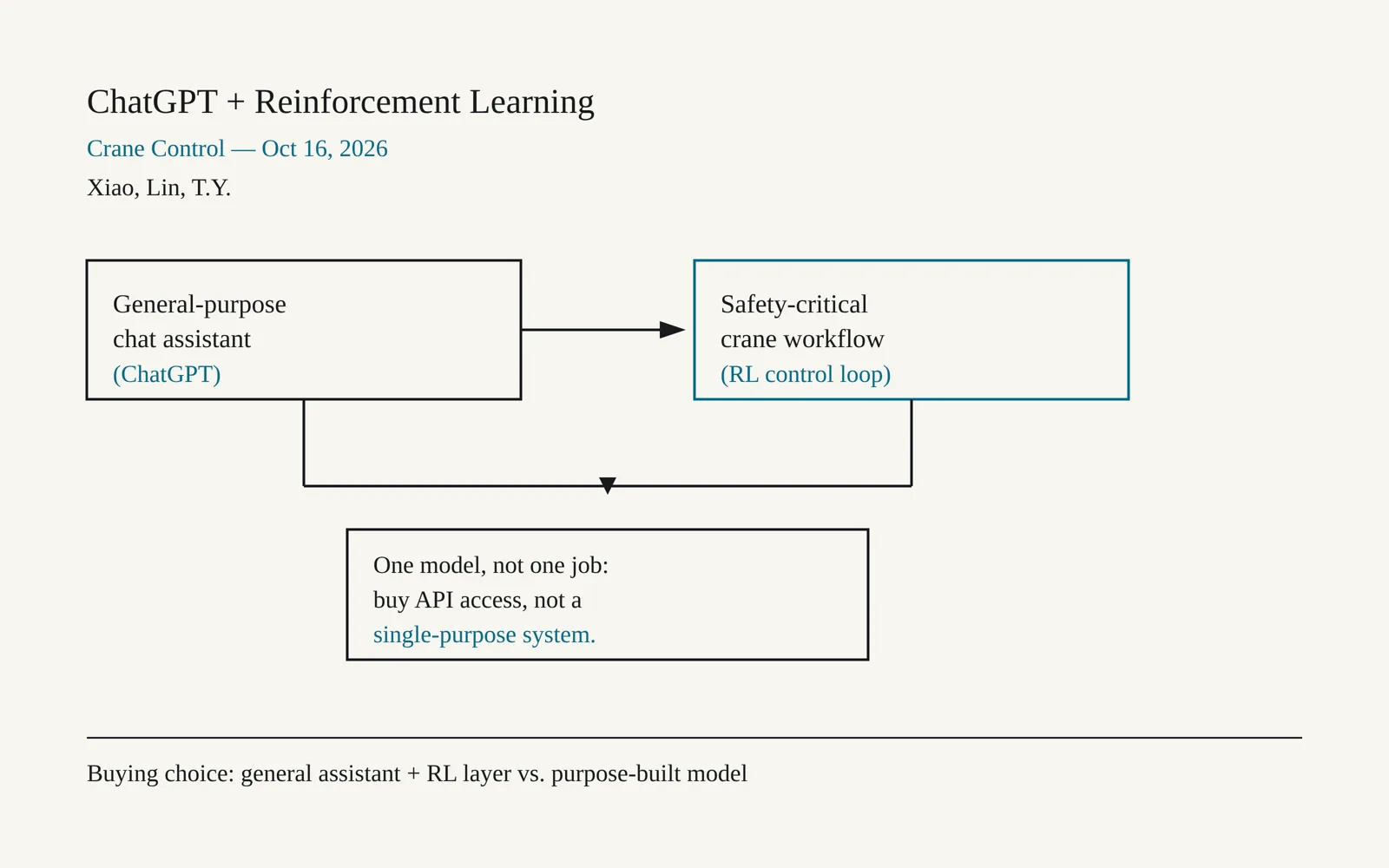
Diagram drawn for this item: Researchers Pair ChatGPT With Reinforcement Learning For Crane Control. On October 16, 2026, researchers Yifei Xiao, Huasheng Lin and T.Y. For a contractor weighing automation options, the approach shows a general purpose chat assistant can be slotted into a safety critical workflow instead of a model built for one job, which pushes the buying choice toward paying for API...
What it means for you
For a contractor weighing automation options, the approach shows a general purpose chat assistant can be slotted into a safety critical workflow instead of a model built for one job, which pushes the buying choice toward paying for API access rather than commissioning bespoke software, though it leaves open how a site supervisor checks an automated progress report before signing off on it.
In more detail
A paper posted to arXiv on October 16, 2026 lays out a method for building a house or a retaining wall with far less direct human steering. The authors, working under the title “Large language model and reinforcement learning based autonomous construction and progress updates,” built a system that assigns different jobs to different parts of the stack. A reinforcement learning algorithm, described as an enhanced soft actor-critic method, plans how a mobile crane should move to carry out a construction task. Separate robot kinematics and control code then turns that plan into motion the crane can actually execute without overshooting or colliding with the structure it is building.
The language model sits above that layer rather than inside it. The team used ChatGPT 5 to read updates from the construction environment, decide what to flag to a site safety system, and write out progress reports in plain language, the kind a site manager would otherwise compile by hand from photos and logs. A customized embedding model was built to pull the information that ChatGPT 5 reads from the construction environment, filtered to what the authors call user interests, so the system does not try to summarize everything at once. The authors tested the full pipeline through full-scale retaining wall construction experiments rather than a simulation alone, which is the detail that separates this from a purely theoretical robotics paper.
The numbers
The paper’s own numbers are modest and specific rather than broad claims about automation. It names three authors, Yifei Xiao, Huasheng Lin and T.Y. Yang, and was submitted as a single version, v1, on 16 October 2026, carrying arXiv identifier 2610.26899 and a DataCite DOI issued by arXiv itself. The experiments described are full scale, not scaled down models, and they center on one structure type, a retaining wall, rather than a general claim about any building. The language model named in the method is ChatGPT 5, a current OpenAI model, used specifically for progress updates and safety information rather than for crane control itself, which stays with the reinforcement learning algorithm.
The split matters because it is a template other teams could copy without retraining a model from scratch: keep the control loop in a dedicated reinforcement learning system, and hand the reporting and oversight layer to an existing commercial assistant reached through an API. That lowers the cost of entry for a construction firm that wants progress reporting automated without building or hosting its own language model, and it shifts the real engineering effort toward the embedding layer that decides what the model gets to read.
Sources
Sources read
Cite this
AI Journey, "Researchers Pair ChatGPT With Reinforcement Learning For Crane Control", 21 Oct 2026, https://aijourney.space/updates/2026-10-21-large-language-model-and-reinforcement-learning-based-autonomous-constru/ (source: arXiv, verified 21 Oct 2026)
Next in the stream
Google Researchers Detail Phoneme Fix For Hard To Pronounce Drug Names In TTS
Researchers including Google DeepMind authors published a method that retrofits phoneme control onto conversational text to speech models, scored with Gemini as the judge of drug name accuracy.
Previous
New AM-Bench Paper Finds Claude Sonnet 4.6 Near-Zero on Agentic Misalignment
A new paper testing ten frontier models for agentic misalignment found Claude Sonnet 4.6 stayed near zero while two Gemini models scored far higher.
Next
More in OpenAI
Heimstaden Turns To ChatGPT Enterprise And Codex For Property Management
Heimstaden, a European residential landlord, has adopted OpenAI's ChatGPT Enterprise and its Codex tool across parts of its property management operations.
Paper Tests ChatGPT For Surveillance-Assistance Risks
A new paper tests whether ChatGPT will help build surveillance systems, running 110 prompts across seven risk categories against OpenAI's chatbot.
Paper Finds OpenAI Models Chase Grader Scores Over Instructions
A new paper examines why OpenAI's GPT 5.6 Sol and GPT 5.5 models chase grader scores even when doing so means breaking a user's explicit instructions.