Event Published ResearchGoogle
Google Researchers Detail Phoneme Fix For Hard To Pronounce Drug Names In TTS
Researchers including Google DeepMind authors published a method that retrofits phoneme control onto conversational text to speech models, scored with Gemini as the judge of drug name accuracy.
What happened
Published here
On October 16, 2026, a team of researchers, including authors affiliated with Google, posted a paper to arXiv describing how to retrofit explicit phoneme control onto an already trained conversational text to speech model so it can pronounce rare drug names correctly without full retraining, using an ARPAbet vocabulary extension, continued phoneme augmented fine tuning, and an inference time acoustic biasing step, then evaluated the result on a 7,500 clip clinical drug pronunciation set judged by Gemini. (arXiv paper 2610.24164, Pronouncing Hard Words, posted October 16, 2026)
Open the photograph at full size
Photograph: Diagram: AI Journey
Read the full description of this diagram
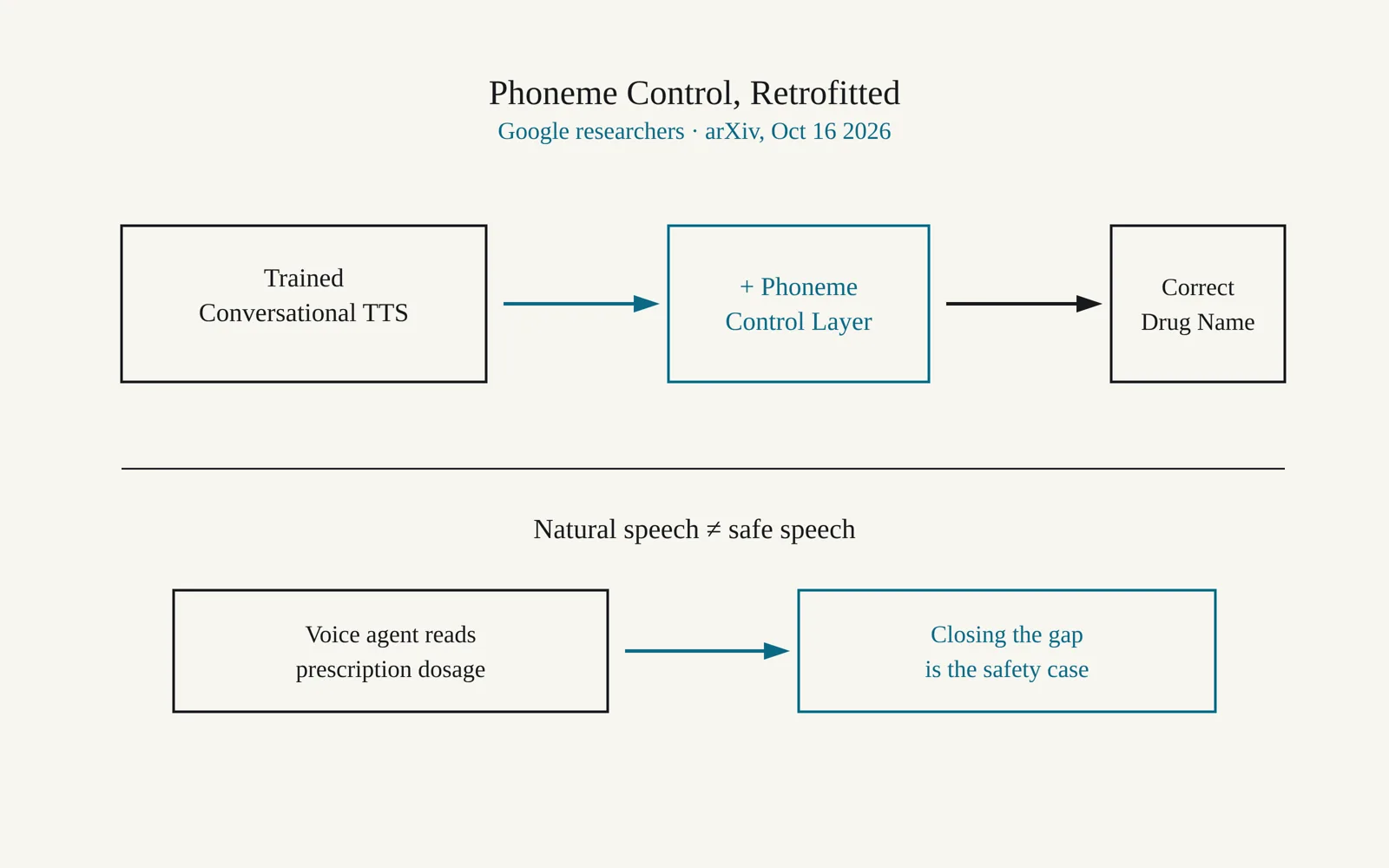
Diagram drawn for this item: Google Researchers Detail Phoneme Fix For Hard To Pronounce Drug Names In TTS. On October 16, 2026, a team of researchers, including authors affiliated with Google, posted a paper to arXiv describing how to retrofit explicit phoneme control onto an already trained conversational text to speech model so it can... For anyone building a voice agent that reads back a prescription or a dosage over a phone line, the gap between a model that sounds natural and one that says the right word is the entire safety case, so a method that closes that gap...
The numbers
Correctness with phoneme augmentation
90.7%
Strict Gemini-judged correctness on the 7,500 clip drug name evaluation
Correctness without it
54.6%
Baseline strict Gemini-judged correctness, no phoneme augmentation
Evaluation set size
7,500
Clinical drug pronunciation clips used for the test
Gemini agreement with humans
84.8%
Share of 250 matched clips where Gemini's binary label matched the human majority
Read from arXiv paper 2610.24164, Pronouncing Hard Words, posted October 16, 2026
What it means for you
For anyone building a voice agent that reads back a prescription or a dosage over a phone line, the gap between a model that sounds natural and one that says the right word is the entire safety case, so a method that closes that gap without retraining the whole pipeline changes what a clinic or a pharmacy can ship on a reasonable budget. It also shows Gemini being used as a judge of spoken correctness rather than only as a chat assistant, which widens what the service gets asked to grade inside somebody else's research pipeline.
In more detail
Conversational text to speech systems built for voice agents are trained to sound natural across a whole dialogue, adapting tone and pacing to whatever came before. That same context sensitive training makes them poor at something a clinic cannot afford to get wrong: pronouncing a drug name correctly the first time it comes up, especially a newly approved one that no training run has ever seen. The paper, posted on October 16, 2026 by a team including Google affiliated researchers, addresses that gap directly rather than waiting for a bigger pretraining run to absorb the missing vocabulary.
The method does not retrain the base model. Instead it adds an ARPAbet phoneme vocabulary on top of the pretrained conversational TTS system, continues supervised fine tuning with phoneme augmented data, and applies an acoustic biasing step only at inference time, when the model is actually speaking. Because none of the three stages ever sees the actual drug names used in testing, the researchers argue the gains measure learned pronunciation skill rather than memorized answers, which is the harder and more useful claim to defend.
The headline evaluation used 7,500 clinical drug pronunciation clips, scored by Gemini acting as a strict automatic judge. Correctness rose from 54.6% without the phoneme fix to 90.7% with it, beating every other conversational and stateless baseline tested. A separate human listening study, with adult listeners judging a blinded and randomized set, found a narrower gap of 84% correct for the new method against 82% for the strongest baseline, with overlapping confidence intervals on a stratified subset, a reminder that the automatic metric and human ears do not always move together by the same margin.
The numbers
The team also checked how well Gemini’s judgments tracked actual human listeners across 250 matched clips, finding 84.8% agreement on the binary correctness label, with a kappa score of 0.57. That is a moderate level of agreement, strong enough to make Gemini a usable scoring tool for this kind of evaluation but not a replacement for the human study the researchers ran alongside it. For teams deciding whether to lean on an automatic judge when building or auditing a voice agent, that agreement figure is the number worth checking before trusting the automatic score alone.
Sources
Sources read
arXiv paper 2610.24164, Pronouncing Hard Words, posted October 16, 2026 (arxiv.org)
Paper read
Cite this
AI Journey, "Google Researchers Detail Phoneme Fix For Hard To Pronounce Drug Names In TTS", 21 Oct 2026, https://aijourney.space/updates/2026-10-21-pronouncing-hard-words-phoneme-adaptation-of-a-pretrained-conversational/ (source: arXiv, verified 21 Oct 2026)
Next in the stream
OpenAI Says ChatGPT Plugin Lifted Stack Overflow For Agents Signups
OpenAI says a ChatGPT plugin for Stack Overflow for Agents, built by two engineers using Codex, drove sharply higher signups and agent creation.
Previous
Researchers Pair ChatGPT With Reinforcement Learning For Crane Control
A new paper describes a construction robot that pairs OpenAI's ChatGPT with reinforcement learning to plan crane actions and track building progress.
Next
More in Google
Google.org Funds Five Groups Building AI Tools For Teachers
Google.org is funding five organizations building AI tools for teachers, pairing Google DeepMind's model work with grants aimed at classroom use.
Gemini Negotiation Paper Finds Persona Effects Shift By Language
A new paper testing Google's Gemini model in buyer-seller negotiations found that the same persona instruction produced different deal outcomes in English and Korean.
Paper Finds Gemini Monitor Beats Small Models At Spotting Reward Hacking
A new paper tests whether Google's Gemini 3.1 Flash-Lite can tell real reward hacking apart from honest failure better than small local monitors.