What happened
Published here
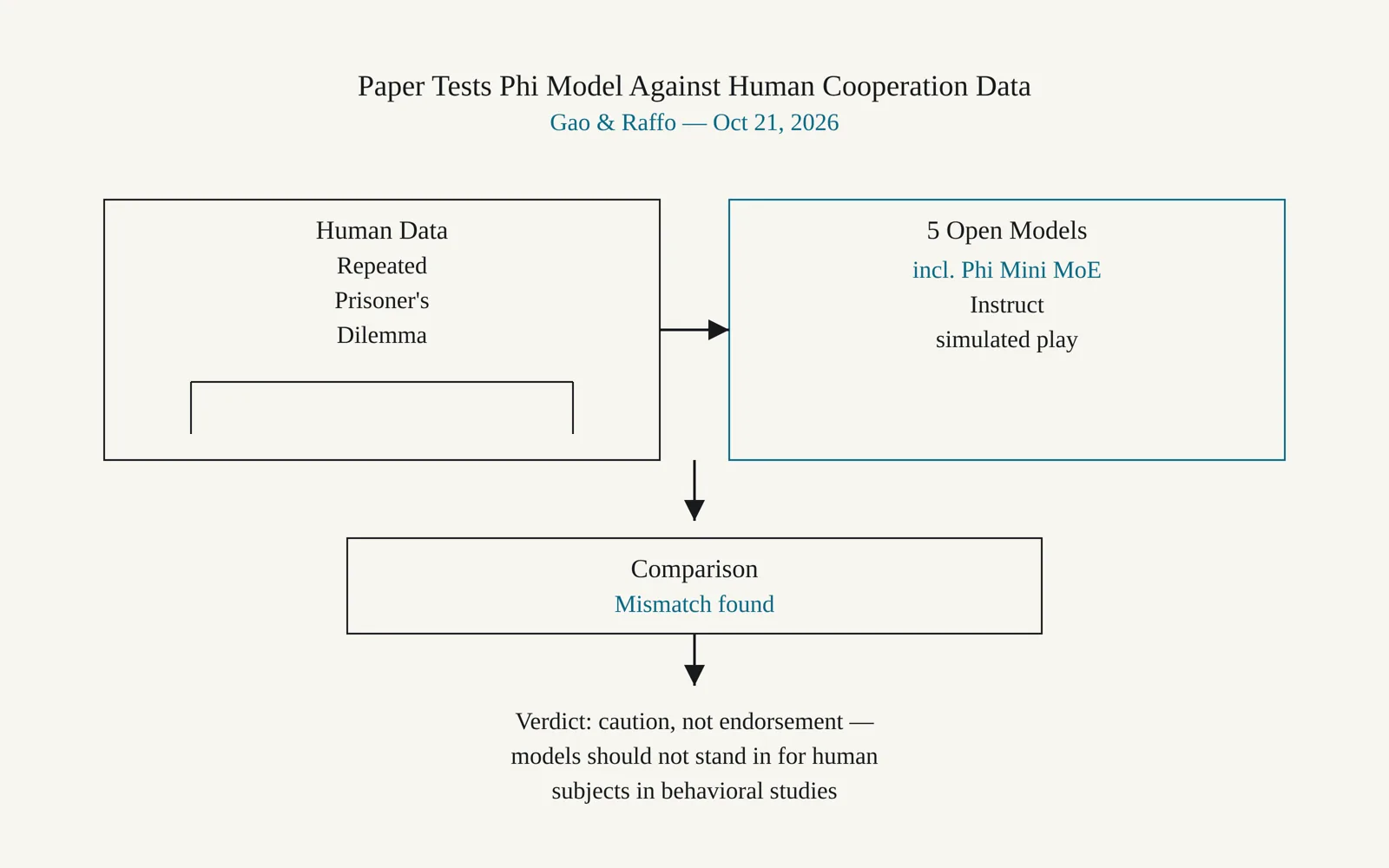
On October 21, 2026, researchers Raina Gao and Tristan Raffo posted a paper comparing five open-source language models, among them Microsoft's Phi Mini MoE Instruct, against published human cooperation data from repeated Prisoner's Dilemma games, running fixed-partner and shuffled-partner trials over 100 rounds measured in 10-round increments. (arXiv paper, Modeling Human Behavior in the Prisoner's Dilemma with Large Language Models, posted October 21, 2026)
Open the photograph at full size
Photograph: Diagram: AI Journey
Read the full description of this diagram
Diagram drawn for this item: Paper Tests Microsoft Phi Model Against Human Cooperation Data. On October 21, 2026, researchers Raina Gao and Tristan Raffo posted a paper comparing five open-source language models, among them Microsoft's Phi Mini MoE Instruct, against published human cooperation data from repeated Prisoner's Dilemma... For anyone weighing whether a small, freely downloadable model can stand in for a human test subject in a behavioral study, this paper is a caution rather than an endorsement: a lab that swaps a panel of people for a batch of model calls...
The numbers
Human cooperation rate
28.5%
Average human cooperation rate in the shuffled-partner setting, from prior human data
Model cooperation rate
80%
Several models exceeded this cooperation rate in the same shuffled setting
Rounds per trial
100
Rounds measured per trial type
Measurement increment
10
Round increments used to track cooperation over a trial
What it means for you
For anyone weighing whether a small, freely downloadable model can stand in for a human test subject in a behavioral study, this paper is a caution rather than an endorsement: a lab that swaps a panel of people for a batch of model calls to save time and cost should expect the output to skew toward cooperation, not match it, unless the prompting setup is checked against a known human benchmark first. That gap also bears on anyone building multi-agent systems where one model's degree of cooperativeness with another, shuffled or not, shapes an outcome like negotiation or resource splitting.
In more detail
Researchers Raina Gao and Tristan Raffo posted a paper on October 21, 2026 asking a narrower question than most prior work on language models and game theory: not whether a model can play the Prisoner’s Dilemma, but whether its pattern of cooperation over many rounds looks anything like a real human’s. Earlier studies had tested LLMs against each other or against hand-picked baselines, but had skipped at least one of three things this paper adds together: a memory component so an agent can recall its partner’s past moves, an accessible open-source model rather than a closed API, and a direct comparison against recorded human cooperation data.
The team ran five open-source models, TII Falcon 7B Instruct, Google Gemma 7B, Meta Llama 3.1 8B Instruct, Microsoft Phi Mini MoE Instruct and Qwen 2.5 7B Instruct, through a standardized prompting setup across two trial types. In the fixed-partner setting, both agents kept memory of the whole interaction. In the shuffled-partner setting, a memory-enabled agent was told its opponent would change each round and was paired against a memoryless agent. Cooperation was tracked over 100 rounds, measured in 10-round increments, and checked against human baseline data from a prior published study.
The result across both setups was the same direction of error: every model’s cooperation pattern diverged from the human one, and the gap widened sharply once partners were shuffled. Human cooperation in that setting averaged 28.5%, while several of the five models cooperated more than 80% of the time, a large overshoot rather than a close match. Qwen 2.5 7B Instruct behaved almost deterministically, settling into one pattern and staying there, while Phi Mini MoE Instruct showed more variability and, for short stretches, came closer to the human rate than the other four models did.
The numbers
- 28.5%: the average human cooperation rate in the shuffled-partner trials, the benchmark the models were measured against.
- 80%: the cooperation rate several of the five models exceeded in that same shuffled setting, well above the human figure.
- 100 rounds: the length of each trial, tracked in 10-round increments to see how cooperation moved over time rather than only at the end.
The authors frame the result as evidence that open-source models have promise as stand-ins for behavioral research subjects, while being explicit that none of the five tested are yet reliable substitutes for actual human participants in a cooperation study.
Sources
Sources read
Cite this
AI Journey, "Paper Tests Microsoft Phi Model Against Human Cooperation Data", 22 Oct 2026, https://aijourney.space/updates/2026-10-22-modeling-human-behavior-in-the-prisoner-s-dilemma-with-large-language-mo/ (source: arXiv, verified 22 Oct 2026)
Next in the stream
ChatGPT Ads Expands To 26 New Countries
OpenAI expanded ChatGPT Ads to 26 new countries, saying more than 100,000 advertisers have now used the ad platform inside ChatGPT.
Previous
Paper Tests ChatGPT and Claude on Medical Triage Chat Safety
Researchers built a simulation framework called SIM-UT and used it to test ChatGPT, Claude and a fine-tuned open model on WhatsApp triage chatbots.
Next
More in Microsoft
GPT-6 Astra reaches general availability in Microsoft Foundry
Microsoft has put OpenAI's GPT-6 Astra into general availability in Foundry, with published token prices that double for long context and rise again in the US Data Zone.
GitHub Copilot retires Gemini, Kimi and Claude models on 2 October, and one replacement costs three times as much
Google's Gemini 3.5 Flash and 3.6 Flash, Moonshot's Kimi K2.7 Code and Anthropic's Claude Opus 4.7 go, and GitHub's reference still lists them as available.
Microsoft details Kier Group's Copilot rollout across an 11,000-employee contractor
Microsoft's newsroom sets out how Kier Group coaxed reluctant executives into using Copilot, and how the contractor split its estate between Microsoft 365 Copilot and Teams Premium.