What happened
Published here
On 3 September 2026 GitHub said it will retire Gemini 3.5 Flash, Gemini 3.6 Flash, Kimi K2.7 Code and Claude Opus 4.7 from every GitHub Copilot surface on 2 October 2026, naming Gemini 3.8 Flash, Kimi K3 and Claude Opus 5 as the replacements. The changelog lists Copilot Chat, inline edits, ask and agent modes and code completions as the surfaces affected, and tells Business and Enterprise administrators they may have to enable the replacement models in their own model policies first. Read on 6 September 2026, GitHub's supported-models reference still listed all four as generally available and its retirement-history table still had no row for any of them. (GitHub Copilot changelog, 3 September 2026, where the retiring models and the retirement date are named)
Read the full description of this diagram
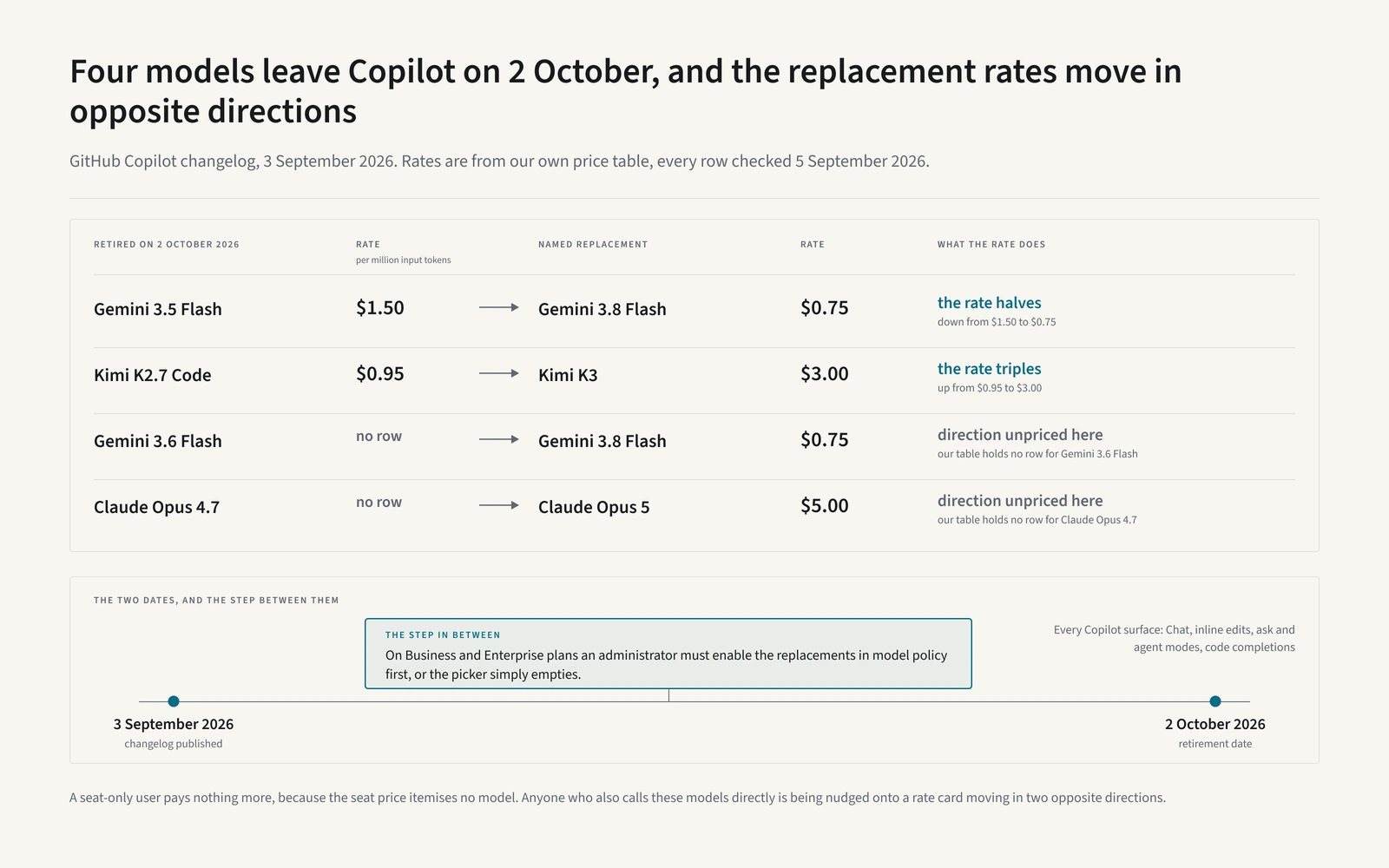
Diagram mapping each model GitHub Copilot retires on 2 October 2026 to its named replacement, with input rates per million tokens from our own table beside each row: Gemini 3.5 Flash at $1.50 to Gemini 3.8 Flash at $0.75, marked the rate halves; Kimi K2.7 Code at $0.95 to Kimi K3 at $3.00, marked the rate triples; Gemini 3.6 Flash to Gemini 3.8 Flash and Claude Opus 4.7 to Claude Opus 5 at $5.00, with each retired model shown as no row on our table and its direction left unpriced. Below, a timeline runs from the changelog on 3 September 2026 to the retirement date of 2 October 2026 across every Copilot surface, with a box between them for the administrator who must enable the replacements in model policy on Business and Enterprise plans, or the picker simply empties.
Tracked on this site: our API price table, where the retired models and their replacements sit side by side
What it means for you
A suggested replacement is not a like-for-like swap, and our own price table says so in both directions. Gemini 3.5 Flash sits at $1.50 per million input tokens and Gemini 3.8 Flash at $0.75, both checked on 5 September 2026, so that substitution halves the rate for the rest of 2026 only: the $0.75 is promotional and Google's pricing page returns it to $1.50 on 1 January 2027, which leaves the Gemini swap costing what the model it replaced costs today. Kimi K2.7 Code sits at $0.95 and Kimi K3 at $3.00 on the same check, so that one triples it. If Copilot is the only place you meet these models the swap costs you nothing, because the seat price does not itemise them. If you also call them directly, the retirement is a nudge toward a rate card you did not choose, and it is worth pricing your own traffic before 2 October rather than after.
In more detail
The numbers, and where each one comes from
- 2 October 2026 is the retirement date for every model on that list, across every Copilot surface, from the GitHub changelog of 3 September 2026.
- Gemini 3.5 Flash at $1.50 and Gemini 3.8 Flash at $0.75 per million input tokens, output at $9.00 against $3.75, from our API price table, both rows checked against ai.google.dev on 5 September 2026.
- Kimi K2.7 Code at $0.95 and Kimi K3 at $3.00 per million input tokens, output at $4.00 against $15.00, same table, both rows checked against platform.kimi.ai on 5 September 2026.
- Claude Opus 5 at $5.00 per million input tokens and $25.00 output, checked against platform.claude.com on 5 September 2026. We hold no row for Claude Opus 4.7, so this site cannot say which way that fourth swap moves.
- A nearer deadline the changelog does not mention: 10 September 2026, the retirement date GitHub’s own reference table gives for MAI-Code-1-Flash.
The reference page and the changelog do not agree yet
Read on 6 September 2026, three days after the announcement, the supported-models reference still carried Gemini 3.5 Flash, Gemini 3.6 Flash, Kimi K2.7 Code and Claude Opus 4.7 in its list of generally available models, and its retirement-history table, which exists precisely to list models scheduled for retirement, had no row for any of the four. The most recent entry in it was the MAI-Code-1-Flash retirement due on 10 September.
That gap matters because of which page a person checks. An administrator auditing model policy goes to the reference, not to a changelog post from earlier in the week. On the day we looked, the reference would have told them nothing was ending. We are recording the state of both pages with the date we read them, and if the reference catches up we will say so here rather than quietly editing this paragraph away.
What to do before 2 October
If your team uses Copilot through a Business or Enterprise plan, the replacement models are not necessarily switched on. GitHub’s own instruction is that an administrator may need to enable them in model policy before anyone can select them, which means the failure mode on 2 October is not an error message, it is a model that has gone from the picker with nothing turned on to take its place.
If you call any of these models outside Copilot as well, treat the retirement as a prompt to look at your own rate rather than as an instruction. Nothing about a model leaving one product retires it from its vendor’s API, and on our table these replacements move the price in opposite directions.
Sources
Sources read
GitHub Copilot changelog, 3 September 2026, where the retiring models and the retirement date are named (github.blog)
Release notes read
GitHub's supported-models reference, including its model retirement history table (docs.github.com)
Docs read
Cite this
AI Journey, "GitHub Copilot retires Gemini, Kimi and Claude models on 2 October, and one replacement costs three times as much", 6 Sep 2026, https://aijourney.space/updates/2026-09-06-github-copilot-retires-four-models/ (source: github.blog, verified 6 Sep 2026)
Next in the stream
Google's new weather model refreshes hourly and lands inside Search, Maps and the Gemini app
Google DeepMind's WeatherNext 3 rebuilds the global forecast every hour from satellite data, and starts powering weather in Search, Maps and the Gemini app the same day.
Previous
GPT-6 Astra reaches general availability in Microsoft Foundry
Microsoft has put OpenAI's GPT-6 Astra into general availability in Foundry, with published token prices that double for long context and rise again in the US Data Zone.
Next
More in Microsoft
Paper Tests Microsoft Phi Model Against Human Cooperation Data
A new paper tests whether open-source models, including Microsoft's Phi Mini MoE Instruct, can reproduce how humans actually cooperate in repeated Prisoner's Dilemma games.
Microsoft details Kier Group's Copilot rollout across an 11,000-employee contractor
Microsoft's newsroom sets out how Kier Group coaxed reluctant executives into using Copilot, and how the contractor split its estate between Microsoft 365 Copilot and Teams Premium.