Event Published Models and productsGoogle
Google's new weather model refreshes hourly and lands inside Search, Maps and the Gemini app
Google DeepMind's WeatherNext 3 rebuilds the global forecast every hour from satellite data, and starts powering weather in Search, Maps and the Gemini app the same day.
What happened
Published here
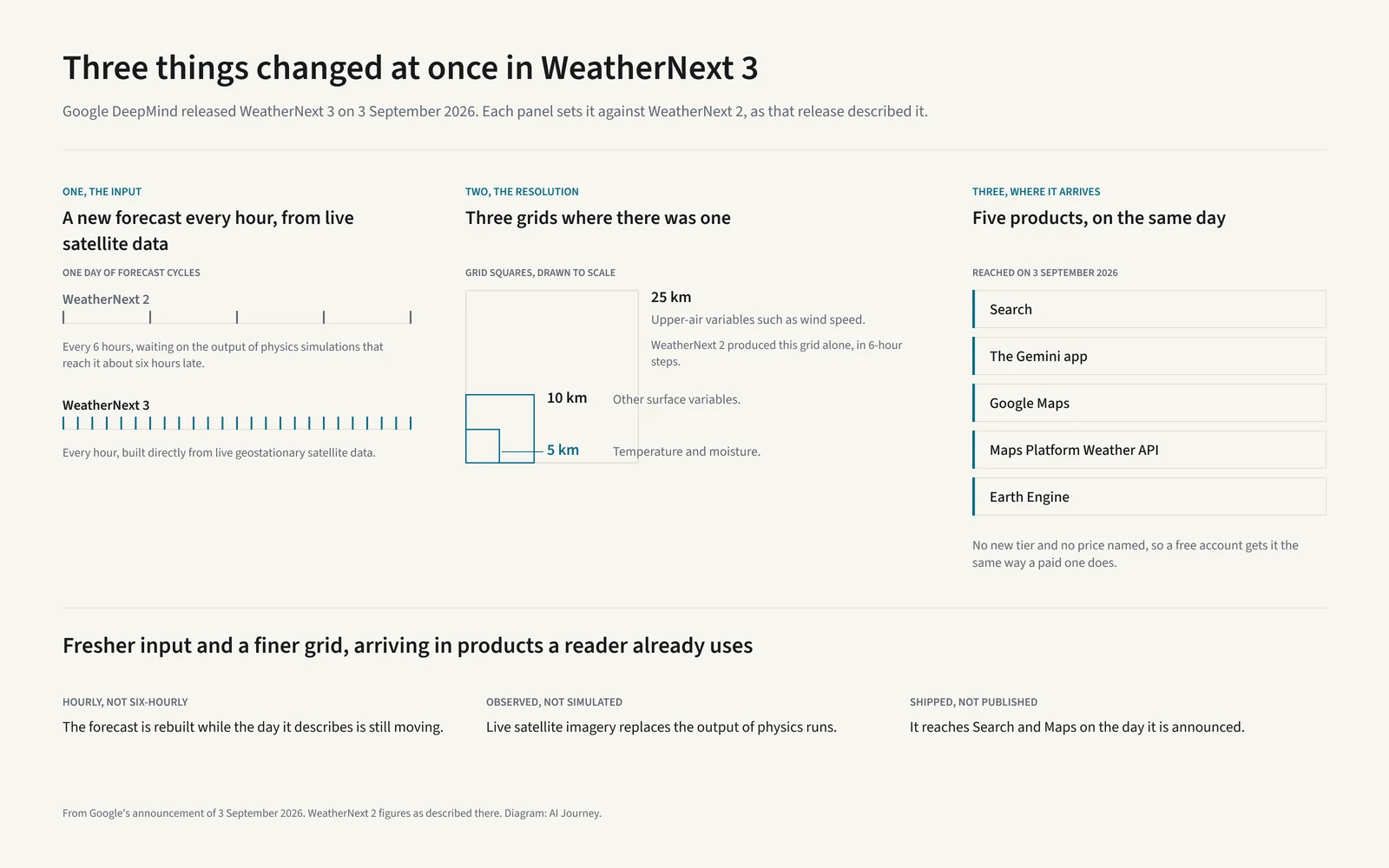
On 3 September 2026 Google DeepMind and Google Research released WeatherNext 3, which produces a new global forecast every hour from live geostationary satellite data rather than from the output of physics simulations that reach it about six hours late. Temperature and moisture come out on a 5-kilometre grid, other surface variables at 10 kilometres and upper-air variables such as wind speed at 25 kilometres, against the 25-kilometre grid in 6-hour steps that WeatherNext 2 produced. Google puts precipitation forecasts up to 50% more accurate when you are planning a day or more ahead, and says the model begins powering weather in Search, the Gemini app, Google Maps, the Maps Platform Weather API and Earth Engine from the same day. (Google announcement, 3 September 2026)
Read the full description of this diagram
Diagram in three panels. The first sets two cadences on a one-day track: WeatherNext 2 with five tick marks at six-hour steps, fed by physics simulations that reach it about six hours late, against WeatherNext 3 with twenty-five hourly ticks in petrol, built from live geostationary satellite data. The second draws grid squares to scale, nested from a shared corner: a 25-kilometre square for upper-air variables such as wind speed, which was WeatherNext 2's only grid, a 10-kilometre square for other surface variables, and a small 5-kilometre square for temperature and moisture. The third lists the five destinations reached on 3 September 2026, Search, the Gemini app, Google Maps, the Maps Platform Weather API and Earth Engine, with a note that no new tier and no price is named.
Tracked on this site: our Gemini plans and limits table
What they are saying
Outlets read
TechCrunchgrades it against everyone else on a public board
The new model has already proven to be the most accurate among leading contenders tested on Operational WeatherBench, a utility for comparing AI forecasts built by the startup Brightband.
read
Unite.AIread the paper, the gain depends what you measure against
In medium-range global precipitation forecasts, Google reported CRPS improvements of up to 60 percent against IMERG, 30 percent for the MRMS radar-based product, and 10 percent against rain gauge measurements for early lead times.
read
TechTimesmeasures it in hours of staleness, not in kilometres
Satellite imagery ingested hourly cuts forecast lag from seven hours to four for grid operators
read
Our verdict
They are grading different exams. TechCrunch takes the public leaderboard, Unite.AI goes to the paper and finds the gain swinging widely with the yardstick it is measured against, and TechTimes cares only about how old a forecast is by the time somebody acts on it. Google's own headline figure is a single number for rain more than a day ahead, and put beside these readings it looks less like a result and more like the friendliest of several.
What it means for you
There is nothing here to buy, which is the point worth noticing. This is a research model shipped straight into products a reader already uses, and our Gemini plans table records what those cost: nothing on the free tier, $4.99 a month for Google AI Plus and $19.99 for Google AI Pro, read from Google's own subscription page on 5 September 2026. The announcement names no price and no new tier, so the change reaches a free account the same way it reaches a paid one. If you work with wind or solar output, the addition of turbine-height wind speed and cloud cover is the part to test, because an hourly refresh is worth more to a dispatch decision than to a weekend plan.
In more detail
The numbers, and where each one comes from
- Every hour: how often a new global forecast is produced, from Google’s announcement of 3 September 2026.
- 5, 10 and 25 kilometres: the grids for key surface variables, other surface variables and upper-air variables, against WeatherNext 2 on a 25-kilometre grid in 6-hour steps.
- Up to 50% more accurate precipitation forecasts when planning a day or more ahead, Google’s own figure, with the largest gains where forecasts have been least reliable.
- About six hours: the lag in the numerical weather prediction data most AI weather models are trained on, which this one replaces with live satellite imagery.
- $0, $4.99, $19.99 a month for the Gemini tiers a person can buy, as our table recorded them on 5 September 2026, none of which this release changes.
Why the training data is the story
The resolution numbers are the easy headline. The change underneath them is what the model learns from: most AI forecasting models are trained on the output of supercomputer physics runs, which arrive hours after the weather they describe. Training on live satellite imagery and on sparse weather-station readings instead means the model is fitted to observations rather than to somebody else’s simulation of them.
That is also the honest caveat. A model trained on observations inherits the gaps in observation coverage, and the places with the thinnest station networks are exactly the places Google says improve most. Both things can be true, and only a year of live scoring will separate them.
What we will watch
This site tracks what Gemini costs, not what the weather does, so the row that matters here is the plan ladder above: a capability of this size arriving with no price attached is a pattern worth dating, because the same company published a promotional API price last week with an end date printed on it. When a free capability starts carrying a fee, our plans table is where that will show up.
Sources
Sources read
Google announcement, 3 September 2026 (blog.google)
Newsroom read
our Gemini plans table, read from Google's subscription page on 5 September 2026 (aijourney.space)
Own ledger read
Cite this
AI Journey, "Google's new weather model refreshes hourly and lands inside Search, Maps and the Gemini app", 6 Sep 2026, https://aijourney.space/updates/2026-09-06-google-weathernext-3/ (source: Google, verified 6 Sep 2026)
Next in the stream
OpenAI announces GPT-6 Astra and puts it on the Plus allowance table
OpenAI has put GPT-6 Astra on the paid ChatGPT rungs at 5 to 45 local messages on Plus, the tightest allowance of any model on its own docs pricing list.
Previous
GitHub Copilot retires Gemini, Kimi and Claude models on 2 October, and one replacement costs three times as much
Google's Gemini 3.5 Flash and 3.6 Flash, Moonshot's Kimi K2.7 Code and Anthropic's Claude Opus 4.7 go, and GitHub's reference still lists them as available.
Next
More in Google
Google.org Funds Five Groups Building AI Tools For Teachers
Google.org is funding five organizations building AI tools for teachers, pairing Google DeepMind's model work with grants aimed at classroom use.
Gemini Negotiation Paper Finds Persona Effects Shift By Language
A new paper testing Google's Gemini model in buyer-seller negotiations found that the same persona instruction produced different deal outcomes in English and Korean.
Paper Finds Gemini Monitor Beats Small Models At Spotting Reward Hacking
A new paper tests whether Google's Gemini 3.1 Flash-Lite can tell real reward hacking apart from honest failure better than small local monitors.