Event Published Models and productsOpenAI
OpenAI Showcases Legora's Agentic Legal Platform Built On Its Models
OpenAI highlighted how legal technology company Legora builds its agentic platform on ChatGPT, Codex, and OpenAI's models for law firms.
What happened
Published here
On October 28, 2026, OpenAI published a newsroom feature describing how legal technology company Legora uses OpenAI's models, including ChatGPT and Codex, to build what it calls an agentic operating system for legal work, covering contract analysis and other document heavy tasks lawyers handle daily. (OpenAI's own page could not be read automatically; this item's text is from its official news feed entry, published October 28, 2026)
Open the photograph at full size
Photograph: Diagram: AI Journey
Read the full description of this diagram
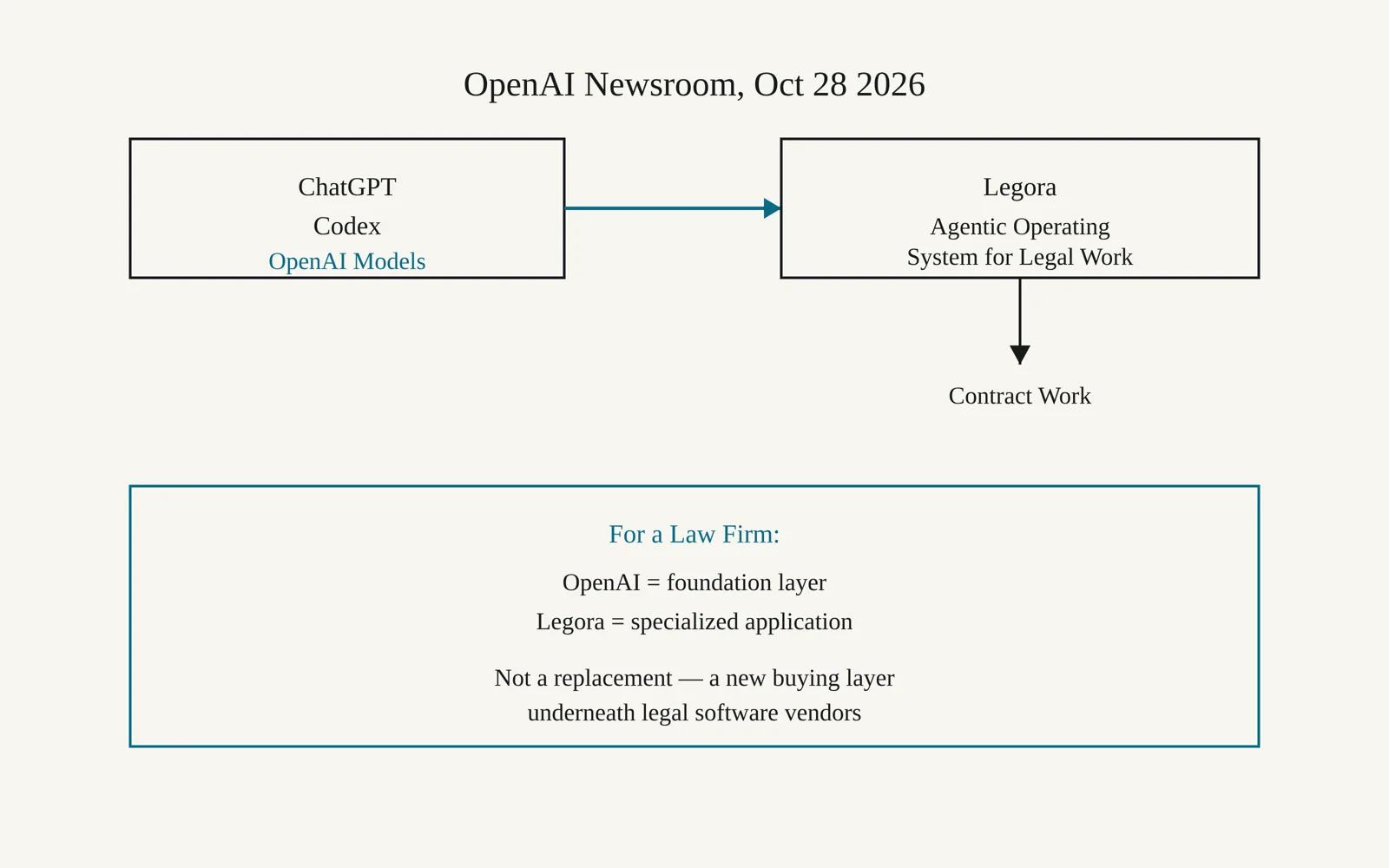
Diagram drawn for this item: OpenAI Showcases Legora's Agentic Legal Platform Built On Its Models. On October 28, 2026, OpenAI published a newsroom feature describing how legal technology company Legora uses OpenAI's models, including ChatGPT and Codex, to build what it calls an agentic operating system for legal work, covering contract... For a law firm weighing whether to add an AI vendor to its stack, this signals OpenAI is positioning ChatGPT and Codex as the foundation underneath specialized legal software rather than as a replacement for it, which changes the buying...
What it means for you
For a law firm weighing whether to add an AI vendor to its stack, this signals OpenAI is positioning ChatGPT and Codex as the foundation underneath specialized legal software rather than as a replacement for it, which changes the buying question from picking one assistant to picking which agentic layer sits on top of OpenAI's models, and who carries the liability when that layer gets something wrong.
In more detail
OpenAI’s newsroom feed entry frames Legora as a case study in what the company calls agentic legal work: software that does not just answer a lawyer’s question but carries out a chain of research, drafting and review steps on its own. According to the entry, Legora builds its platform on OpenAI’s models, using ChatGPT alongside Codex to speed up legal workflows, widen contract analysis, and free lawyers to spend more time on judgment calls rather than document assembly.
The framing matters because it places OpenAI on the supply side of a specific professional market rather than only the general consumer chatbot market. Law firms already pay for dedicated legal research and drafting tools, and a model vendor publicly backing one of those tools as a reference customer is a signal to the rest of the sector about where OpenAI expects its enterprise and developer business to grow next. Codex’s inclusion alongside ChatGPT also suggests the workflow spans both conversational drafting and more structured, code-like automation of repeatable legal tasks such as clause extraction across a large contract set.
The numbers
The feed entry that stands in for the blocked page gives no measured figures: no client count, no contract volume, no time saved and no pricing detail for Legora’s own product. That absence is itself worth noting for anyone tracking what OpenAI chooses to disclose in a customer feature. Unlike a pricing page or an API docs update, this is a promotional case study, and it carries no verifiable workload size or before-and-after comparison the way a benchmark report would. Readers who want a cost or throughput comparison between Legora’s agentic approach and a traditional legal research seat license will not find one here; that comparison would have to come from Legora’s own disclosures or from independent reporting, neither of which has surfaced yet.
What is confirmed is the technical stack: OpenAI’s models sit underneath ChatGPT and Codex, and Legora is named as the applied layer on top. For a firm deciding how to evaluate an AI vendor relationship, that stack detail is the one fact in this item that can be checked against OpenAI’s own developer pricing and model documentation going forward, even though this particular announcement carries no dollar figure or contract metric of its own.
Sources
Sources read
Cite this
AI Journey, "OpenAI Showcases Legora's Agentic Legal Platform Built On Its Models", 1 Nov 2026, https://aijourney.space/updates/2026-11-01-legora-is-building-the-agentic-operating-system-for-legal-work/ (source: OpenAI, verified 1 Nov 2026)
Next in the stream
Nvidia RTX Spark Laptops Add Transcription Model and New Game Support
Nvidia detailed new RTX Spark laptop updates, including a transcription model from its Nemotron line and support for Liquid AI's LFM3 models.
Previous
Gemini App Adds Immersive Explorations For Student Hub Users
Google added a library of immersive explorations to the Gemini app's student hub, letting learners move through topics layer by layer from one interactive panel.
Next
More in OpenAI
Heimstaden Turns To ChatGPT Enterprise And Codex For Property Management
Heimstaden, a European residential landlord, has adopted OpenAI's ChatGPT Enterprise and its Codex tool across parts of its property management operations.
Paper Tests ChatGPT For Surveillance-Assistance Risks
A new paper tests whether ChatGPT will help build surveillance systems, running 110 prompts across seven risk categories against OpenAI's chatbot.
Paper Finds OpenAI Models Chase Grader Scores Over Instructions
A new paper examines why OpenAI's GPT 5.6 Sol and GPT 5.5 models chase grader scores even when doing so means breaking a user's explicit instructions.