What happened
Published here
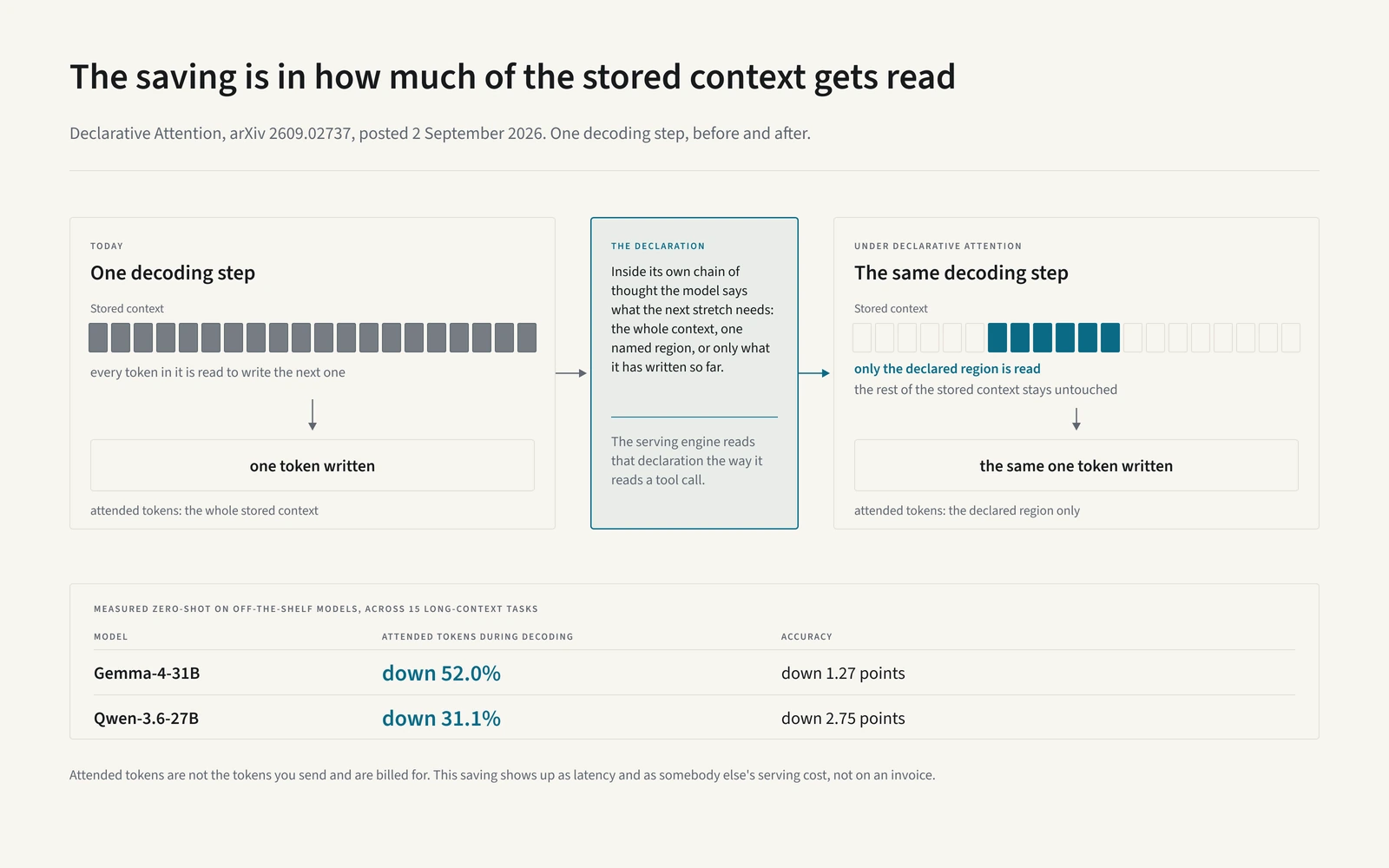
On 2 September 2026 researchers at KAIST AI and Google DeepMind posted Declarative Attention to arXiv as 2609.02737. The method has the model say, inside its own chain of thought, whether the next stretch of writing needs the whole context, one named region of it, or only what it has written so far; the serving engine reads those declarations the way it reads a tool call and skips most of the stored context instead of scanning all of it. Run zero-shot across 15 long-context tasks on open models taken off the shelf, it cut attended tokens during decoding by 52.0% on Gemma-4-31B and 31.1% on Qwen-3.6-27B, for accuracy drops of 1.27 and 2.75 percentage points, and the paper projects decode wall-clock cost at 0.71 and 0.77 times the usual on a well-optimised serving stack. (arXiv listing and abstract, submitted 2 September 2026)
Read the full description of this diagram
Two-panel diagram of one decoding step. On the left, every cell of a row standing for the stored context is filled, to show all of it being read to write a single token. Between the panels a box labelled the declaration says the model states inside its own chain of thought whether the next stretch needs the whole context, one named region, or only what it has written so far, and that the serving engine reads that declaration the way it reads a tool call. On the right, the same row has only a middle group of cells filled as the declared region while the rest stays untouched, and the same single token comes out. A table below records attended tokens during decoding down 52.0% on Gemma-4-31B and down 31.1% on Qwen-3.6-27B, for accuracy down 1.27 and 2.75 points.
Tracked on this site: our API price table, where the cache read column lives
What it means for you
Nothing on your invoice changes because of this, and the reason is worth understanding, because it is the same reason long conversations feel expensive. Vendors bill you for context they have seen before as a discounted input token: our table records Claude Fable 5.1 at $10 per million input tokens with cache reads at $0.25, and GPT-6 Astra at $10 with cached input at $1, both read on 5 September 2026. That price covers sending the context again. What this paper cuts is how much of that stored context the model actually reads while it writes each token, which nobody bills separately and which shows up instead as somebody else's serving cost and as your latency. If it holds up, the first thing you will notice is a long chat that answers faster, and the price sheet will be the last thing to move.
In more detail
The numbers, and where each one comes from
- 52.0% and 31.1% fewer attended tokens during decoding, on Gemma-4-31B and Qwen-3.6-27B, with accuracy falling 1.27 and 2.75 percentage points, from the abstract.
- 0.71x and 0.77x of the usual decode wall-clock cost on those same models, a roofline projection rather than a measured serving benchmark, from the paper’s HTML version.
- Up to 98% and 99% of the per-step attention read saved in the focus and local modes at contexts beyond 128K tokens, from the same text.
- $0.25 against $10, and $1 against $10: what a cache read costs against a fresh input token per million at Claude Fable 5.1 and GPT-6 Astra, as our table recorded them on 5 September 2026.
Why we ran a research paper in a price stream
Because the ledger has a column for exactly the thing being attacked, and the column and the paper do not line up in the way you would expect.
A cache read on a price sheet is what you pay to send a model context it has already been given. It is charged per token sent. Attention over the stored context is what happens next, and it is charged to nobody: the vendor absorbs it as serving cost and you feel it as the wait. So a method that halves the second one is invisible on a bill and obvious in a chat window, and a reader who has been told this makes models cheaper is owed the distinction.
The honest caveats
The wall-clock figure is a projection from a roofline model, not a timing on a live serving stack, and the paper says so. The accuracy cost is small but real, and it was measured zero-shot on open models rather than on the closed ones most readers actually pay for. And a model that declares where it will look can declare wrongly, which is a failure mode with no equivalent in a system that always reads everything.
We are recording it here because it is the kind of change that reaches a price sheet late and quietly, through a cheaper long-context tier rather than through an announcement. Our cache read column is dated. When a cache read price moves, this item is the note it will be dated against.
Sources
Sources read
arXiv listing and abstract, submitted 2 September 2026 (arxiv.org)
Paper read
the paper's own HTML version, where the affiliations and the wall-clock projection are printed (arxiv.org)
Paper read
Cite this
AI Journey, "A paper has models declare which part of their memory to read, cutting attended tokens by half", 6 Sep 2026, https://aijourney.space/updates/2026-09-06-declarative-attention-kv-cache/ (source: arXiv, verified 6 Sep 2026)
Next in the stream
Nvidia agrees to buy Hugging Face, and writes open model rules into its risk factors
Nvidia has agreed to buy Hugging Face for about $11.9 billion, and its SEC filing lists government limits on distributing open models as a risk to the platform.
Previous
Microsoft details Kier Group's Copilot rollout across an 11,000-employee contractor
Microsoft's newsroom sets out how Kier Group coaxed reluctant executives into using Copilot, and how the contractor split its estate between Microsoft 365 Copilot and Teams Premium.
Next
More in Google
Google.org Funds Five Groups Building AI Tools For Teachers
Google.org is funding five organizations building AI tools for teachers, pairing Google DeepMind's model work with grants aimed at classroom use.
Gemini Negotiation Paper Finds Persona Effects Shift By Language
A new paper testing Google's Gemini model in buyer-seller negotiations found that the same persona instruction produced different deal outcomes in English and Korean.
Paper Finds Gemini Monitor Beats Small Models At Spotting Reward Hacking
A new paper tests whether Google's Gemini 3.1 Flash-Lite can tell real reward hacking apart from honest failure better than small local monitors.