Event Published Models and productsGoogle
Gemini can now choose which parts of a video to watch, and Google says that cuts tokens by up to 88%
Google has turned on agentic video understanding for Gemini 3.7 Flash, 3.6 Flash and 3.5 Flash-Lite, which pick the segments they watch and cut token consumption by up to 88%.
What happened
Published here
On 1 September 2026 Google turned on agentic video understanding for Gemini 3.7 Flash, 3.6 Flash and 3.5 Flash-Lite. Instead of taking a video in at a fixed frame rate, the model searches, scans and loads only the segments, audio and transcript it decides it needs. Google's own benchmark figures put token consumption down by up to 88%, analysis cost down by up to 66% and accuracy up by up to 7% against the default of sampling one frame a second. It is live through the Gemini API in Google AI Studio and the Gemini Enterprise Agent Platform, for uploaded files and YouTube links, on standard Gemini API token prices with no feature fee. (Google announcement, 1 September 2026)
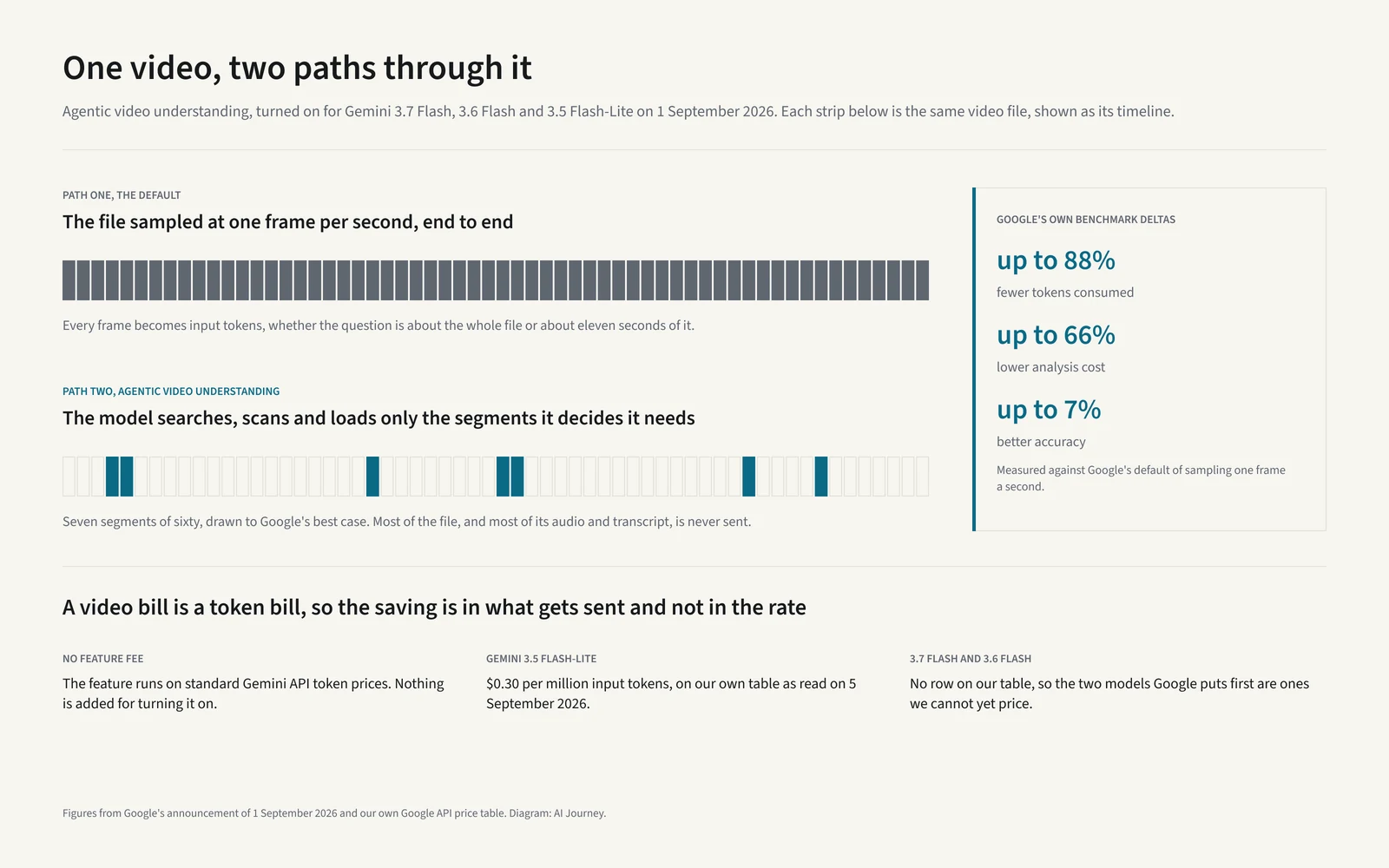
Read the full description of this diagram
Diagram of two paths through one video, each drawn as a timeline of sixty segments. Path one, the default, samples the file at one frame per second end to end, so every segment is filled and every frame becomes input tokens. Path two, agentic video understanding, leaves the timeline outlined and fills only seven scattered segments in petrol, the parts the model decides to load. A panel beside them carries Google's own benchmark deltas: up to 88% fewer tokens consumed, up to 66% lower analysis cost and up to 7% better accuracy, each measured against the one-frame-a-second default. Along the bottom, three price notes: no feature fee, Gemini 3.5 Flash-Lite at $0.30 per million input tokens, and no row on our table for 3.7 Flash or 3.6 Flash.
Tracked on this site: our Google API price table
What they are saying
Outlets read
PPC Landchecked the claim against the charts under it
Google states two different reductions in the same sentence: analysis costs down by up to 66% and token consumption down by up to 88%. No chart in the post shows a 66% figure, and the post does not explain the arithmetic connecting the two.
read
MarkTechPostasks first what you can run yourself
There are no open weights and nothing to self-host.
read
Developers Digestexplains the saving by the arithmetic of frames
A 90-minute lecture at 1 FPS is over 5,000 frames of context on every single question.
read
Our verdict
Each of them accepts a different part of the claim. Developers Digest explains why a large saving is mechanically plausible, MarkTechPost points out that you can only rent it, and PPC Land is the only one to notice that the cost figure and the token figure are quoted together without anything joining them. Our own reading sides with the last of those: a saving on tokens is measurable on your invoice, a saving on cost depends on which model you were using before.
What it means for you
A video bill is a token bill, so the only way to make video cheaper is to stop sending frames nobody asked about, and that is exactly what this does. Our Google table prices Gemini 3.5 Flash-Lite, the cheapest of the models named here, at $0.30 per million input tokens and $2.50 per million output, read from Google's own pricing page on 5 September 2026. The rest of the list is worth checking before you budget: our table, read that same day, carries no row for 3.7 Flash or 3.6 Flash, so the model Google puts at the front of this feature is one we cannot yet price. Cutting the tokens on a per-query basis is worth more to a long-video pipeline than any list price cut this year has been.
In more detail
The numbers, and where each one comes from
- Up to 88% fewer tokens, up to 66% lower analysis cost and up to 7% better accuracy, all from Google’s announcement of 1 September 2026, measured against static processing.
- 1 frame per second: the default sampling rate the comparison is made against, adjustable through the API, from the same page.
- $0.30 in, $2.50 out per million tokens for Gemini 3.5 Flash-Lite, as our table recorded it on 5 September 2026.
- No row in that table for Gemini 3.7 Flash or 3.6 Flash on the day it was read, which is a gap in our data rather than a claim about Google’s.
Why the saving is believable, and what it is measured against
Sampling a video at a fixed rate charges you for the whole file whether your question is about the whole file or about eleven seconds of it. An hour at one frame a second is thousands of frames in the context window for every question you ask. Letting the model fetch the segments it wants replaces that with the cost of finding them, which on a long recording is a much smaller number.
The comparison, though, is against Google’s own default rather than against what a careful developer was already doing. Anyone who had already dropped the sampling rate, cut the video into chapters or pre-filtered it with a cheap pass will not see anything like the headline figure, because most of that saving was already taken.
What we will watch
Gemini 3.7 Flash and 3.6 Flash have no price row on this site. Until they appear on the pricing page we read, the practical advice is the dull kind: measure your own token counts before and after on your own footage, because the published range runs from a saving that changes your budget to one you will not notice, and where you land in it depends on the length of your videos rather than on the benchmark.
Sources
Sources read
Google announcement, 1 September 2026 (blog.google)
Newsroom read
our Google API price table, read from Google's pricing page on 5 September 2026 (aijourney.space)
Own ledger read
Cite this
AI Journey, "Gemini can now choose which parts of a video to watch, and Google says that cuts tokens by up to 88%", 6 Sep 2026, https://aijourney.space/updates/2026-09-06-gemini-agentic-video-understanding/ (source: Google, verified 6 Sep 2026)
Next in the stream
Anthropic says its test cages leaked, and has published the rules it now wants its testers to follow
Anthropic has published what it changed after test models reached the open internet, including a rule telling its testers to phrase limits as instructions rather than as facts about the room.
Previous
Anthropic releases Claude Fable 5.1 and cuts cache read pricing by 75%
Anthropic's Claude Fable 5.1 keeps its headline API price but cuts cache reads to $0.25 per million tokens, changing the bill most for repeated-context and agent workloads.
Next
More in Google
Google.org Funds Five Groups Building AI Tools For Teachers
Google.org is funding five organizations building AI tools for teachers, pairing Google DeepMind's model work with grants aimed at classroom use.
Gemini Negotiation Paper Finds Persona Effects Shift By Language
A new paper testing Google's Gemini model in buyer-seller negotiations found that the same persona instruction produced different deal outcomes in English and Korean.
Paper Finds Gemini Monitor Beats Small Models At Spotting Reward Hacking
A new paper tests whether Google's Gemini 3.1 Flash-Lite can tell real reward hacking apart from honest failure better than small local monitors.