What happened
Published here
On September 23, 2026, researchers from a Vietnamese university group posted a paper describing RoPA Manager, a hybrid retrieval system built to automatically extract Records of Processing Activities required under Vietnam's Personal Data Protection Law, which took effect January 1, 2026, and comparing a cloud-hosted DeepSeek model against a locally deployed model on that extraction task. (arXiv paper on RoPA Manager, hybrid RAG and locally deployed LLMs, submitted 23 September 2026)
Open the photograph at full size
Photograph: Diagram: AI Journey
Read the full description of this diagram
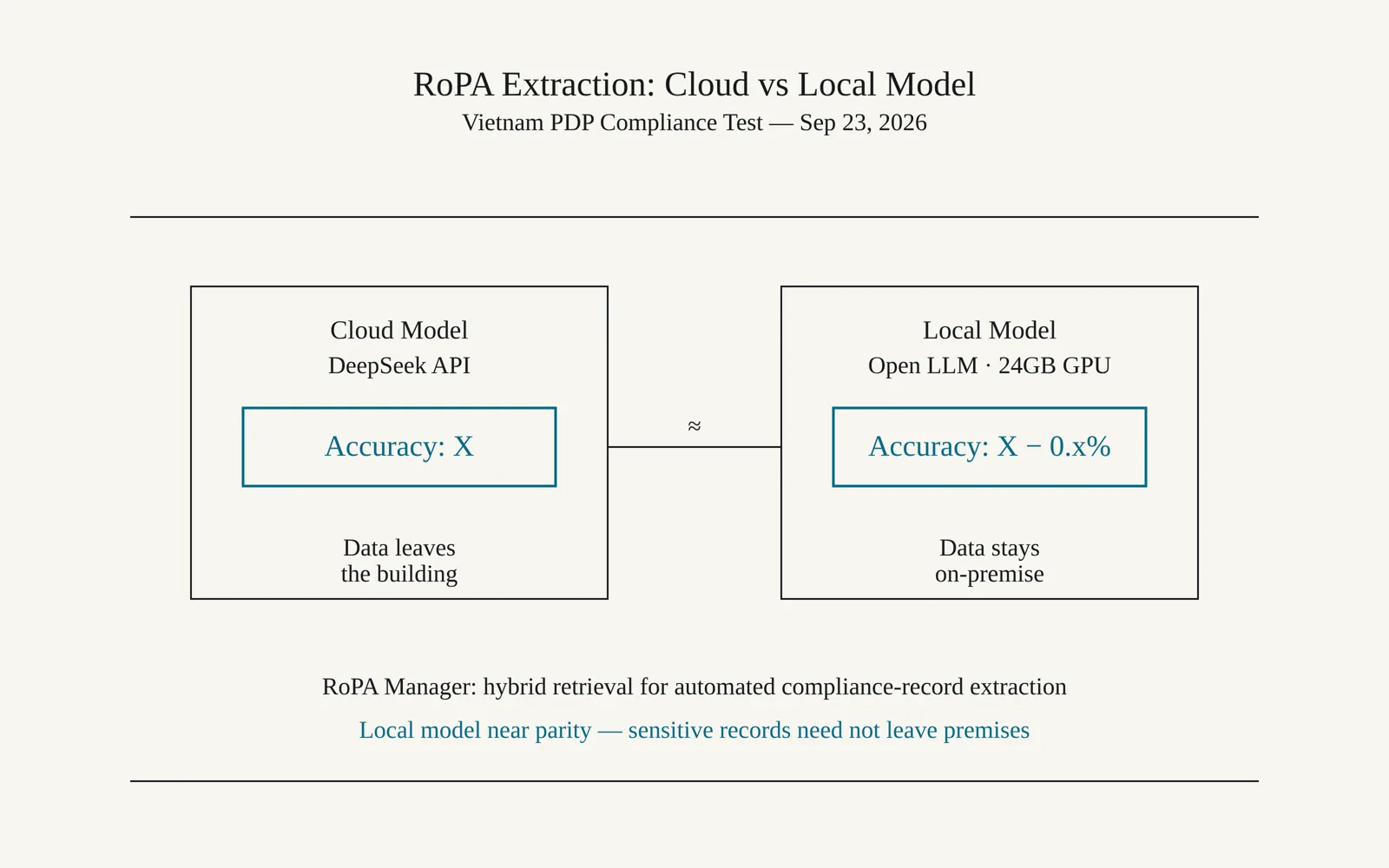
Diagram drawn for this item: DeepSeek Cloud Model Ties Local LLM in Compliance Extraction Test. On September 23, 2026, researchers from a Vietnamese university group posted a paper describing RoPA Manager, a hybrid retrieval system built to automatically extract Records of Processing Activities required under Vietnam's Personal Data... For a compliance team deciding whether sensitive processing records can leave the building, this test gives a concrete number rather than a guess: a locally run open model on a single 24 GB card came within a fraction of a percentage point...
The numbers
Scorer F1
0.9493
Automated scorer robustness score on perturbed benchmark data
Expert agreement
99.68%
Agreement rate between two independent expert reviewers
Reference values
4,338
Total reference values in the Vietnamese RoPA benchmark
GPU used
24 GB
Size of the GPU running the local model comparison
Read from arXiv paper on RoPA Manager, hybrid RAG and locally deployed LLMs, submitted 23 September 2026
What it means for you
For a compliance team deciding whether sensitive processing records can leave the building, this test gives a concrete number rather than a guess: a locally run open model on a single 24 GB card came within a fraction of a percentage point of the cloud service, so the sovereignty requirement in the new decree does not have to cost accuracy. That changes the calculus for smaller organizations that cannot run large GPU clusters but still need to keep processing logs on premises, since a modest local card becomes a workable substitute for a paid API rather than a compromise they have to accept.
In more detail
A team of four researchers, led by Khuong Nguyen-An, submitted a paper on September 23, 2026 describing RoPA Manager, a system meant to solve a narrow but pressing compliance problem in Vietnam. Under Law No. 91/2025/QH15 and its implementing decree, which became binding on January 1, 2026, organizations operating in the country must keep detailed Records of Processing Activities describing how they collect and use personal data. Writing those records by hand is slow, and sending the underlying documents to a cloud-hosted large language model can conflict with data sovereignty rules that many organizations now have to follow.
RoPA Manager answers that tension by combining hybrid retrieval, lexical ranking over tsvector, dense vector search and Reciprocal Rank Fusion, with locally deployed language models that never send source documents off premises. To test it, the authors built a benchmark drawn from 32 organizations, covering 77 processing activities across 12 field groups. End to end extraction against that benchmark reached token coverage between roughly 50 and 55 percent of the reference labels, a figure the paper is careful to separate from the scorer’s own robustness rating.
The most notable comparison sits inside that benchmark. Across 32 paired scenarios run on a single 24 GB GPU, a locally hosted Qwen3.5 model showed no statistically significant difference from the cloud-based DeepSeek model the team used as a comparison point, with the gap measured at 0.20 percentage points in DeepSeek’s favor and a p-value of 0.72. A third model, Gemma-4-31B, performed significantly worse in the same test, which the authors flag with a p-value under 0.01.
The numbers
Two independent experts reviewed 1,558 of the benchmark’s reference values, a little over a third of the full set, and found no incorrect entries, reaching 99.68 percent agreement between reviewers. The automated scorer itself, tested separately on perturbed data without calling any model, reached an F1 score of 0.9493. Those two figures measure different things: one checks whether human experts agree with the benchmark’s labels, the other checks whether the scoring code can tell a right answer from a wrong one, and the paper is explicit that neither substitutes for end-to-end extraction accuracy, which the token coverage figures address instead. The work is due to appear at the VNICT 2026 conference in Hanoi in November.
Sources
Sources read
Cite this
AI Journey, "DeepSeek Cloud Model Ties Local LLM in Compliance Extraction Test", 24 Sep 2026, https://aijourney.space/updates/2026-09-24-automated-extraction-of-records-of-processing-activities-ropa-using-hybr/ (source: arXiv, verified 24 Sep 2026)
Next in the stream
Claude Pricing Page Now Shows Claude Cowork Folded Into Claude
Anthropic's pricing page now shows Claude Cowork merged into the main Claude product, with new figures for Pro, Max and Team seats.
Previous
Gemini Adds Connected Apps From Adobe, Airtable and Peloton
Google began rolling out a new wave of Connected Apps inside Gemini, letting the assistant reach into productivity, creative and lifestyle tools without switching tabs.
Next
More in DeepSeek
Paper Tests Whether DeepSeek Models Earn Predictive Credit for Explanations
A new paper tests whether DeepSeek's models add real predictive value when research agents explain planned experiments, not just describe them.
GAVEL Paper Proposes LLM Judge to Adjudicate Clinical Timeline Extraction Disputes
A new paper submitted September 11, 2026 pits GPT5.6sol against DeepSeek V3.2 timelines and uses an LLM judge to arbitrate the differences.