What happened
Published here
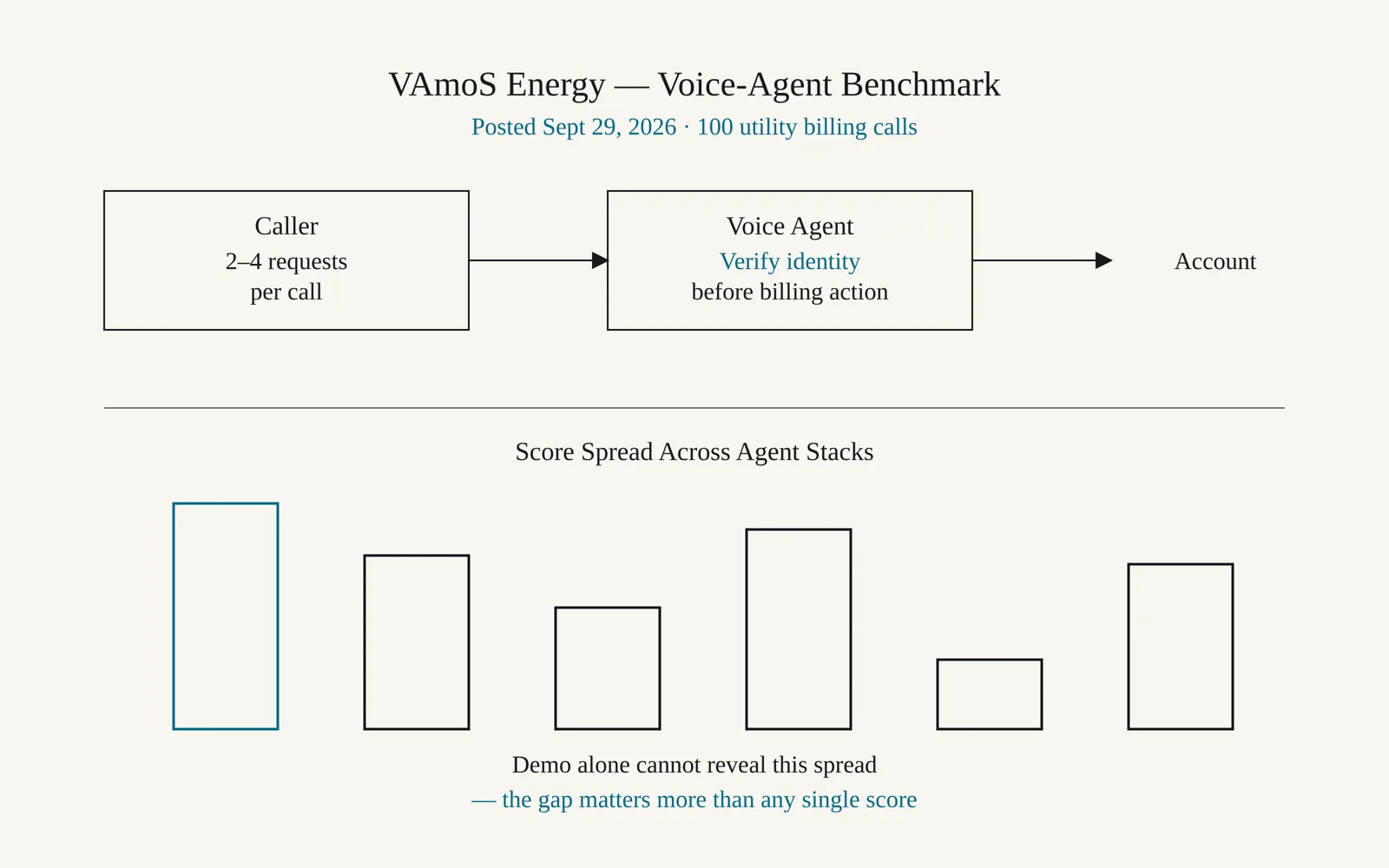
On September 29, 2026, researchers posted VAmoS Energy, a voice-agent benchmark built from 100 calls about utility billing and payment help, where each caller makes two to four requests and the agent must verify identity before touching an account. Fourteen voice stacks were tested, including Google's Gemini 3.8 Live, Grok Voice and GPT-Live, each run three times per task, with an LLM verifier checking both what the agent said and what it actually changed in a stateful billing system built on Stripe and the Apache Fineract loan engine. (VAmoS Part Deux paper on arXiv, submitted 29 September 2026)
Open the photograph at full size
Photograph: Diagram: AI Journey
Read the full description of this diagram
Diagram drawn for this item: Google's Gemini Live Benchmarked in New Voice-Agent Stress Test. On September 29, 2026, researchers posted VAmoS Energy, a voice-agent benchmark built from 100 calls about utility billing and payment help, where each caller makes two to four requests and the agent must verify identity before touching an... For anyone deciding whether to put a voice agent in front of paying customers, the spread between stacks matters more than any single headline number, because a call center choosing a vendor on a demo alone has no way to see how that...
The numbers
Verifier agreement
99.1%
Agreement between the LLM verifier and a code verifier on a calibration run
Completion range, low
17.3%
Lowest task completion rate across the fourteen tested voice stacks
Completion range, high
44.7%
Highest task completion rate across the fourteen tested voice stacks
Completion with television
8.6%
Pooled completion once background television noise is added to the call
Read from VAmoS Part Deux paper on arXiv, submitted 29 September 2026
What it means for you
For anyone deciding whether to put a voice agent in front of paying customers, the spread between stacks matters more than any single headline number, because a call center choosing a vendor on a demo alone has no way to see how that vendor degrades once a television is on in the background. The paper's verifier checks what an agent did to an account, not just what it said aloud, which is the failure mode a billing dispute actually turns on: a caller who hears a correct-sounding answer has no way to check whether the balance behind it was ever touched.
In more detail
A benchmark published on arXiv on September 29, 2026 gives the clearest public reading yet of how voice agents behave once a call stops being a clean, quiet demo. VAmoS Energy, built by a team including Joshua Meyer and Sahar Shayegan, runs 100 simulated calls about utility billing and payment assistance, each with a caller who makes two to four separate requests in one conversation. The agent under test carries sixteen tools, wired to a stateful Stripe billing twin and the Apache Fineract loan engine, and account access stays locked until the caller passes verification. Task data comes from public household electricity records, and the billing policy is modeled on Pennsylvania’s residential rules.
What sets this benchmark apart from an ordinary transcript check is that it grades two different things at once: what the agent says out loud, and what it actually changes in the underlying account. An LLM-as-a-verifier compares both against explicit written requirements, and on a calibration run it agreed with a separate code-based verifier on 99.1 percent of checks, giving the authors a reason to trust the automated grading at scale.
Fourteen voice stacks were run through the full test, three repeats per task, and completion rates varied widely, from 17.3 percent to 44.7 percent across the pool. Grok Voice came out ahead overall, while Google’s Gemini 3.8 Live and GPT-Live followed close behind each other at roughly similar cost per call. The paper’s most striking single result is what happens when a television plays in the background during the call: pooled completion fell from 38.7 percent down to 8.6 percent, a collapse the authors attribute partly to callers who accept an incorrect result simply because they heard words that sounded right, with no way to inspect what the agent had actually done to their account.
The numbers
- 99.1% agreement between the automated verifier and a code-based check, the figure used to justify scaling the grading.
- 17.3% to 44.7% was the completion range across the fourteen voice stacks tested, three runs per task.
- 8.6% was pooled completion once background television noise was added to calls, down from a much higher baseline without it.
For teams evaluating Gemini 3.8 Live or any rival voice stack for a billing or payments workflow, this benchmark argues for testing under noise and with multi-step requests before signing a contract, not after a smooth-sounding pilot call.
Sources
Sources read
VAmoS Part Deux paper on arXiv, submitted 29 September 2026 (arxiv.org)
Paper read
Cite this
AI Journey, "Google's Gemini Live Benchmarked in New Voice-Agent Stress Test", 2 Oct 2026, https://aijourney.space/updates/2026-10-02-vamos-part-deux-harder-more-realistic-voice-agent-simulation/ (source: arXiv, verified 2 Oct 2026)
Next in the stream
Paper Finds Claude Opus 5 Favors Biology Over Logic in Prose Reports
A new paper tests whether Claude Opus 5 resolves contradictory scientific reports by logic or by what it expects biology to look like.
Previous
Paper Tests Whether DeepSeek Models Earn Predictive Credit for Explanations
A new paper tests whether DeepSeek's models add real predictive value when research agents explain planned experiments, not just describe them.
Next
More in Google
Google.org Funds Five Groups Building AI Tools For Teachers
Google.org is funding five organizations building AI tools for teachers, pairing Google DeepMind's model work with grants aimed at classroom use.
Gemini Negotiation Paper Finds Persona Effects Shift By Language
A new paper testing Google's Gemini model in buyer-seller negotiations found that the same persona instruction produced different deal outcomes in English and Korean.
Paper Finds Gemini Monitor Beats Small Models At Spotting Reward Hacking
A new paper tests whether Google's Gemini 3.1 Flash-Lite can tell real reward hacking apart from honest failure better than small local monitors.