What happened
Published here
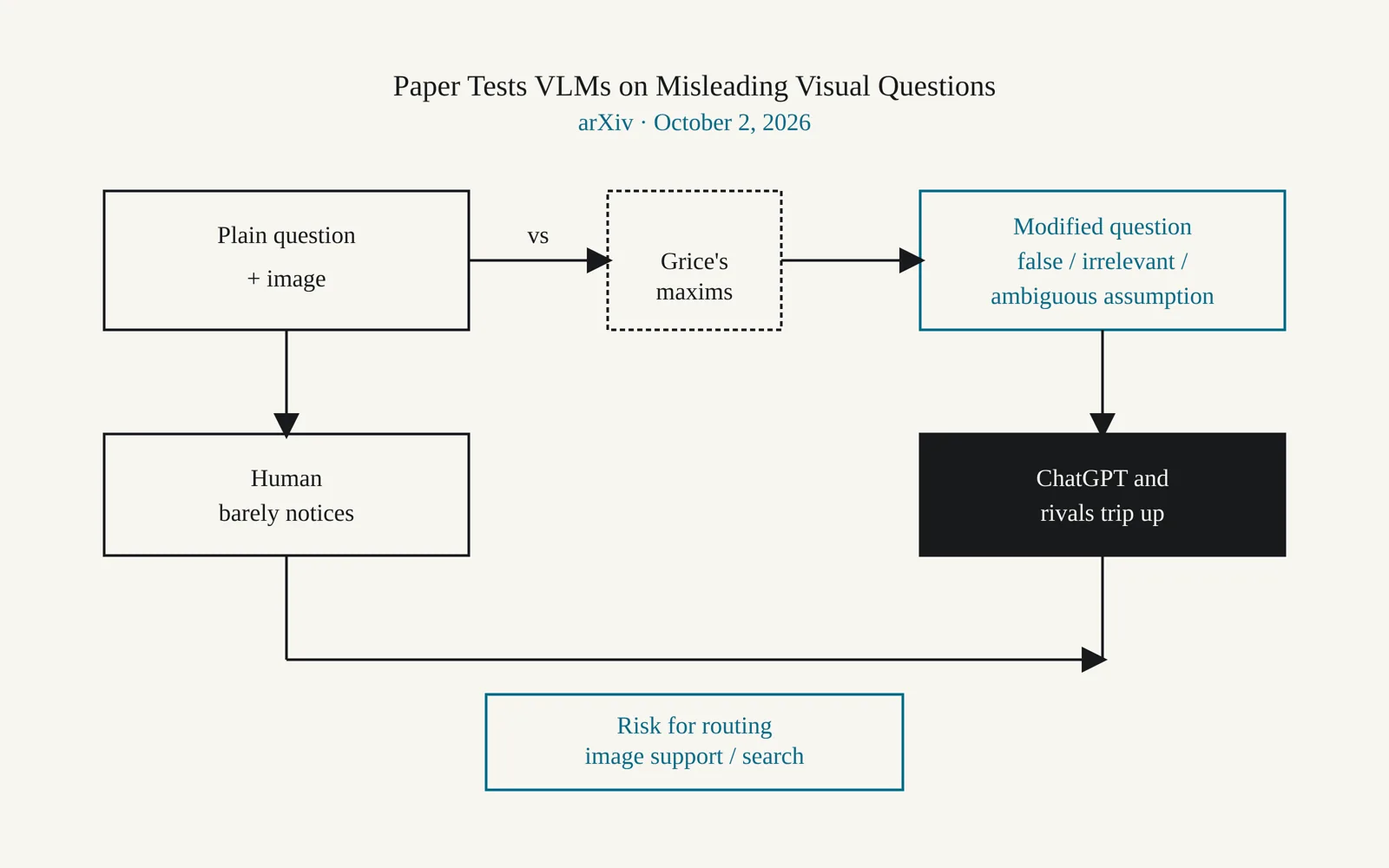
On October 2, 2026, researchers posted a paper on arXiv testing how vision language models answer visual questions that violate Grice's conversational maxims, by generating question modifiers that add irrelevant, ambiguous or false information, and found that ChatGPT, Claude, Gemini and Llava all showed diminished accuracy when such violations were present, with further differences between human and model handling of the same confusing prompts. (arXiv paper, Evaluating VQA in Vision Language Models using Cooperative Principles, submitted October 2, 2026)
Open the photograph at full size
Photograph: Diagram: AI Journey
Read the full description of this diagram
Diagram drawn for this item: Paper Tests ChatGPT and Rival Models on Misleading Visual Questions. On October 2, 2026, researchers posted a paper on arXiv testing how vision language models answer visual questions that violate Grice's conversational maxims, by generating question modifiers that add irrelevant, ambiguous or false... For a team deciding whether to route an image-based support or search feature through ChatGPT, the result flags a specific failure mode: a question that quietly smuggles in wrong assumptions can trip the model even when a person would...
What it means for you
For a team deciding whether to route an image-based support or search feature through ChatGPT, the result flags a specific failure mode: a question that quietly smuggles in wrong assumptions can trip the model even when a person would barely notice the trap, so output built on visual answers needs a check step rather than a single pass trust.
In more detail
Researchers describe a method for probing how vision language models handle questions that are not perfectly worded, the kind a real user actually types rather than a clean benchmark prompt. The team used the models themselves to generate question modifiers that insert information a questioner would not normally add: details that are beside the point, details that are vague enough to allow more than one reading, and details that are flatly false. The idea borrows from the philosopher Paul Grice’s maxims of cooperative conversation, which describe the unstated rules people follow when they ask and answer questions honestly and efficiently. A question that breaks one of those rules is harder to answer well even for a person, and the paper asks whether current models struggle in the same way or in a different way entirely.
The four models evaluated, ChatGPT, Claude, Gemini and Llava, all showed weaker performance once a question carried one of these violations, according to the paper. The authors also compared how the models handled violations a human had written into the question against violations the models themselves had generated, and found the two were not resolved the same way. A further experiment measured how long human participants took to work through the same confusing questions, using time on task as a stand in for cognitive effort, and found that people spent less time resolving model-generated violations than human-induced ones even though the models answered those cases less accurately.
That gap between human effort and model accuracy is the paper’s sharper finding. It suggests the kind of confusing question a model itself tends to produce is, in a narrow sense, easier for a person to brush past than it is for a model to answer correctly, which runs against the simple assumption that whatever is easy for a person to parse should also be easy for a model to parse.
The numbers
The paper does not publish a scoreboard of exact accuracy figures in its abstract, so this item reports the comparison in the terms the authors use: four named models tested, one human baseline measured by time on task, and two distinct violation sources, human written and model generated, compared against each other.
For anyone building a product on top of visual question answering, the practical read is narrower than the paper’s full scope: a prompt that looks innocuous to a reviewer can still carry an ambiguity or a false premise that the model will answer confidently and wrongly, and no amount of general benchmark performance tells you that in advance.
Sources
Sources read
Cite this
AI Journey, "Paper Tests ChatGPT and Rival Models on Misleading Visual Questions", 6 Oct 2026, https://aijourney.space/updates/2026-10-06-evaluating-vqa-in-vision-language-models-using-cooperative-principles/ (source: arXiv, verified 6 Oct 2026)
Next in the stream
Paper Tests Separate Checker Roles For Agents Using Claude Sonnet 4.5
A new paper, DeReAct, measures how splitting an agent's action-checking from its reasoning changes task success for agents built on Claude Sonnet 4.5.
Previous
Benchmark From Open Chip Tapeouts Shows Claude Models Refusing Sizing Tasks
A new circuit design benchmark built from open-source chip tapeouts found that two of Anthropic's Claude models decline a share of sizing prompts they transcribe without objection.
Next
More in OpenAI
Heimstaden Turns To ChatGPT Enterprise And Codex For Property Management
Heimstaden, a European residential landlord, has adopted OpenAI's ChatGPT Enterprise and its Codex tool across parts of its property management operations.
Paper Tests ChatGPT For Surveillance-Assistance Risks
A new paper tests whether ChatGPT will help build surveillance systems, running 110 prompts across seven risk categories against OpenAI's chatbot.
Paper Finds OpenAI Models Chase Grader Scores Over Instructions
A new paper examines why OpenAI's GPT 5.6 Sol and GPT 5.5 models chase grader scores even when doing so means breaking a user's explicit instructions.