What happened
Published here
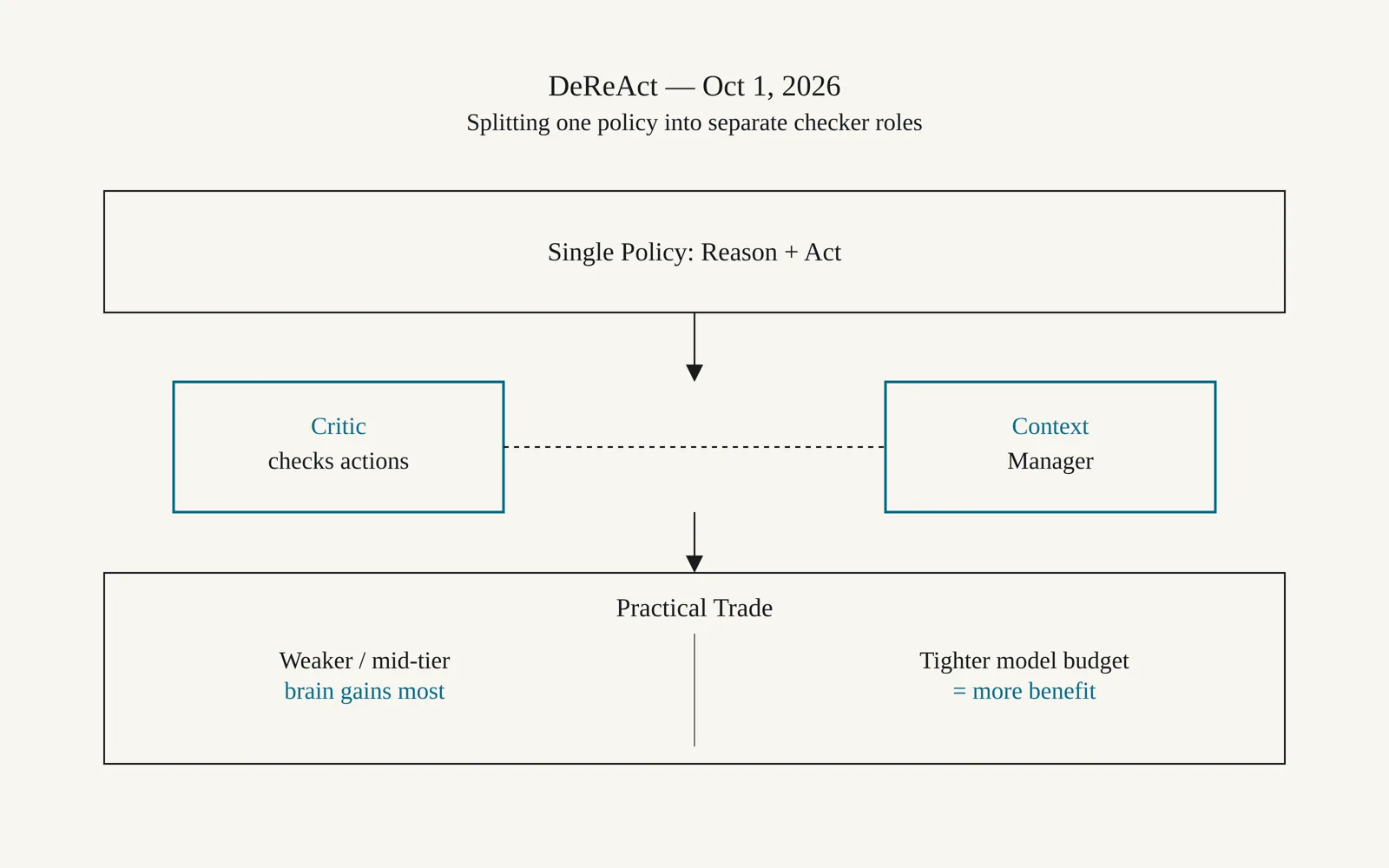
On October 1, 2026, researchers posted DeReAct, a paper describing a modular agent architecture that separates a single policy's reasoning and acting duties into two external gates, a Critic that checks proposed actions and a Context Manager that certifies when a task is actually finished, tested across the GAIA and SWE-bench Verified benchmarks using several underlying models including Claude Sonnet 4.5 and Claude Opus 4.5. (DeReAct paper abstract on arXiv, posted October 1, 2026)
Open the photograph at full size
Photograph: Diagram: AI Journey
Read the full description of this diagram
Diagram drawn for this item: Paper Tests Separate Checker Roles For Agents Using Claude Sonnet 4.5. On October 1, 2026, researchers posted DeReAct, a paper describing a modular agent architecture that separates a single policy's reasoning and acting duties into two external gates, a Critic that checks proposed actions and a Context... For a team choosing which model to pair with an agent framework, the result is a practical trade: a weaker or mid-tier brain gains the most from an external checker bolted on top, so teams on a tighter model budget get more of the benefit...
The numbers
Qwen3-Coder-480B gain
6.5--7.0
Pass@1 point gain for Qwen3-Coder-480B as the Brain model
Claude Sonnet 4.5 gain
4.2--5.2
Pass@1 point gain for Claude Sonnet 4.5 as the Brain model
Read from DeReAct paper abstract on arXiv, posted October 1, 2026
What it means for you
For a team choosing which model to pair with an agent framework, the result is a practical trade: a weaker or mid-tier brain gains the most from an external checker bolted on top, so teams on a tighter model budget get more of the benefit than teams already paying for the strongest available brain, where the same checker buys steadier, better-grounded answers rather than a higher pass rate. That reframes the decision from which model scores highest in isolation to which pairing of model and gating setup fits the bill a team is actually working with.
In more detail
The paper addresses a structural problem in ReAct-style agents, the common pattern where one language model proposes an action, carries it out and then decides on its own when the task is done. The authors argue that folding all three jobs into one policy makes it hard to stop an unsupported completion claim from ending a run early, or to catch a bad action before it executes, because the same model that might be wrong is also the one checking its own work.
DeReAct answers this by pulling two of those jobs out into separate, external gating policies. A Critic sits between the policy and the environment and validates a proposed action before it runs. A Context Manager rebuilds a state that is actually supported by what has happened in the environment, rather than trusting the policy’s own account of events, and only then certifies that a task is complete.
The authors tested the architecture on GAIA and SWE-bench Verified with several different models playing the role of the underlying Brain. The headline pattern is that the gains are uneven across models. Qwen3-Coder-480B, used as a weaker Brain, gained 6.5 to 7.0 points of Pass@1 from the added gating. Claude Sonnet 4.5 gained a smaller but still meaningful 4.2 to 5.2 points. With Claude Opus 4.5, a stronger Brain, Pass@1 stayed roughly level with plain ReAct, though the paper reports that the trajectories themselves became more evidence complete and more consistent with stated constraints even without a pass rate increase.
The authors read this as evidence that external gating does its clearest work when a model’s own failures are frequent enough for a Critic and Context Manager to catch, and when the gating policy is itself reliable enough to be trusted over the Brain’s own judgment. As the underlying model gets stronger, that gap narrows, but the paper argues the grounding benefit does not disappear, it just stops showing up as a higher score and starts showing up as a trajectory that is harder to fault.
The numbers
- Qwen3-Coder-480B as Brain model gained 6.5 to 7.0 points of Pass@1 with DeReAct’s external gating added.
- Claude Sonnet 4.5 as Brain model gained 4.2 to 5.2 points of Pass@1 under the same setup.
- With Claude Opus 4.5 as Brain model, Pass@1 stayed comparable to plain ReAct, with gains showing instead in trajectory grounding.
The paper’s authors list Ajay Vohra, Tao Chen, Neeti Narayan and Caron Zhang, and the submission does not name an affiliated company or lab for the work, nor does it name a release date for any accompanying code.
Sources
Sources read
DeReAct paper abstract on arXiv, posted October 1, 2026 (arxiv.org)
Paper read
Cite this
AI Journey, "Paper Tests Separate Checker Roles For Agents Using Claude Sonnet 4.5", 5 Oct 2026, https://aijourney.space/updates/2026-10-05-dereact-decomposed-reasoning-and-acting-for-reliable-ai-agents/ (source: arXiv, verified 5 Oct 2026)
Next in the stream
Barclays Expands Claude Deployment Across Global Operations
Barclays is widening its use of Claude, Anthropic's AI model, targeting half its developer population on Claude Code by the end of 2026.
Previous
Paper Tests ChatGPT and Rival Models on Misleading Visual Questions
A new paper tests ChatGPT, Claude, Gemini and Llava on visual questions that break conversational norms, finding all four models answer less accurately when questions carry hidden traps.
Next
More in Anthropic
Study Finds Precedent Labels Sway Claude Haiku Approval Calls
A new paper tests Claude Haiku 5.5 alongside other models on refund and claim decisions, showing that past case labels shift approvals sharply.
Paper Tests Claude Opus 4.8 Agents on Conflicting Code Edits
A new paper benchmarks Claude Code running Claude Opus 4.8 against other coding agents on tasks where two agents edit the same shared codebase at once.
Paper Finds Claude Opus 5.5 Agent Beats Automated CT Labeling Harness
A new paper testing CT scan labeling finds a free-form agent running Claude Opus 5.5 outscored an automated review harness on most of six public datasets.