What happened
Published here
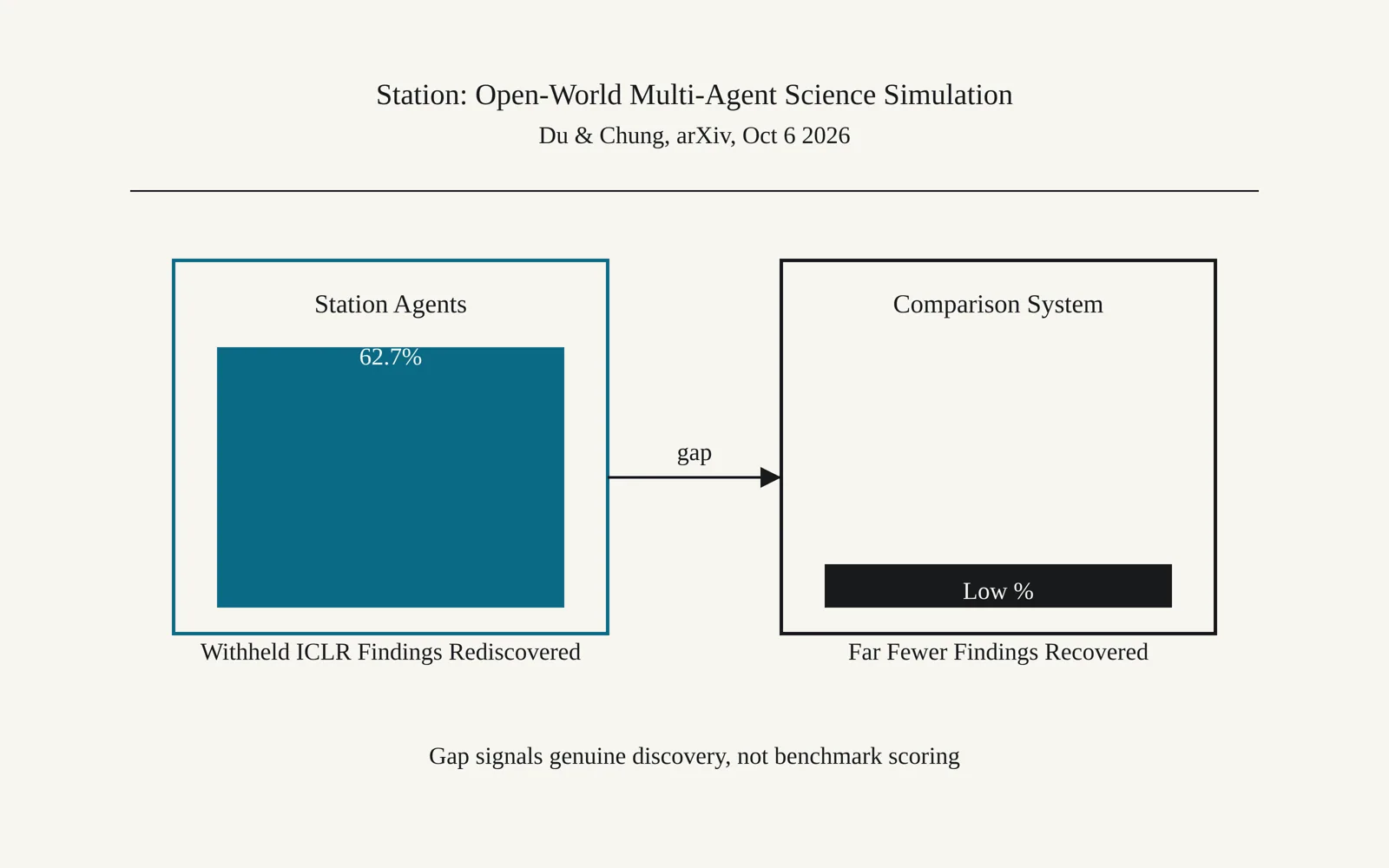
On October 6, 2026, researchers Wenyu Du and Stephen Chung posted a paper on arXiv describing Station, an open-world environment where multiple AI agents simulate a scientific ecosystem, and reporting that Station rediscovered 62.7 percent of withheld findings from three ICLR papers when agents were given only the research question and no web access. (arXiv preprint, Can AI Agents Make Open-Ended Scientific Discovery? Evidence from Station, submitted October 6, 2026)
Open the photograph at full size
Photograph: Diagram: AI Journey
Read the full description of this diagram
Diagram drawn for this item: Paper Reports Station Agents Rediscover 62.7% of Withheld ICLR Findings. On October 6, 2026, researchers Wenyu Du and Stephen Chung posted a paper on arXiv describing Station, an open-world environment where multiple AI agents simulate a scientific ecosystem, and reporting that Station rediscovered 62.7 percent... For a reader deciding how much weight to put on claims that software can do open-ended science rather than scoring a fixed benchmark, the gap between a 62.7 percent recovery rate and a far lower figure from a comparison system shows the...
The numbers
Station recovery rate
62.7%
Share of withheld ICLR findings Station rediscovered on average
Codex Multiagent-v2 recovery
15.4%
Comparison system's average recovery rate on the same task
What they are saying
Outlets read
Meta's Muse has become the most popular and buzzy version of personal AI agents since hitting the market in early September.
read
OpenAI's recently released dots and Meta's Muse are built around the assistant first and then sent out to use other companies' websites and services.
read
Our verdict
CNBC and Semafor both describe assistant-first agent products already reaching consumers, while this paper is a lab test of whether agents can reconstruct unseen research findings, a narrower and earlier-stage question that neither outlet's framing addresses. Reading the three together shows how far shipped consumer agents have moved past the still-unsettled question of whether agents can genuinely discover rather than retrieve.
What it means for you
For a reader deciding how much weight to put on claims that software can do open-ended science rather than scoring a fixed benchmark, the gap between a 62.7 percent recovery rate and a far lower figure from a comparison system shows the method, not just the model, drives the result, which raises the bar for what any future agent claiming similar discovery must beat before it is taken as more than a metrics exercise.
In more detail
Researchers Wenyu Du and Stephen Chung posted a paper to arXiv on October 6, 2026, asking a question that sits behind much of the current enthusiasm for AI agents: can a system find things out on its own, rather than optimize toward a metric somebody else already defined. Their testbed, called Station, is an open-world environment in which several agents operate together to simulate a working scientific ecosystem, exploring, proposing and checking ideas rather than chasing a single score.
To test open-ended discovery honestly, the authors built tasks from three recent oral papers presented at ICLR. Agents received only the main research question each paper set out to answer. The paper’s actual results were withheld, and the agents had no access to the web, so they could not simply look up what the original authors found. The authors then checked how many of the original findings, broken into separate criteria, the agents reconstructed on their own.
Two mechanisms were added to help agents keep exploring when there is no intermediate score telling them whether they are on the right track: a Supervisor mechanism that oversees the research process, and periodic Meta Reflection, which prompts agents to step back and reassess their direction. Ablation tests, which remove one mechanism at a time to see what each contributes, indicated that combining both improved how much ground the agents covered and how well they sustained a line of inquiry rather than drifting.
The authors also ran Station on two further open-ended tasks that had no existing paper to check against, what they call tasks without an oracle. In those cases, some of the conclusions the agents reached closely matched findings that researchers only reported after Station’s training data cutoff, meaning the agents could not have simply memorized the answer.
The numbers
- Station rediscovered 62.7 percent of the withheld findings on average across the three ICLR tasks.
- A comparison system, Codex Multiagent-v2, rediscovered 15.4 percent of the same findings under the identical setup.
- A second comparison system, AI Scientist-v2, scored in the mid-teens to low twenties, well below Station’s result.
The gap between those figures is the paper’s central claim: the two added mechanisms, not simply a stronger underlying model, account for most of the difference, since the comparison systems were working from comparable base capabilities. For anyone trying to judge whether an “AI scientist” headline describes a working method or a cherry-picked demo, this paper is useful precisely because it withheld the answer key rather than letting agents search for it, and because it reports a result against two named baselines instead of a single showcase run. That is a higher bar than most agent papers set for themselves, and it is one that future claims in this area will now be measured against.
Sources
Sources read
Cite this
AI Journey, "Paper Reports Station Agents Rediscover 62.7% of Withheld ICLR Findings", 9 Oct 2026, https://aijourney.space/updates/2026-10-09-can-ai-agents-make-open-ended-scientific-discovery-evidence-from-station/ (source: arXiv, verified 9 Oct 2026)
Next in the stream
Paper Benchmarks Claude Sonnet 4 on Geospatial Tool Use Tasks
A new benchmark called GeoNatureAgent tested nine large language models on geospatial tool calling tasks, and Claude Sonnet 4 came out ahead of every rival model tested.
Previous
Paper Tests Agent-Controlled Forgetting To Cut Tool-Use Context
A new preprint tests letting an agent archive its own old tool outputs and recover them later, cutting token use in one noisy debugging case.
Next