Event Published ResearchResearch
Paper Tests Agent-Controlled Forgetting To Cut Tool-Use Context
A new preprint tests letting an agent archive its own old tool outputs and recover them later, cutting token use in one noisy debugging case.
What happened
Published here
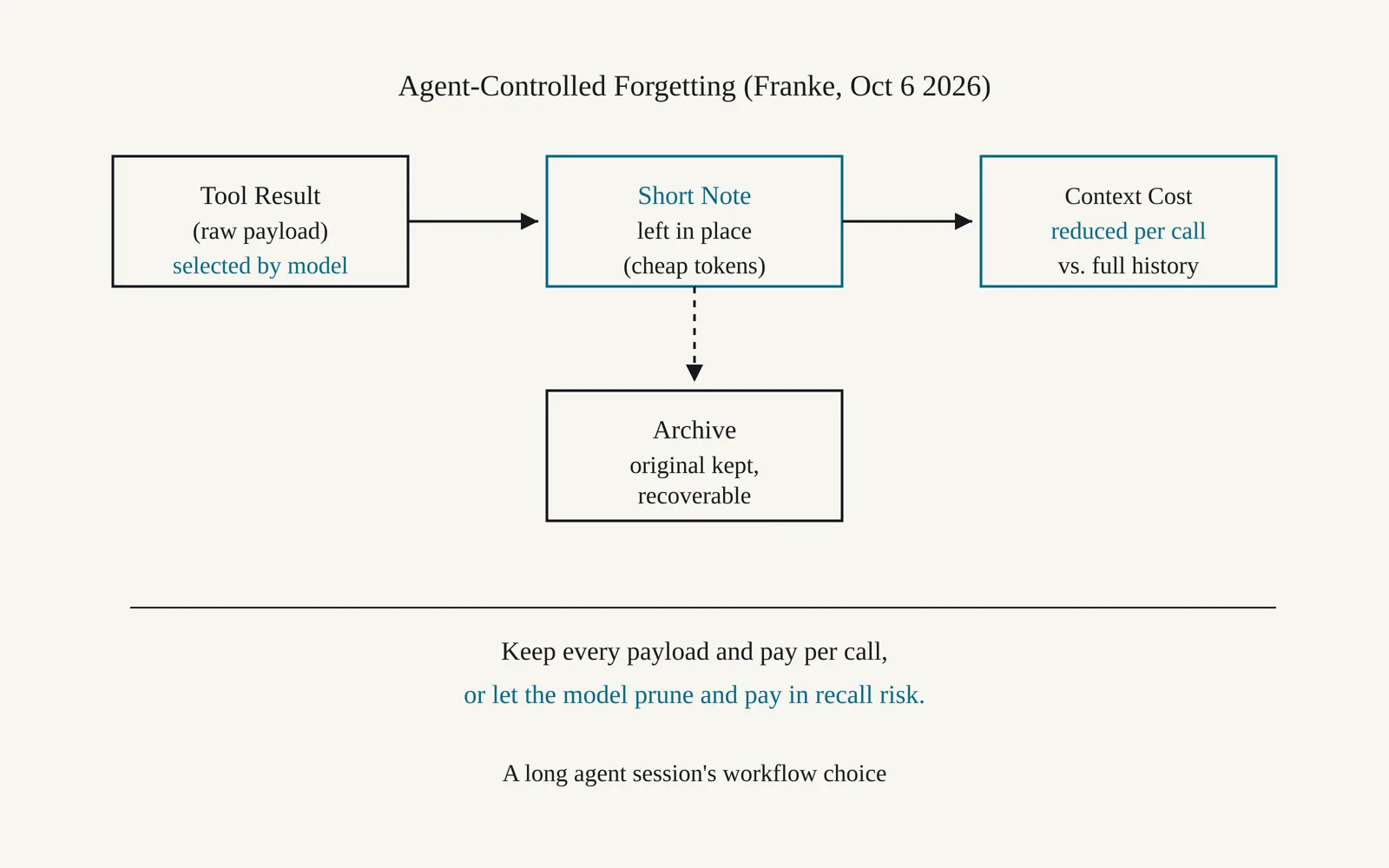
A preprint posted October 6, 2026 by Jan-Peter Franke describes agent-controlled forgetting, where a tool-using model selects earlier tool results, replaces each with a short note in place, and keeps the original in a recoverable archive accessed through a Python harness that exposes batch archival and explicit recovery, with no task-specific training and with user instructions and assistant messages left untouched. (arXiv preprint 2610.10590, submitted October 6, 2026)
Open the photograph at full size
Photograph: Diagram: AI Journey
Read the full description of this diagram
Diagram drawn for this item: Paper Tests Agent-Controlled Forgetting To Cut Tool-Use Context. A preprint posted October 6, 2026 by Jan-Peter Franke describes agent-controlled forgetting, where a tool-using model selects earlier tool results, replaces each with a short note in place, and keeps the original in a recoverable archive... For anyone running a long debugging or multi-step agent session, the finding points to a workflow choice: hold on to every raw tool payload and pay for it on every subsequent call, or let the model prune its own trace and pay instead in...
The numbers
Prompt tokens, forgetting
231,951
Provider-reported prompt tokens with agent-controlled forgetting
Prompt tokens, retained
912,492
Provider-reported prompt tokens with full retained history
Input token reduction
50%
Fewer cumulative input tokens used with forgetting
Time cost
17%
Longer run time with forgetting in the OpenTelemetry case
Read from arXiv preprint 2610.10590, submitted October 6, 2026
What it means for you
For anyone running a long debugging or multi-step agent session, the finding points to a workflow choice: hold on to every raw tool payload and pay for it on every subsequent call, or let the model prune its own trace and pay instead in extra retrieval requests and a slightly longer run, a trade a team can only judge once it knows which of its own tasks look like the noisy OpenTelemetry case and which look like the flat application-development case where no saving appeared at all.
In more detail
A preprint posted to arXiv on October 6, 2026 by Jan-Peter Franke tests a simple idea for agents that repeatedly call tools: let the model decide which of its own past tool outputs it no longer needs in full, swap each one for a short note at the same spot in the conversation, and keep the full original somewhere it can be recovered if needed later. The paper calls this agent-controlled forgetting, and it is implemented through a Python harness that lets the agent archive results in batches and recover them explicitly, with no model fine-tuning required. User instructions and the assistant’s own messages are protected from the process, so only tool observations get pruned.
The study is small and exploratory rather than a benchmark. It runs one OpenTelemetry debugging case followed by an unrelated implementation task, plus a separate application-development pair and an earlier continuation case for comparison. In the debugging case, the method ended with far fewer provider-reported prompt tokens than the version that retained full history, and used half as many cumulative input tokens overall. The author estimates the agent-controlled-forgetting run cost roughly a dollar less than retaining everything, though it issued more individual requests and took longer to finish. Both the forgetting arm and the retained-history arm passed what the paper calls the primary behavioral oracle, a two-case check of correct task completion, but neither satisfied a stricter follow-up evaluation.
The result that matters most for anyone considering the technique is not the saving itself but its unevenness. The application-development pair showed no context or cost saving at all, and an earlier continuation case actually produced lower manually assessed output quality despite using less context. The paper frames workload dependence as the central open question for reversible context management, not a solved problem.
The numbers
- 231,951 provider-reported prompt tokens with forgetting against 912,492 with full retained history in the debugging case.
- 50% fewer cumulative input tokens used overall with the method applied.
- An estimated USD 1.28 to 1.44 API cost against roughly USD 4.38 for the retained-history run.
- 17% longer run time for the agent using forgetting in that same case.
For teams running agents against noisy, tool-heavy trajectories such as log analysis or debugging, this is early evidence that pruning old tool payloads can meaningfully lower per-session token bills, provided the archive and recovery step is reliable enough that nothing important is actually lost. For flatter, more linear tasks, the paper’s own application-development result suggests the technique may add complexity without changing the bill at all, which argues against applying it as a blanket default across every agent workflow.
Sources
Sources read
arXiv preprint 2610.10590, submitted October 6, 2026 (arxiv.org)
Paper read
Cite this
AI Journey, "Paper Tests Agent-Controlled Forgetting To Cut Tool-Use Context", 9 Oct 2026, https://aijourney.space/updates/2026-10-09-agent-controlled-forgetting-for-tool-using-agents-reversible-context-cur/ (source: arXiv, verified 9 Oct 2026)
Next in the stream
Paper Reports Station Agents Rediscover 62.7% of Withheld ICLR Findings
A new paper tied to Meta's broader AI research push tests whether agent systems can rediscover scientific findings without being told the answer in advance.
Previous
Google Opens SynthID Detector to Everyone Worldwide
Google said its SynthID Detector, which flags AI-generated images, video and audio, is now open to anyone online rather than only media professionals.
Next
More in Research
Study Finds Precedent Labels Sway Claude Haiku Approval Calls
A new paper tests Claude Haiku 5.5 alongside other models on refund and claim decisions, showing that past case labels shift approvals sharply.
Paper Tests Claude Opus 4.8 Agents on Conflicting Code Edits
A new paper benchmarks Claude Code running Claude Opus 4.8 against other coding agents on tasks where two agents edit the same shared codebase at once.
Perplexity AI Researchers Detail LoRA Recipe For Converting Four Language Models To Diffusion
A paper associated with Perplexity AI describes BYOD, a LoRA-only method that converts standard autoregressive language models into diffusion language models without full retraining.