What happened
Published here
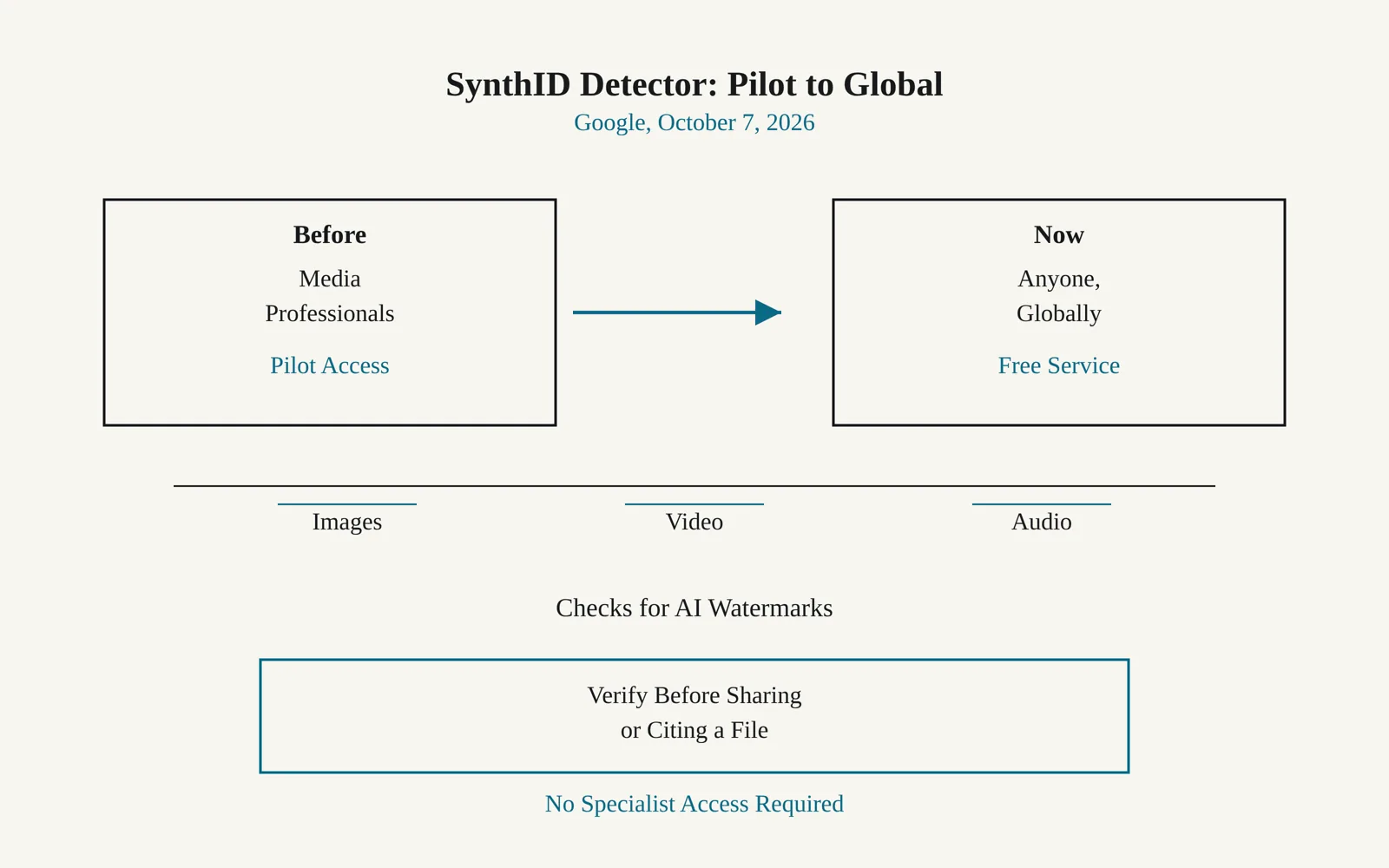
On October 7, 2026, Google said it opened its SynthID Detector tool to everyone online in English, ending the limit that had reserved the tool for media professionals since it introduced an early version last year. (Google DeepMind newsroom post announcing global SynthID Detector access, published October 7, 2026)
Open the photograph at full size
Photograph: Diagram: AI Journey
Read the full description of this diagram
Diagram drawn for this item: Google Opens SynthID Detector to Everyone Worldwide. On October 7, 2026, Google said it opened its SynthID Detector tool to everyone online in English, ending the limit that had reserved the tool for media professionals since it introduced an early version last year. For someone trying to judge whether a photo or clip circulating online is genuine, a single checking page that reads watermarks from several companies at once changes the question from which company made this to whether any detector flags...
The numbers
Media watermarked
180 billion
images and videos watermarked with SynthID since its 2023 launch
Audio watermarked
240,000
years of audio content watermarked with SynthID
Daily checks
1 million
requests handled daily by verification features in Search, the Gemini app and Chrome
Read from Google DeepMind newsroom post announcing global SynthID Detector access, published October 7, 2026
What they are saying
Outlets read
Google is using SynthID, which it introduced in 2023, to identify whether media is AI-generated.
read
The new SynthID website can now identify AI content from Google, OpenAI, and more.
read
Our verdict
TechCrunch frames the page mainly as a way to check Google's own output, while Ars Technica stresses the wider roster of makers it now covers, a distinction the vendor post blurs by listing partners without separating what each company's content looks like once run through the tool. Neither outlet tests how the detector performs on content that has been cropped, re-encoded or partly edited after the watermark was added, which is the harder question for anyone relying on it day to day.
What it means for you
For someone trying to judge whether a photo or clip circulating online is genuine, a single checking page that reads watermarks from several companies at once changes the question from which company made this to whether any detector flags it, which matters as more image and video generators enter daily use and a reader has no way to ask the maker of each one directly.
In more detail
Google has removed the wall between its SynthID Detector and the general public. The company said on October 7, 2026 that the checking tool, which had been limited to media professionals since an early version appeared last year, is now open to anyone online, starting with English. Pushmeet Kohli, who leads science and strategic initiatives at Google DeepMind, framed the move as part of giving people clearer context about what they see online so they can decide what to trust.
SynthID itself is older than the detector built around it. Google introduced the watermarking technology in 2023, embedding imperceptible marks into images, video and audio generated by its own models. Those marks survive common edits such as cropping, compression and filters, which is what lets the detector read them back out later. The new site lets a person upload a file and see whether any of those marks are present, rather than having to guess from how an image looks.
The detector does not stop at Google’s own models. The company said it can recognize content made with tools from partners including OpenAI, NVIDIA and Kakao, with Apple named as a coming addition. That breadth is the part of the announcement that separates this release from a simple product update: a single page now checks against watermarks set by several different AI labs rather than just the one that built it, assuming each partner continues to embed SynthID consistently and keeps that arrangement current as its own models change.
The numbers
- Google has applied SynthID watermarks to 180 billion images and videos since the technology launched in 2023.
- The company has also watermarked 240,000 years of audio content, a figure that signals how much synthetic audio the system has touched rather than how much any single listener will ever check.
- Built in verification features across Search, the Gemini app and Chrome already handle over 1 million requests daily, a volume the standalone detector page now adds to directly.
Google positions the expansion as routine safety infrastructure rather than a new product line, folding it in alongside its SynthID Bio work in synthetic biology and its existing verification features in Search and Chrome. The open question for a reader is less about Google’s own content and more about coverage: a watermark only helps if the tool that made the file actually applied one, and the detector can say nothing useful about content made with a generator that never adopted SynthID in the first place. That gap, not the technology itself, is where most AI-generated media will likely keep slipping through unflagged.
Sources
Sources read
Google DeepMind newsroom post announcing global SynthID Detector access, published October 7, 2026 (blog.google)
Newsroom read
Cite this
AI Journey, "Google Opens SynthID Detector to Everyone Worldwide", 7 Oct 2026, https://aijourney.space/updates/2026-10-07-we-re-making-it-easier-to-identify-ai-generated-content-globally/ (source: Google, verified 7 Oct 2026)
Next in the stream
Paper Tests Agent-Controlled Forgetting To Cut Tool-Use Context
A new preprint tests letting an agent archive its own old tool outputs and recover them later, cutting token use in one noisy debugging case.
Previous
Paper Tests Whether Claude Gives Another State's Medicaid Figure by Mistake
A new paper measures how often Anthropic's Claude Sonnet 5.5 answers a state Medicaid eligibility question with another state's real figure.
Next
More in Google
Google.org Funds Five Groups Building AI Tools For Teachers
Google.org is funding five organizations building AI tools for teachers, pairing Google DeepMind's model work with grants aimed at classroom use.
Gemini Negotiation Paper Finds Persona Effects Shift By Language
A new paper testing Google's Gemini model in buyer-seller negotiations found that the same persona instruction produced different deal outcomes in English and Korean.
Paper Finds Gemini Monitor Beats Small Models At Spotting Reward Hacking
A new paper tests whether Google's Gemini 3.1 Flash-Lite can tell real reward hacking apart from honest failure better than small local monitors.