What happened
Published here
On October 6, 2026, researchers published a paper introducing GeoNatureAgent (GNA), a framework and 103-task benchmark for testing tool-using agents against a fixed sixteen-tool geospatial interface built on the Model Context Protocol. The benchmark covers an open, self-hostable API serving three environmental indicators across Spain and Portugal, and the authors ran nine large language models through it under three temperature-1.0 seeds to score both task accuracy and per-case cost. (arXiv paper, GeoNatureAgent (GNA), submitted October 6, 2026)
Open the photograph at full size
Photograph: Diagram: AI Journey
Read the full description of this diagram
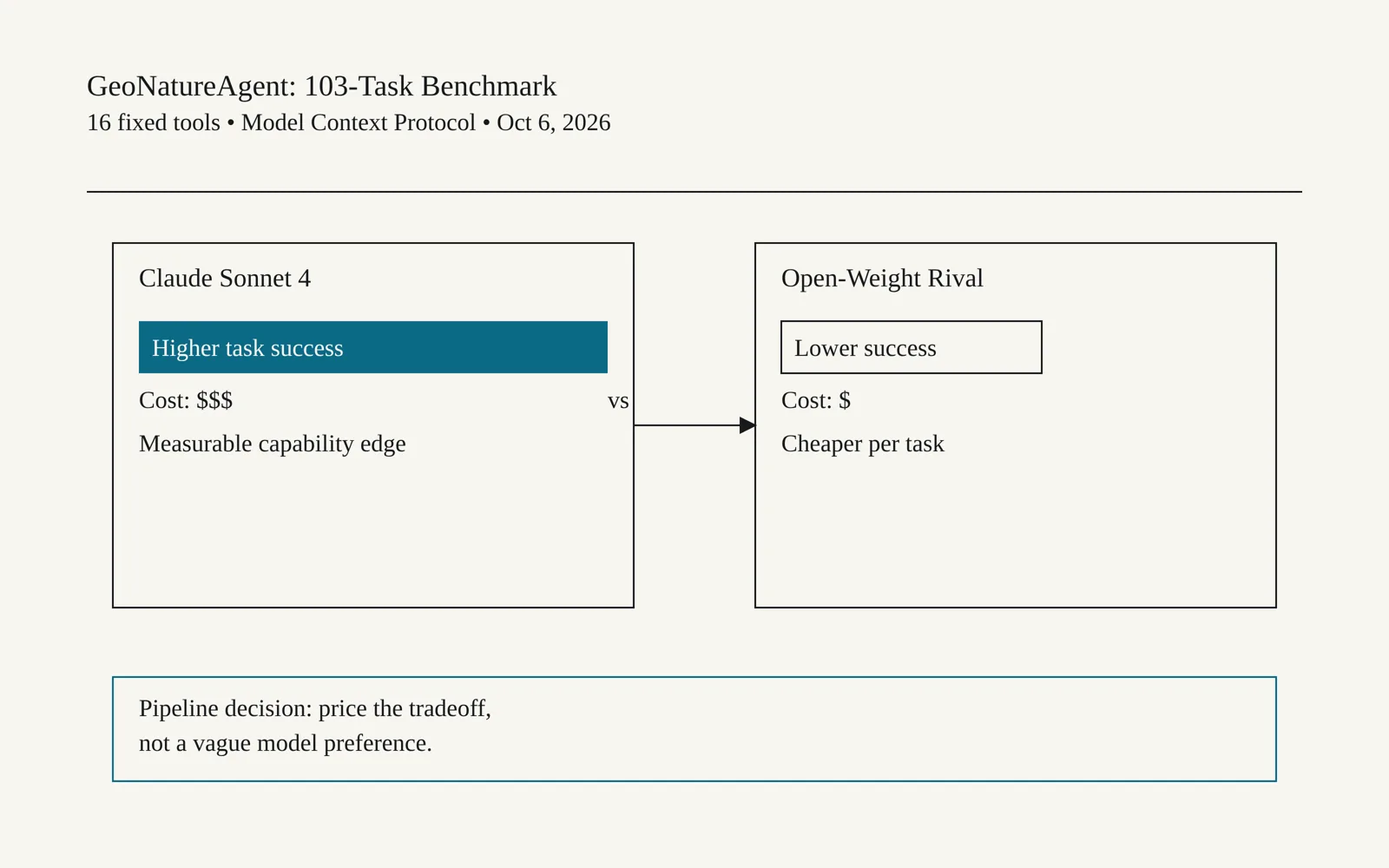
Diagram drawn for this item: Paper Benchmarks Claude Sonnet 4 on Geospatial Tool Use Tasks. On October 6, 2026, researchers published a paper introducing GeoNatureAgent (GNA), a framework and 103-task benchmark for testing tool-using agents against a fixed sixteen-tool geospatial interface built on the Model Context Protocol. For a team deciding which model to wire into an environmental monitoring pipeline, this paper turns a vague preference into a priced tradeoff: paying more for Claude buys a measurable capability edge, while a cheaper open-weight rival...
The numbers
Claude Sonnet 4 capability
61.7% +/- 0.7%
Score across all 103 tasks
Claude on main suite
60.8%
Score on the 93-task main suite
DeepSeek V3.2 capability
57.9%
Runner-up model's score across all 103 tasks
Cost advantage
11.3x
DeepSeek V3.2's lower list-price cost versus Claude at 93% of its capability
Read from arXiv paper, GeoNatureAgent (GNA), submitted October 6, 2026
What it means for you
For a team deciding which model to wire into an environmental monitoring pipeline, this paper turns a vague preference into a priced tradeoff: paying more for Claude buys a measurable capability edge, while a cheaper open-weight rival closes most of that gap at a fraction of the list price, so the right pick depends on whether the workflow tolerates the lower accuracy band or needs the ceiling. It also warns that strict scoring on a narrow domain benchmark, rather than a general-purpose one, can make every model look far weaker than headline GIS leaderboard numbers suggest, which matters to anyone budgeting accuracy targets off those broader scores.
In more detail
A team of six researchers, led by Gabriel Diaz-Ireland, submitted a paper on October 6, 2026 describing GeoNatureAgent, a framework built to check whether a tool-using agent actually picks the right operation when it is pointed at a real geospatial API. The setup fixes a sixteen-tool interface, published as a Model Context Protocol server, so that whichever model is under test is the only variable changing: same tools, same task suite, same deterministic scorer.
The flagship benchmark runs 103 tasks, split into a 93-task main suite spread across 18 categories plus a ten-task comparison set, against an open, self-hostable API covering three environmental indicators in Spain and Portugal. Nine large language models were evaluated across three seeds at temperature 1.0, with the authors deliberately treating capability and per-case cost as separate measures rather than folding them into one score.
Claude Sonnet 4 came out on top, scoring 61.7% across all 103 tasks and 60.8% on the main suite, ahead of DeepSeek V3.2 at 57.9%. No other model in the lineup cleared 53%. The paper also plots a cost-accuracy frontier that is dominated by open-weight models: DeepSeek V3.2 reaches 93% of Claude’s capability while costing 11.3 times less at list price, which is the kind of tradeoff a procurement decision actually has to weigh rather than a single leaderboard number.
A separate finding complicates how those scores should be read against other benchmarks. Under the paper’s strict all-checks scoring, the best model lands 24 to 36 points below the 85 to 97% range typically reported on general-purpose GIS benchmarks. But when partial credit is given per check instead, the top four models cluster at 86 to 90%, which the authors argue shows that much of the apparent gap comes from how strictly a benchmark marks partial progress, not from the geospatial tasks being harder than general GIS work.
The numbers
- Claude Sonnet 4: 61.7% +/- 0.7% across all 103 tasks, 60.8% on the main suite alone.
- DeepSeek V3.2: 57.9% capability, at 11.3 times lower list-price cost than Claude.
- No other evaluated model exceeded 53% capability.
The authors note the server, harness, benchmark and API are public, and that swapping in different tool executors and tasks builds an equivalent benchmark for any other geospatial domain.
Sources
Sources read
arXiv paper, GeoNatureAgent (GNA), submitted October 6, 2026 (arxiv.org)
Paper read
Cite this
AI Journey, "Paper Benchmarks Claude Sonnet 4 on Geospatial Tool Use Tasks", 9 Oct 2026, https://aijourney.space/updates/2026-10-09-geonatureagent-gna-a-framework-and-benchmark-for-pre-production-evaluati/ (source: arXiv, verified 9 Oct 2026)
Next in the stream
Study Finds Tiny Chinese BERT Models Favor MLM Over MacBERT
A paper measures candidate masking strategies by their Perplexity score, among other metrics, and finds the winner flips entirely once a Chinese BERT model shrinks to under nine million parameters.
Previous
Paper Reports Station Agents Rediscover 62.7% of Withheld ICLR Findings
A new paper tied to Meta's broader AI research push tests whether agent systems can rediscover scientific findings without being told the answer in advance.
Next
More in Anthropic
Study Finds Precedent Labels Sway Claude Haiku Approval Calls
A new paper tests Claude Haiku 5.5 alongside other models on refund and claim decisions, showing that past case labels shift approvals sharply.
Paper Tests Claude Opus 4.8 Agents on Conflicting Code Edits
A new paper benchmarks Claude Code running Claude Opus 4.8 against other coding agents on tasks where two agents edit the same shared codebase at once.
Paper Finds Claude Opus 5.5 Agent Beats Automated CT Labeling Harness
A new paper testing CT scan labeling finds a free-form agent running Claude Opus 5.5 outscored an automated review harness on most of six public datasets.