Event Published ResearchPerplexity AI
Study Finds Tiny Chinese BERT Models Favor MLM Over MacBERT
A paper measures candidate masking strategies by their Perplexity score, among other metrics, and finds the winner flips entirely once a Chinese BERT model shrinks to under nine million parameters.
What happened
Published here
On October 6, 2026, a single-author paper posted to arXiv compared three pretraining strategies, MLM, WWM and MacBERT-style masking, on an 8.7 million parameter Chinese BERT model trained from scratch on 1.29 million Wikipedia sentences, measuring each with perplexity and four other intrinsic tests. (arXiv paper 2610.08879, Tiny-Scale Chinese BERT Pretraining, submitted October 6, 2026)
Open the photograph at full size
Photograph: Diagram: AI Journey
Read the full description of this diagram
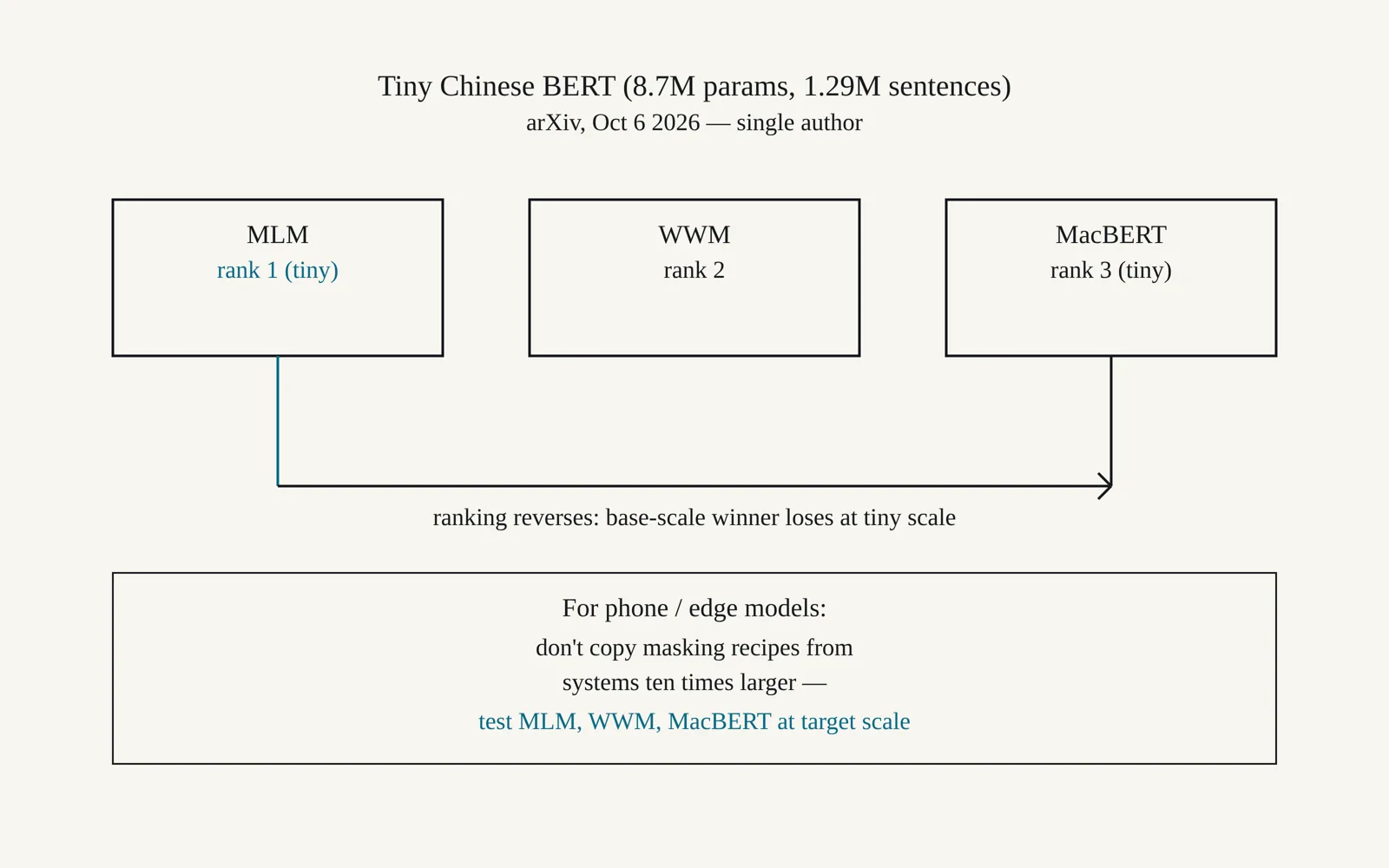
Diagram drawn for this item: Study Finds Tiny Chinese BERT Models Favor MLM Over MacBERT. On October 6, 2026, a single-author paper posted to arXiv compared three pretraining strategies, MLM, WWM and MacBERT-style masking, on an 8.7 million parameter Chinese BERT model trained from scratch on 1.29 million Wikipedia sentences... For teams choosing a pretraining recipe for models meant to run on phones or at the edge, this result argues against copying masking choices from systems ten times larger, since the ranking that holds at base scale reversed entirely once...
The numbers
WWM perplexity
1.27
WWM's perplexity score against MLM's 2.10
MLM perplexity
2.10
The baseline WWM improved on
Perplexity improvement
39.5%
WWM's gain over MLM on perplexity
MacBERT perplexity
47.23
MacBERT's result despite its lowest training loss
Read from arXiv paper 2610.08879, Tiny-Scale Chinese BERT Pretraining, submitted October 6, 2026
What it means for you
For teams choosing a pretraining recipe for models meant to run on phones or at the edge, this result argues against copying masking choices from systems ten times larger, since the ranking that holds at base scale reversed entirely once this model shrank under nine million parameters, so a workflow built on big model defaults could quietly end up picking the worst available option, raising the real cost of deployment chosen on reputation rather than measurement.
In more detail
A paper posted to arXiv on October 6, 2026 reports a controlled comparison of three pretraining strategies for Chinese BERT models: standard Masked Language Modeling (MLM), Whole Word Masking (WWM), and the synonym-replacement approach used by MacBERT. The author, Yiping Bai, trained three models from an identical four-layer, 256-hidden-dimension architecture with 8.7 million parameters, using the same 1.29 million-sentence corpus drawn from Chinese Wikipedia and identical hyperparameters, so that only the masking strategy differed between runs.
Most prior work testing these three strategies against each other used base-scale models of 110 million parameters or more, where the published ranking favors MacBERT over WWM over MLM. At the much smaller scale tested here, that ranking reversed. MLM won three of the five intrinsic evaluation dimensions the paper tracks, which are perplexity, MLM hit rate, semantic discrimination, grammatical judgment and contextual sensitivity. WWM came out ahead on perplexity and hit rate specifically, while MacBERT, hampered by a synonym dictionary covering only 222 entries and 3.3 percent of tokens, produced a model whose perplexity was far worse than either rival despite recording the lowest training loss of the three during training.
That last detail is the paper’s sharper warning. A model’s own training loss is often used as a stand-in for how good it will be once deployed, and here the model with the best loss number produced the worst perplexity score once evaluated, a pitfall the author ties specifically to mixed replacement strategies like MacBERT’s.
The numbers
- WWM perplexity: 1.27, well below MLM’s score.
- MLM perplexity: 2.10, the figure WWM improved on.
- Perplexity improvement: 39.5%, WWM’s gain over the MLM baseline.
- MacBERT perplexity: 47.23, far above either rival despite its lower training loss.
For a reader choosing how to pretrain a small model meant to run on a phone or at the edge rather than in a data centre, the lesson is specific rather than general: a masking recipe copied from a paper that tested a model with 110 million or more parameters may be the wrong choice once the parameter budget drops under nine million, and checking training loss alone before shipping a tiny model would have hidden exactly the failure this comparison caught. The author has released the trained models and corpus publicly, which lets other teams rerun the same five tests on their own tiny architectures rather than trusting a single paper’s ranking as a given across every model size.
Sources
Sources read
arXiv paper 2610.08879, Tiny-Scale Chinese BERT Pretraining, submitted October 6, 2026 (arxiv.org)
Paper read
Cite this
AI Journey, "Study Finds Tiny Chinese BERT Models Favor MLM Over MacBERT", 9 Oct 2026, https://aijourney.space/updates/2026-10-09-tiny-scale-chinese-bert-pretraining-a-controlled-comparison-of-mlm-wwm-a/ (source: arXiv, verified 9 Oct 2026)
Next in the stream
Paper Tests Whether AI Safety Governors Block Gemini Agents From Finishing Tasks
A new paper runs Gemini 2.5 Flash through a governed file-recovery test to see whether a safety supervisor's own interventions can stall the agent it is meant to control.
Previous
Paper Benchmarks Claude Sonnet 4 on Geospatial Tool Use Tasks
A new benchmark called GeoNatureAgent tested nine large language models on geospatial tool calling tasks, and Claude Sonnet 4 came out ahead of every rival model tested.
Next
More in Perplexity AI
Perplexity AI Researchers Detail LoRA Recipe For Converting Four Language Models To Diffusion
A paper associated with Perplexity AI describes BYOD, a LoRA-only method that converts standard autoregressive language models into diffusion language models without full retraining.
Paper Proposes Message-Passing Method For Compressing LLM Weights
A new arXiv paper proposes a message-passing method for compressing large language model weights, the kind of efficiency work that underlies answer engines like Perplexity AI.
Researchers Publish S-SALAAD Framework For Sparse Large Model Inference
A new paper on compressing large models for edge devices matters to Perplexity AI and any company whose answer engine has to run inference away from a data center.