What happened
Published here
On October 16, 2026, researchers Man-Ling Sung, Chak Fai Li, Damianos Karakos, Fred Bernardin and Brian Ulicny posted a paper on arXiv describing a method for multi-author style change detection, the task of finding where one writer's contribution ends and another's begins inside a single document. The team found that using large language models off the shelf, or fine-tuning them only within the target writing domain, failed to produce useful features. Instead they fine-tuned the Mistral-7B embedding model for authorship verification and compared it against DeBERTa, the model behind the state of the art systems in the PAN-25 multi-author writing style analysis challenge. The paper was accepted to the Workshop on Natural User-generated Text at EMNLP 2026. (arXiv paper, Multi-author style detection with stylistic embeddings, submitted October 16, 2026)
Open the photograph at full size
Photograph: Diagram: AI Journey
Read the full description of this diagram
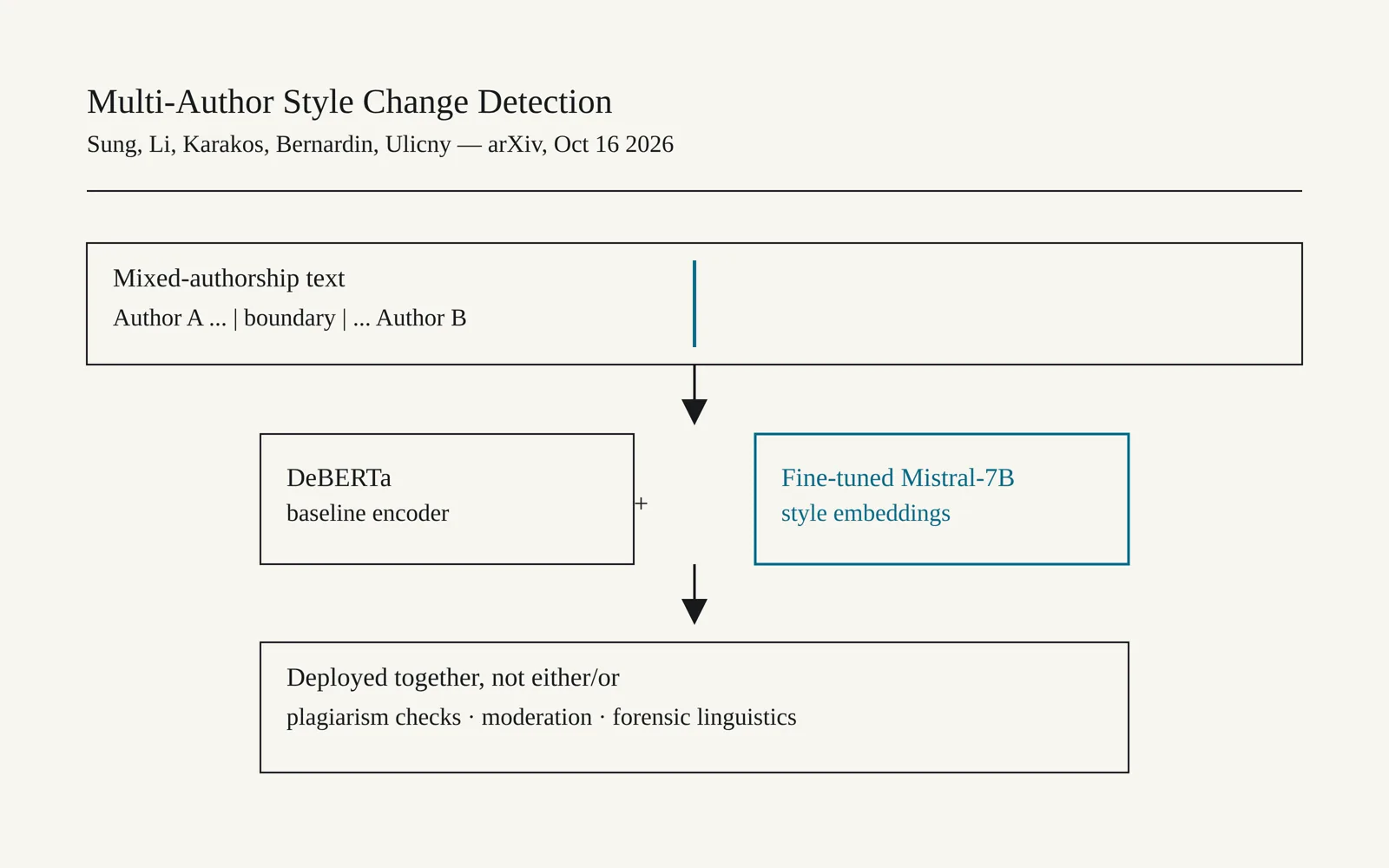
Diagram drawn for this item: Paper Fine-Tunes Mistral-7B Embeddings For Style Detection. On October 16, 2026, researchers Man-Ling Sung, Chak Fai Li, Damianos Karakos, Fred Bernardin and Brian Ulicny posted a paper on arXiv describing a method for multi-author style change detection, the task of finding where one writer's... For anyone building a tool that has to flag mixed-authorship text, such as a plagiarism checker, a moderation pipeline or a forensic linguistics workflow, the choice is no longer DeBERTa or a newer open-weight model but both at once, since...
What it means for you
For anyone building a tool that has to flag mixed-authorship text, such as a plagiarism checker, a moderation pipeline or a forensic linguistics workflow, the choice is no longer DeBERTa or a newer open-weight model but both at once, since the paper reports that each catches cases the other misses across different kinds of user-generated writing. That changes the build decision from picking a single embedding model to budgeting for two inference passes and a combination step, raising the compute cost of a detector that previously ran one model alone. It also gives Mistral a concrete citation point inside an authorship verification benchmark rather than a general purpose chat leaderboard, which is the kind of specialist reference that academic and forensic buyers look for before they commit to an embedding provider.
In more detail
A team of five researchers, writing for the Workshop on Natural User-generated Text at EMNLP 2026, has published a method for spotting where authorship switches inside a document that multiple people wrote together, a task known as multi-author style change detection. The paper matters to anyone who builds tools for plagiarism review, content moderation or forensic text analysis, because it settles a practical question those builders face: which embedding model should do the work of telling one author’s sentences from another’s.
The authors’ starting point is a negative result. Taking a large language model off the shelf and asking it to separate authors does not work well, and neither does fine-tuning that model only on data drawn from the target writing domain. Both approaches fail to produce features that actually separate one writer’s style from another’s. The fix the paper proposes is cross-domain transfer learning: fine-tune an embedding model for authorship verification broadly, rather than narrowly on the domain at hand, and carry that training across into the detection task.
The paper fine-tunes Mistral’s 7B embedding model for this purpose and sets it against DeBERTa, the model used in the systems that led the PAN-25 multi-author writing style analysis challenge. Rather than picking a single winner, the authors report that the two models excel in different user-generated text scenarios, meaning each handles cases the other struggles with. Their proposed system therefore combines both embeddings rather than relying on either one alone, and the paper reports that this combination produces more effective style change detection than either model used by itself.
The numbers
The paper’s own benchmark is the PAN-25 multi-author writing style analysis challenge, the established shared task the authors use to judge whether DeBERTa and Mistral-7B features actually separate authors. The comparison is run across multiple user-generated text scenarios rather than a single dataset, which is why the authors frame their finding as a split in strengths rather than a single leaderboard score. No conversion figures, percentages or prices appear in the abstract itself, since the paper reports a methodological result rather than a priced product.
For teams evaluating embedding providers for authorship work, the practical takeaway is that a single-model benchmark score can hide a model’s actual coverage. A detector built only on DeBERTa or only on Mistral-7B will miss cases the other model would catch, and the paper’s own combined approach is the clearest evidence that neither model alone was sufficient for the full range of scenarios tested.
Sources
Sources read
Cite this
AI Journey, "Paper Fine-Tunes Mistral-7B Embeddings For Style Detection", 22 Oct 2026, https://aijourney.space/updates/2026-10-22-multi-author-style-detection-with-stylistic-embeddings/ (source: arXiv, verified 22 Oct 2026)
Next in the stream
OR-License Benchmark Tests Claude Code On Real Consulting Work
A new benchmark called OR-License tests whether agents built on models including Claude Code can turn raw client documents into operations research solutions that match paid consultants.
Previous
Nvidia RTX Spark Laptops Go On Sale From $2,399
Nvidia marked the retail arrival of its RTX Spark laptops with launch events worldwide, as partner Windows PCs built around the new chip reached buyers.
Next
More in Mistral
Paper Traces How Mistral and Peer Models Encode Three-Token Relationships
A new paper studies how Mistral's language models, alongside Llama, Qwen and Gemma, build up layer by layer representations of relationships among three tokens.
Mistral raises €3 billion at a post-money valuation above €21 billion
Samsung Electronics led the round, with Advent, BlackRock funds and Luxembourg new on the register, and Mistral's published API prices did not move with it.