What happened
Published here
On October 16, 2026, researchers posted OR-License, a benchmark built from 31 real paid operations research engagements worth a combined USD 3.68 million, and used it to test 11 frontier large language model agents, including a Claude Code configuration, on whether they could turn unedited client materials into deliverables a paying client would accept. (OR-License paper abstract and submission record, posted October 16, 2026)
Open the photograph at full size
Photograph: Diagram: AI Journey
Read the full description of this diagram
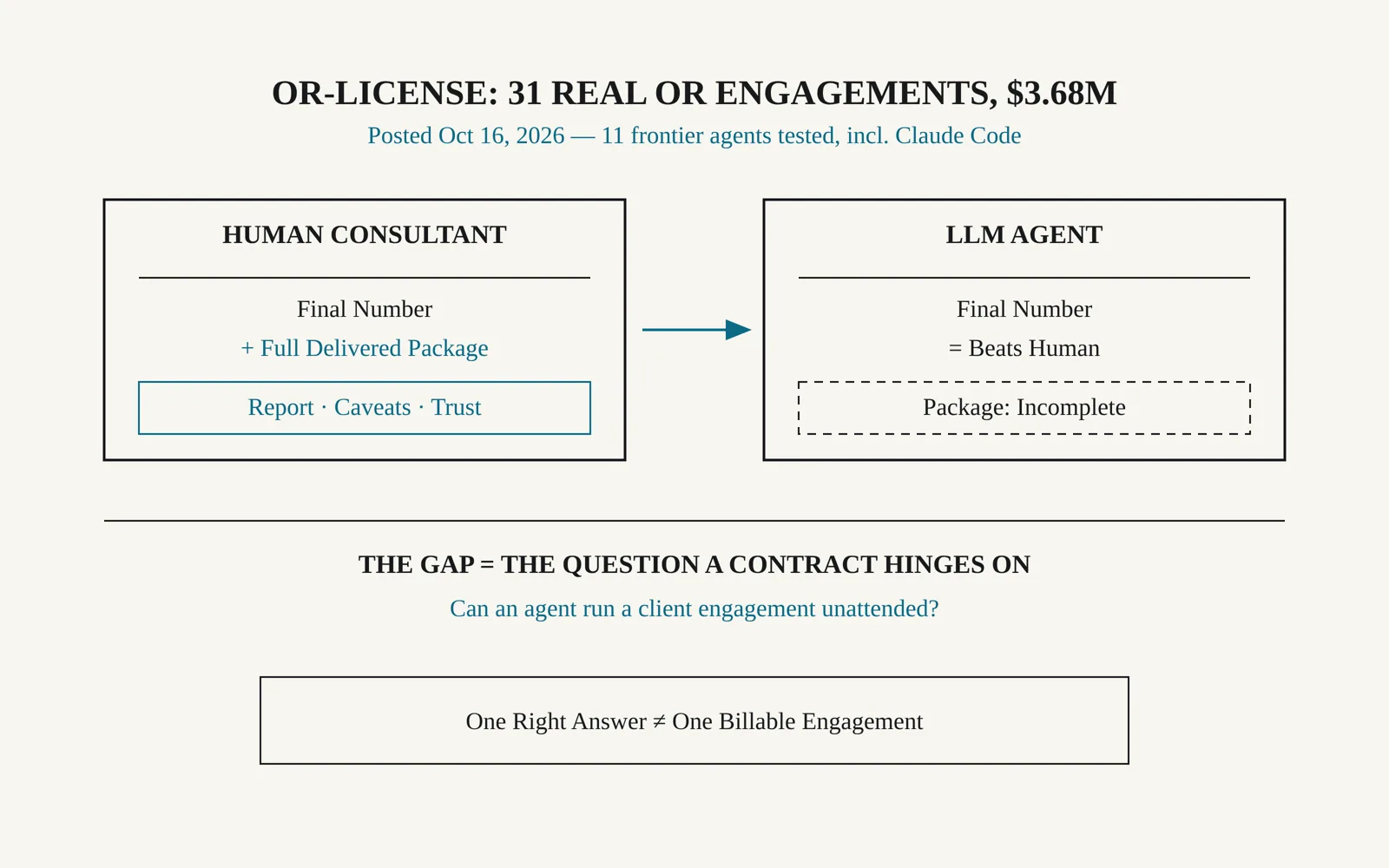
Diagram drawn for this item: OR-License Benchmark Tests Claude Code On Real Consulting Work. On October 16, 2026, researchers posted OR-License, a benchmark built from 31 real paid operations research engagements worth a combined USD 3.68 million, and used it to test 11 frontier large language model agents, including a Claude Code... For anyone deciding whether to let an agent run a client engagement unattended, the gap between beating a human on one finished number and matching the human's full delivered package is the entire question a bill or a contract would hinge...
The numbers
Engagement value
USD 3.68 million
Combined value of the 31 paid OR engagements the benchmark is drawn from
Strict feasibility
88.39%
Share of tasks the strongest Claude Code configuration delivered as feasible solutions
Deployment-Adjusted Quality
0.87
Claude Code's DAQ score against an expert reference score of 1
Benchmark instances
31
Number of real client scenarios the benchmark preserves end to end
Read from OR-License paper abstract and submission record, posted October 16, 2026
What it means for you
For anyone deciding whether to let an agent run a client engagement unattended, the gap between beating a human on one finished number and matching the human's full delivered package is the entire question a bill or a contract would hinge on, and this paper puts a measured number on that gap rather than a guess.
In more detail
A group of researchers released OR-License, a benchmark meant to close a gap in how operations research agents get graded. Most existing tests start from a tidy, already-formulated optimization problem. OR-License instead starts from the messy originals: 31 instances across 10 industrial scenarios, each one a de-identified paid consulting engagement with the client’s original requirements, raw input data and deliverable format left intact. The engagements behind the benchmark were together worth USD 3.68 million, which the authors use to argue the work is representative of what a real OR shop actually sells, not a textbook abstraction of it.
To stress the hardest part of that work, the authors built ORSim, a simulated client that will disclose business facts on request but will not hand over any operations research expertise. An agent has to ask the right questions, at the right stage, to get what it needs. Eleven frontier agents were run against the benchmark, among them a configuration built on Claude Code. Several agents produced individual solutions whose objective quality beat the expert reference once a solution was feasible at all. None matched the expert on the benchmark’s combined Deployment-Adjusted Quality score, which counts an infeasible delivery as a zero rather than ignoring it.
The strongest Claude Code configuration reached 88.39% strict feasibility and a Deployment-Adjusted Quality of 0.87 against the expert’s reference score of 1. The authors trace the shortfall to two separate failure types: agents mis-formulating the underlying problem, and agents implementing a correct formulation incorrectly. They also found that confirming information with the simulated client kept mattering well past the opening clarification stage, continuing into solution development and validation.
The numbers
- USD 3.68 million: the combined value of the paid engagements the 31 benchmark instances are drawn from.
- 88.39%: the strict feasibility rate of the strongest Claude Code configuration tested.
- 0.87: that configuration’s Deployment-Adjusted Quality score, against an expert reference of 1.
- 31: the number of end-to-end industrial scenarios the benchmark preserves after de-identification.
For a reader weighing whether to route a consulting-style workload to an agent, the finding to hold onto is the distance between a strong per-task number and a weaker delivered-package score, since a client paying for a finished answer is paying for the package, not the best single result inside it.
Sources
Sources read
OR-License paper abstract and submission record, posted October 16, 2026 (arxiv.org)
Paper read
Cite this
AI Journey, "OR-License Benchmark Tests Claude Code On Real Consulting Work", 22 Oct 2026, https://aijourney.space/updates/2026-10-22-or-license-evaluating-llm-agents-as-real-world-operations-research-pract/ (source: arXiv, verified 22 Oct 2026)
Next in the stream
New AM-Bench Paper Finds Claude Sonnet 4.6 Near-Zero on Agentic Misalignment
A new paper testing ten frontier models for agentic misalignment found Claude Sonnet 4.6 stayed near zero while two Gemini models scored far higher.
Previous
Paper Fine-Tunes Mistral-7B Embeddings For Style Detection
A new paper fine-tunes Mistral's 7B embedding model for authorship verification, pairing it with DeBERTa to detect where multiple writers split a single document.
Next
More in Anthropic
Study Finds Precedent Labels Sway Claude Haiku Approval Calls
A new paper tests Claude Haiku 5.5 alongside other models on refund and claim decisions, showing that past case labels shift approvals sharply.
Paper Tests Claude Opus 4.8 Agents on Conflicting Code Edits
A new paper benchmarks Claude Code running Claude Opus 4.8 against other coding agents on tasks where two agents edit the same shared codebase at once.
Paper Finds Claude Opus 5.5 Agent Beats Automated CT Labeling Harness
A new paper testing CT scan labeling finds a free-form agent running Claude Opus 5.5 outscored an automated review harness on most of six public datasets.