Event Published ResearchResearch
Paper Presents Script-Aware Tokenizer For Indic Languages
A new preprint describes AdaptTok-Indic, a tokenization method that cuts token fertility for Bengali and Hindi text compared with standard subword tokenizers.
What happened
Published here
On October 27, 2026, researchers posted a preprint on arXiv, numbered 2610.33017, describing AdaptTok-Indic, a script-aware adaptive tokenizer built for Bengali, Hindi, Gujarati, Tamil and Telugu text, which combines Unicode-normalized preprocessing, explicit handling of Indic conjunct characters and learned byte-level boundary prediction trained alongside a small Transformer language model. (arXiv preprint 2610.33017, AdaptTok-Indic: Script-Aware Adaptive Tokenization for Indic Languages, posted October 8, 2026)
Open the photograph at full size
Photograph: Diagram: AI Journey
Read the full description of this diagram
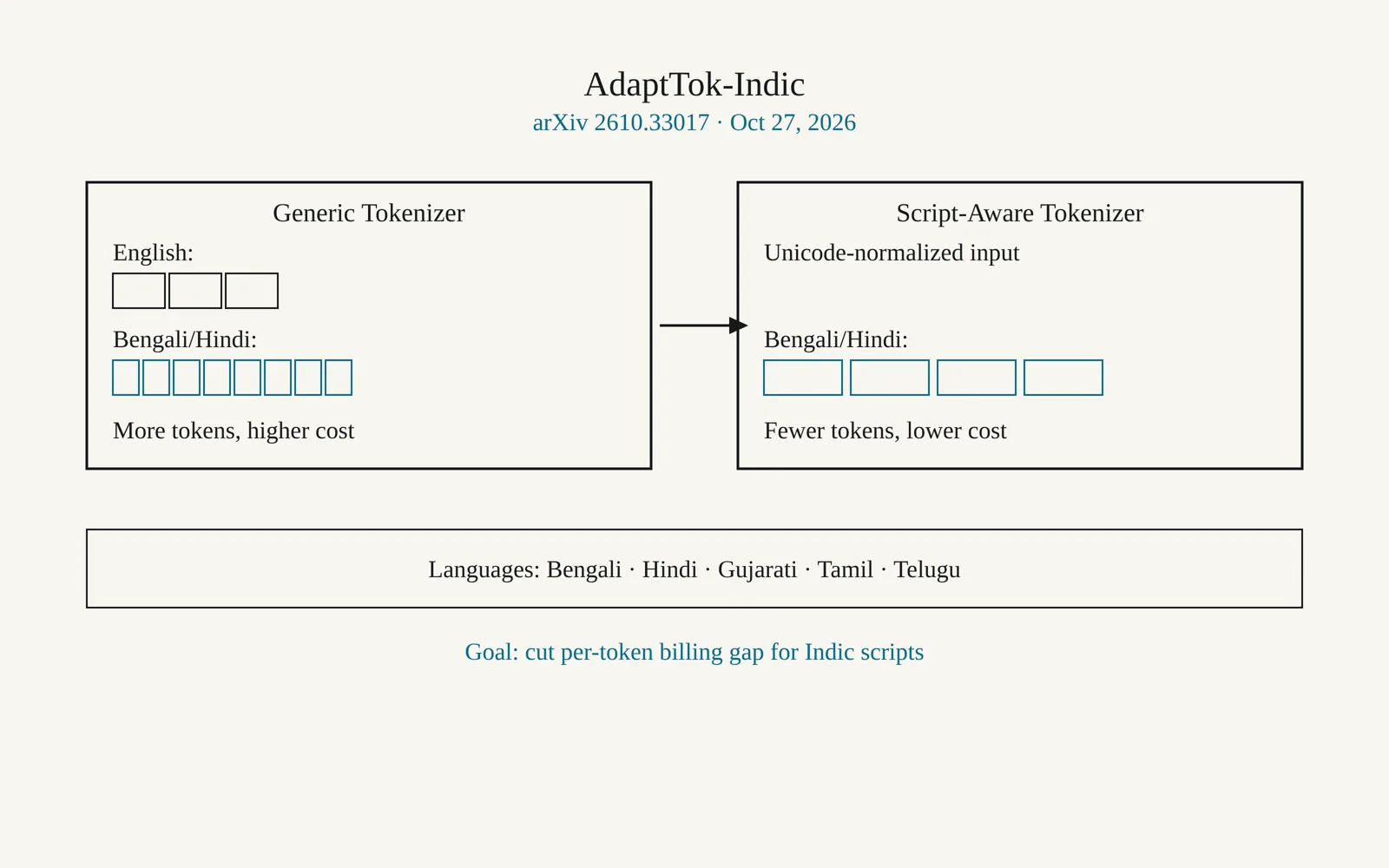
Diagram drawn for this item: Paper Presents Script-Aware Tokenizer For Indic Languages. On October 27, 2026, researchers posted a preprint on arXiv, numbered 2610.33017, describing AdaptTok-Indic, a script-aware adaptive tokenizer built for Bengali, Hindi, Gujarati, Tamil and Telugu text, which combines Unicode-normalized... Multilingual tokenizers trained mostly on English text tend to chop Bengali or Hindi sentences into far more pieces than an equivalent English sentence, so every prompt and response in those languages costs more against a token-based bill...
The numbers
Bengali fertility
1.432
Mean token fertility for Bengali across five recorded seeds
Hindi fertility
1.388
Mean token fertility for Hindi across five recorded seeds
SentencePiece BPE Bengali
2.156
Baseline mean fertility for Bengali
Downstream score
57.69
Average recorded downstream score on evaluated Indic settings
What it means for you
Multilingual tokenizers trained mostly on English text tend to chop Bengali or Hindi sentences into far more pieces than an equivalent English sentence, so every prompt and response in those languages costs more against a token-based bill and leaves less room under a fixed context window. If a method like this one holds up at larger scale, a developer serving Indic language users could see shorter encoded sequences for the same sentence, which changes how far a fixed token budget stretches and how a usage-based invoice adds up for that user base.
In more detail
Tokenization is the first thing that happens to any piece of text an AI model reads, and it is also the step that decides how much a prompt in a given language actually costs. A new preprint, posted to arXiv on October 8, 2026 and recorded here on October 27, 2026, tackles a problem that has sat quietly under multilingual AI systems for years: tokenizers trained mostly on English corpora tend to break Bengali, Hindi and other Indic-script text into noticeably more pieces than an English sentence carrying the same meaning.
The paper, titled AdaptTok-Indic, extends an approach called adaptive tokenization with features aimed squarely at Indic scripts. It applies Unicode normalization before anything else happens, adds explicit handling for Indic conjunct characters, which are compound letterforms that standard byte-pair tokenizers often split in ways that do not match how a reader would parse the word, and routes text through script-aware logic paired with a learned byte-level boundary predictor. All of this is trained jointly with a small Transformer language model rather than bolted on afterward.
The authors tested the method on Bengali and Hindi as primary targets, with further evaluation on Gujarati, Tamil and Telugu. They compared it against SentencePiece BPE, an existing Indic-oriented tokenizer, and their own implementation of a MAGNET-style baseline.
The numbers
Across five recorded seeds, mean token fertility, a measure of how many tokens a tokenizer needs per word, came to 1.432 for Bengali and 1.388 for Hindi under AdaptTok-Indic, against 2.156 and 2.085 for SentencePiece BPE on the same languages. Recorded downstream task scores averaged 57.69 on the evaluated Indic settings versus 50.82 for the SentencePiece BPE setup. The authors note that independent verification runs using the released prototype reproduced the same directional pattern.
The paper is careful to flag its own limits. It describes the current implementation as a small-scale prototype with documented simplifications, and says no statistical significance testing, no comparison against a released MAGNET model, and no evaluation on code-mixed text, where speakers blend languages within a single sentence, has been carried out yet. Those gaps matter for anyone deciding whether to build on these results now or wait for a larger-scale version with significance testing attached.
Sources
Sources read
Cite this
AI Journey, "Paper Presents Script-Aware Tokenizer For Indic Languages", 28 Oct 2026, https://aijourney.space/updates/2026-10-28-adapttok-indic-script-aware-adaptive-tokenization-for-indic-languages/ (source: arXiv, verified 28 Oct 2026)
Next in the stream
OpenAI Expands Oracle Partnership To Bring Apps Into ChatGPT
OpenAI is widening its partnership with Oracle so Oracle's business applications and AI agents appear directly inside ChatGPT for enterprise users.
Previous
Anthropic Expands GSA Partnership With 40% Government Discount
Anthropic struck a new agreement with the US General Services Administration that gives government buyers a 40% discount on Claude Enterprise, Claude for Government and the Claude API.
Next
More in Research
Perplexity AI Researchers Detail LoRA Recipe For Converting Four Language Models To Diffusion
A paper associated with Perplexity AI describes BYOD, a LoRA-only method that converts standard autoregressive language models into diffusion language models without full retraining.
Gemini Negotiation Paper Finds Persona Effects Shift By Language
A new paper testing Google's Gemini model in buyer-seller negotiations found that the same persona instruction produced different deal outcomes in English and Korean.
Paper Finds Gemini Monitor Beats Small Models At Spotting Reward Hacking
A new paper tests whether Google's Gemini 3.1 Flash-Lite can tell real reward hacking apart from honest failure better than small local monitors.