Event Published Models and productsGoogle
Google ships Gemini 3.8 Live and 3.8 Live Extended Thinking
Google released two new Gemini voice models on September 15, 2026, adding faster live dialogue and a slower reasoning mode for complex spoken tasks.
What happened
Published here
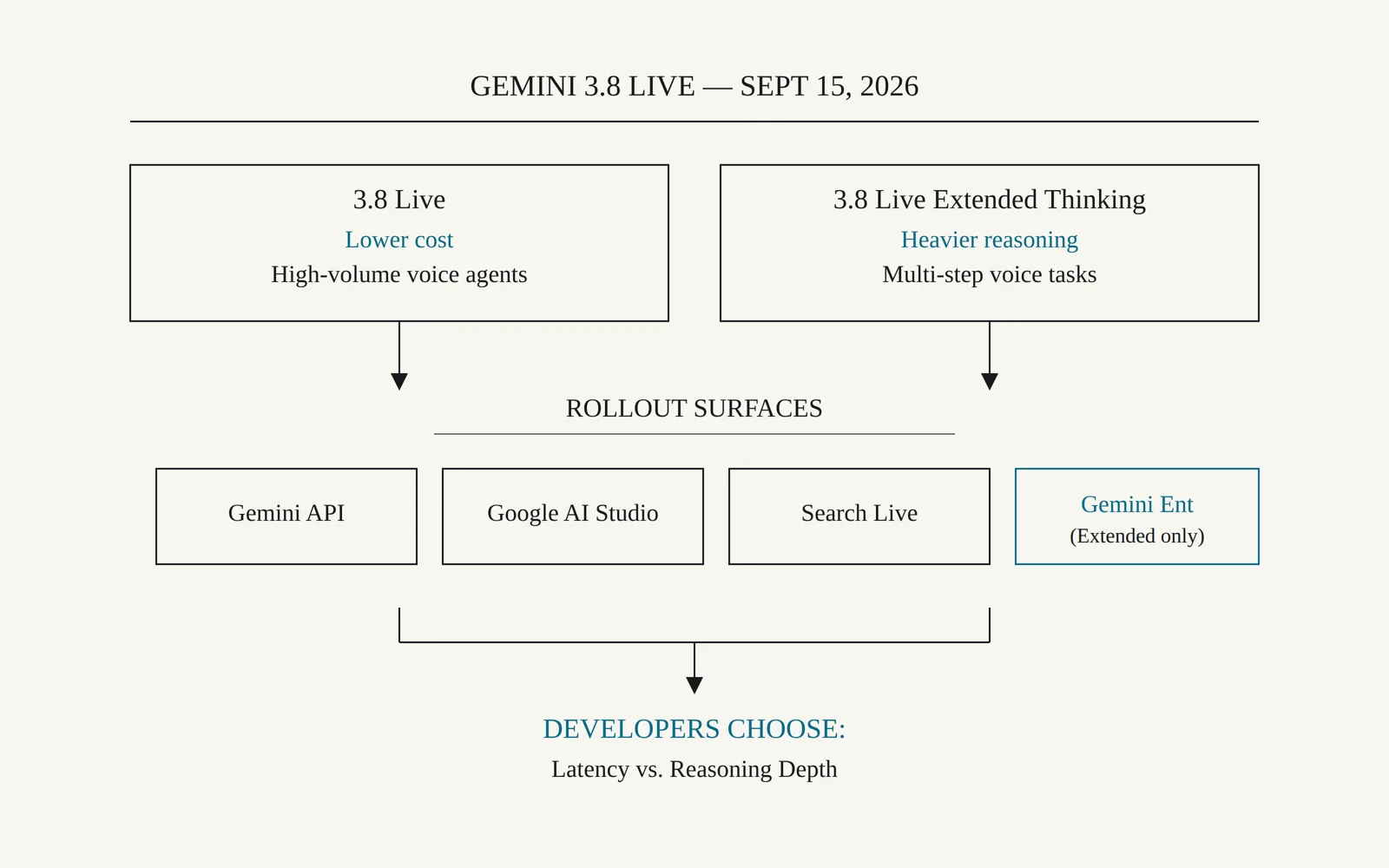
On September 15, 2026, Google introduced Gemini 3.8 Live and Gemini 3.8 Live Extended Thinking, its newest voice dialogue models, through a newsroom post on blog.google. Gemini 3.8 Live is built for fast, low-cost conversation with visual grounding, while Gemini 3.8 Live Extended Thinking reasons and speaks at the same time for multi-step tasks, narrating progress as it works. Both models detect and switch between many supported languages mid-conversation and can run tool calls or API requests in the background without pausing the exchange. Google says the models are rolling out immediately to developers through the Gemini API and Google AI Studio, to enterprises in private preview through Gemini Enterprise, and to consumers through Search Live, the Gemini app, and Google Workspace apps including Docs, Gmail, and Keep. (Google newsroom, Introducing Gemini 3.8 Live and 3.8 Live Extended Thinking, 15 September 2026)
Open the photograph at full size
Photograph: Diagram: AI Journey
Read the full description of this diagram
Diagram drawn for this item: Google ships Gemini 3.8 Live and 3.8 Live Extended Thinking. On September 15, 2026, Google introduced Gemini 3.8 Live and Gemini 3.8 Live Extended Thinking, its newest voice dialogue models, through a newsroom post on blog.google. For a developer choosing a voice model, the split into a fast, cheaper Live tier and a slower Extended Thinking tier is a workflow decision, not just a spec bump.
What it means for you
For a developer choosing a voice model, the split into a fast, cheaper Live tier and a slower Extended Thinking tier is a workflow decision, not just a spec bump. A support bot that only needs to acknowledge a request and hand off to a background tool call fits the plain Live model, while a bot walking a customer through a multi-step booking or a coding task benefits from Extended Thinking's live narration, at whatever added latency and cost that reasoning carries. Google has not published per-token pricing for either model on its public pricing page yet, so buyers evaluating the swap from an older Gemini Live model still have to test cost against their own call volumes before committing.
In more detail
What happened
Google’s newsroom post, published September 15, 2026, describes two new additions to its Gemini Live lineup. Gemini 3.8 Live is pitched at scale and cost efficiency, combining conversational fluency with visual grounding so the model can reference what a camera or screen share shows during a spoken exchange. Gemini 3.8 Live Extended Thinking targets harder tasks: it reasons and speaks in the same turn, using verbal filler such as “let me check that” while it works, and narrates progress through multi-step jobs like coordinating a booking or turning a sketch into working code.
Both models can detect and switch between many supported languages without the user restarting the conversation, and both can hand off tool calls or API requests to run in the background while the spoken exchange continues uninterrupted. Google frames this as the difference between a voice assistant that pauses while it works and one that keeps talking.
Availability is staggered by audience. Developers can access both models today through the Gemini API and Google AI Studio. Enterprise customers get Gemini 3.8 Live in private preview through Gemini Enterprise, with Extended Thinking following for Gemini Enterprise for Customer Experience and Workspace business customers. Consumers reach the plain Live model through Search Live, and Extended Thinking through the Gemini app and, for AI Pro and Ultra subscribers, Docs, Gmail, and Keep.
The numbers
Google’s post cites third-party benchmark placements rather than internal figures. It says Extended Thinking took the top spot on Artificial Analysis’ Speech to Speech Quality Index and posted a strong score on Big Bench Audio, while the plain Live model placed second in the Speech Agent Arena ranking. Google did not publish new per-token API pricing alongside the announcement.
Why it matters
The two-tier split forces a concrete build choice on anyone integrating voice AI. A customer-facing assistant that mostly confirms requests and delegates to background tools has little reason to pay for Extended Thinking’s added reasoning step; a workflow that needs the model to talk a user through a multi-stage process, such as rebooking a flight across several conditional steps, is the case the slower model is built for. Because Google has not listed public per-token prices for either model, teams migrating from an earlier Gemini Live version cannot yet do a clean cost comparison and will need to test against their own traffic before switching.
Sources
Sources read
Google newsroom, Introducing Gemini 3.8 Live and 3.8 Live Extended Thinking, 15 September 2026 (blog.google)
Newsroom read
Cite this
AI Journey, "Google ships Gemini 3.8 Live and 3.8 Live Extended Thinking", 16 Sep 2026, https://aijourney.space/updates/2026-09-16-introducing-gemini-3-8-live-and-3-8-live-extended-thinking/ (source: Google, verified 16 Sep 2026)
Next in the stream
Google Adds Real-Time Voice Chat and Quiz Tools to Gemini Notebook
Google rolled out new Gemini Notebook study tools on September 15, 2026, adding voice chat, quizzes, flashcards and short video summaries.
Previous
Anthropic's Claude Opus 4.8 Inspects Safety Evidence Nearly by Default, New Benchmark Finds
A new benchmark called SAFE tests whether frontier models seek out safety evidence before acting, and finds Anthropic's Claude models inspect readily while OpenAI's o3 skips more often.
Next
More in Google
Google.org Funds Five Groups Building AI Tools For Teachers
Google.org is funding five organizations building AI tools for teachers, pairing Google DeepMind's model work with grants aimed at classroom use.
Gemini Negotiation Paper Finds Persona Effects Shift By Language
A new paper testing Google's Gemini model in buyer-seller negotiations found that the same persona instruction produced different deal outcomes in English and Korean.
Paper Finds Gemini Monitor Beats Small Models At Spotting Reward Hacking
A new paper tests whether Google's Gemini 3.1 Flash-Lite can tell real reward hacking apart from honest failure better than small local monitors.