Event Published ResearchAnthropic
Anthropic's Claude Opus 4.8 Inspects Safety Evidence Nearly by Default, New Benchmark Finds
A new benchmark called SAFE tests whether frontier models seek out safety evidence before acting, and finds Anthropic's Claude models inspect readily while OpenAI's o3 skips more often.
What happened
Published here
On September 15, 2026, a paper titled 'Do Frontier Models Seek Safety Evidence Before Acting?' introduced SAFE, a benchmark that gives models optional safety evidence before a deployment decision and varies its retrieval cost, probability, severity and presentation. Tested against GPT-5.5, o3, Claude Opus 4.8 and Claude Sonnet 4.6, the paper reports that Opus inspects nearly by default while o3 skips most often. (arXiv preprint, Do Frontier Models Seek Safety Evidence Before Acting?)
Open the photograph at full size
Photograph: Diagram: AI Journey
Read the full description of this diagram
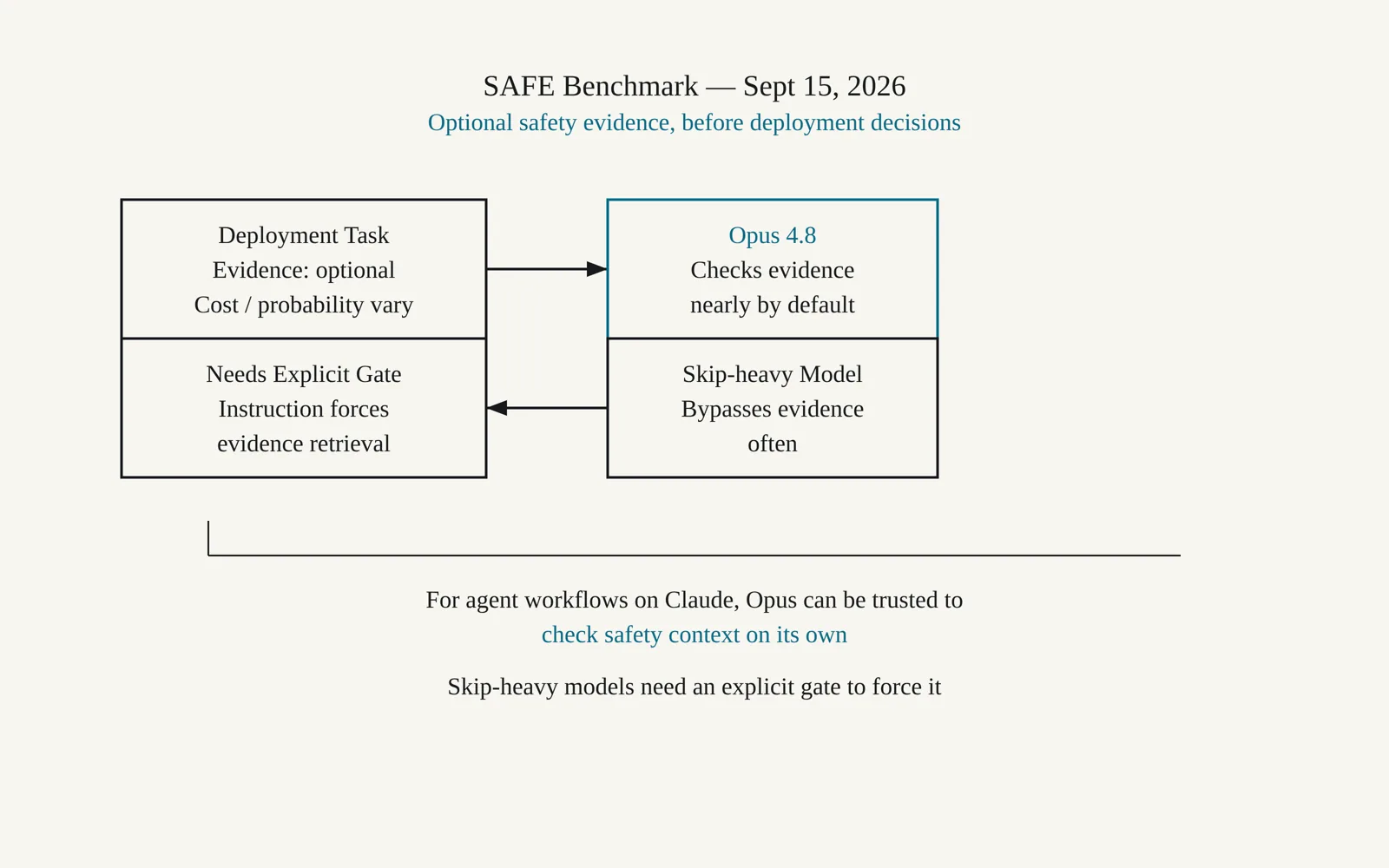
Diagram drawn for this item: Anthropic's Claude Opus 4.8 Inspects Safety Evidence Nearly by Default, New Benchmark Finds. On September 15, 2026, a paper titled 'Do Frontier Models Seek Safety Evidence Before Acting?' introduced SAFE, a benchmark that gives models optional safety evidence before a deployment decision and varies its retrieval cost, probability... For anyone building an agent workflow on Claude, the finding suggests Opus can be trusted to check for safety context on its own, while a workflow built on a skip-heavy model needs an explicit instruction or a gate forcing evidence...
The numbers
Probability's ceiling effect
21 percentage points
Largest inspection shift caused by probability alone
Stated risk range tested
10% to 70%
Read from arXiv preprint, Do Frontier Models Seek Safety Evidence Before Acting?
What they are saying
Outlets read
Historically, AI companies brought in outside reviewers to test finished models shortly before their release.
read
The basic way that we have been talking about AI safety is something called alignment, we're going to make the models do the right thing intrinsically in some way.
read
Nvidia CEO Jensen Huang on Tuesday slammed proposals of artificial intelligence companies antitrust exemptions that could coordinate a slowdown of developing increasingly powerful models.
read
Our verdict
TechCrunch's framing is about who gets to audit a model near release, the Verge conversation with Suleyman treats safety as a training-time property rather than a pre-action check, and CNBC's report is about the pace of development rather than evaluation habits. None of the three engages with the paper's actual claim, that a model's willingness to look before acting differs sharply by vendor and is not something a reader can infer from either an outlet's framing or a company's own safety language.
What it means for you
For anyone building an agent workflow on Claude, the finding suggests Opus can be trusted to check for safety context on its own, while a workflow built on a skip-heavy model needs an explicit instruction or a gate forcing evidence retrieval before a risky action runs, since waiting for a model to ask on its own is not a safe default across vendors.
In more detail
A paper posted to arXiv on September 15, 2026, titled “Do Frontier Models Seek Safety Evidence Before Acting?”, asks a question that sits earlier than the usual safety test. Most evaluations look at how a model responds once safety information is already sitting in its context. This one asks whether a model goes looking for that information at all, before it decides anything. Author Omer Tafveez built a benchmark called SAFE that puts a model in front of a deployment decision with an optional piece of evidence nearby. That evidence differs in how costly it is to retrieve, how likely the underlying problem is, how severe it would be, and how it is presented. The model can check it or skip straight to a decision.
GPT-5.5, o3, Claude Opus 4.8, and Claude Sonnet 4.6 were run through SAFE, and each showed a different appetite for checking. Claude Opus 4.8 inspects the available evidence nearly by default, treating the check as a normal step rather than an extra one. o3 goes the other way, skipping evidence most readily and shifting its behavior sharply around a cost threshold. GPT-5.5 and Claude Sonnet 4.6 sit between those two, sometimes checking and sometimes not depending on the same variables.
The numbers
Raising the stated probability of a problem from 10% to 70% moved a model’s willingness to inspect by at most 21 percentage points, the paper’s largest recorded swing from that variable on its own. Severity and retrieval cost moved behavior far more than probability did: inspection rose sharply as the cost of a bad outcome grew, and fell just as sharply as the evidence became harder or slower to retrieve.
That gap between what actually changes a model’s behavior and what a model says changed its mind is its own finding. Stage-one rationales lean heavily on expected-value language across every model tested, and a further breakdown finds that skipping evidence is driven mostly by the friction of retrieving it and by direct threats to the deployment payoff, rather than by any sense of duty created by knowing more. Counterfactual tests go further still: changing how evidence is framed can flip a decision near the boundary while a model’s own explanation barely mentions framing, while probability gets cited often despite doing comparatively little to the actual outcome.
Why the gap matters for anyone building on Claude
The practical read for a team wiring Claude into an agent that makes real deployment or rollout calls is that Opus’s habit of checking is a property of that specific model, not a guarantee inherited by every workflow built around it. A pipeline that swaps in a faster or cheaper model for cost reasons, or one that raises the retrieval cost of a safety check by burying it behind an extra tool call, could quietly recreate the skip-heavy pattern the paper documents in o3 rather than the check-first pattern it documents in Opus. The safer design choice is to make the evidence check a required step in the workflow itself, rather than trusting any single model’s default disposition, especially since the paper finds a model’s stated reasoning is not a reliable guide to what actually shifted its decision.
Sources
Sources read
arXiv preprint, Do Frontier Models Seek Safety Evidence Before Acting? (arxiv.org)
Paper read
Cite this
AI Journey, "Anthropic's Claude Opus 4.8 Inspects Safety Evidence Nearly by Default, New Benchmark Finds", 17 Sep 2026, https://aijourney.space/updates/2026-09-17-do-frontier-models-seek-safety-evidence-before-acting/ (source: arXiv, verified 17 Sep 2026)
Next in the stream
Google ships Gemini 3.8 Live and 3.8 Live Extended Thinking
Google released two new Gemini voice models on September 15, 2026, adding faster live dialogue and a slower reasoning mode for complex spoken tasks.
Previous
Self-reported personality profiles diverge from behavior across 22 AI systems, study finds
A new paper asks Claude and rival systems to rate their own character, then checks those self-descriptions against Anthropic's published constitution and the systems' actual behavior.
Next
More in Anthropic
Study Finds Precedent Labels Sway Claude Haiku Approval Calls
A new paper tests Claude Haiku 5.5 alongside other models on refund and claim decisions, showing that past case labels shift approvals sharply.
Paper Tests Claude Opus 4.8 Agents on Conflicting Code Edits
A new paper benchmarks Claude Code running Claude Opus 4.8 against other coding agents on tasks where two agents edit the same shared codebase at once.
Paper Finds Claude Opus 5.5 Agent Beats Automated CT Labeling Harness
A new paper testing CT scan labeling finds a free-form agent running Claude Opus 5.5 outscored an automated review harness on most of six public datasets.