Event Published Models and productsNvidia
Nvidia's Physical AI Stack Underpins Skild AI's S1 Robot Model
Nvidia detailed how its simulation, training and inference tools support Skild AI's new S1 robot foundation model, in a post published on September 10, 2026.
What happened
Published here
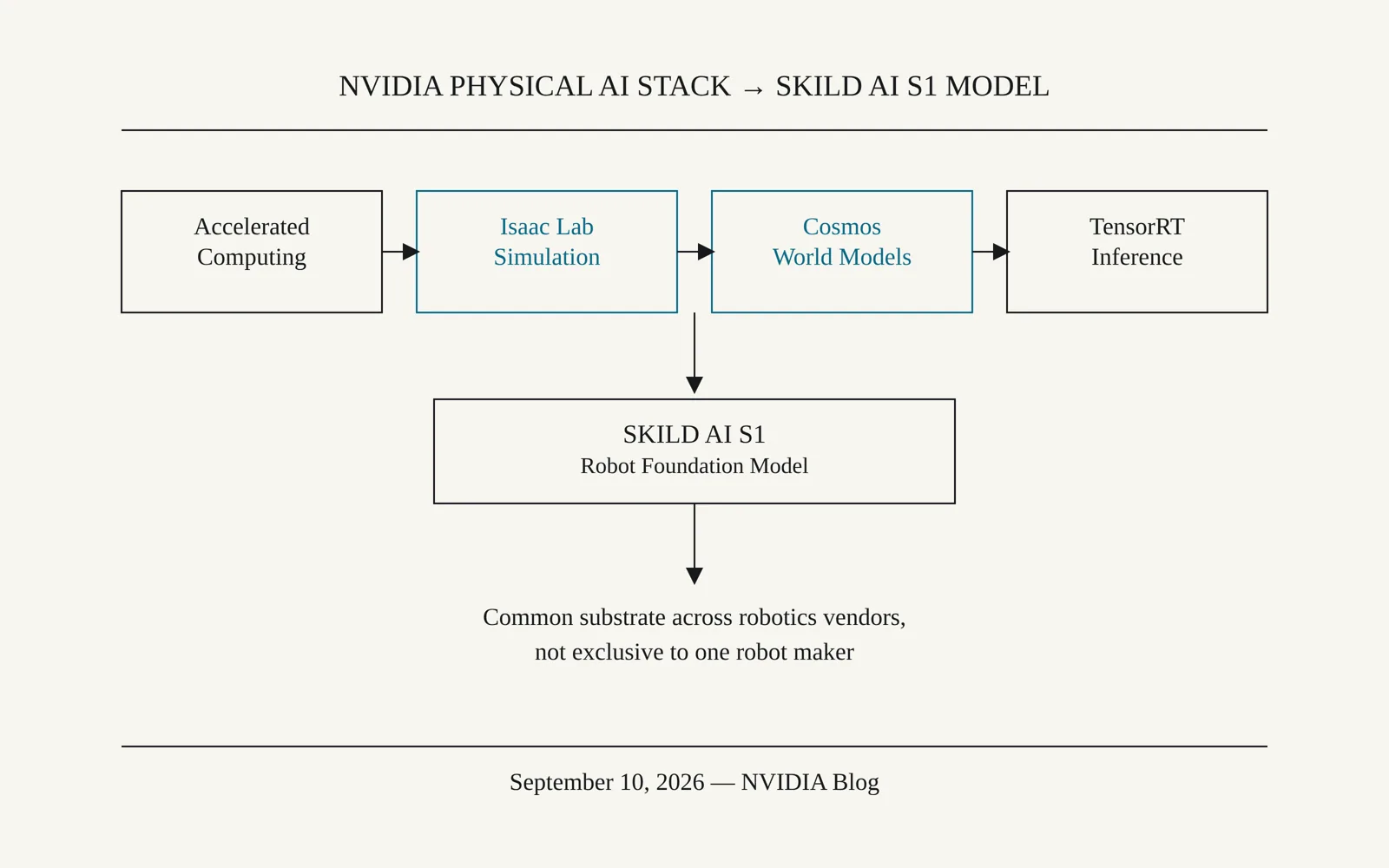
On September 10, 2026, Nvidia published a blog post describing how its accelerated computing, Isaac Lab simulation, Cosmos world models and TensorRT inference software support Skild AI's newly launched S1 robot foundation model, which lets robots learn new tasks from a single video demonstration without retraining or updating model weights. (Nvidia newsroom post on Skild AI's S1 robot model, 10 September 2026)
Open the photograph at full size
Photograph: Diagram: AI Journey
Read the full description of this diagram
Diagram drawn for this item: Nvidia's Physical AI Stack Underpins Skild AI's S1 Robot Model. On September 10, 2026, Nvidia published a blog post describing how its accelerated computing, Isaac Lab simulation, Cosmos world models and TensorRT inference software support Skild AI's newly launched S1 robot foundation model, which lets... For a manufacturer weighing robot software, the case shows Nvidia's simulation-to-deployment stack, Isaac Lab, Cosmos and TensorRT, working as a common substrate several robotics vendors build on rather than a stack tied to one robot...
The numbers
S1 success rate
66%
on new, multistep tasks, per Skild AI's own testing
Comparison system rate
9%
success rate for a similar AI system in the same test
Revenue run rate
$100 million
annualized, reached 10 months after first commercial deployment
Video-to-examples estimate
380
hands-on training examples Skild says one video can replace
Read from Nvidia newsroom post on Skild AI's S1 robot model, 10 September 2026
What it means for you
For a manufacturer weighing robot software, the case shows Nvidia's simulation-to-deployment stack, Isaac Lab, Cosmos and TensorRT, working as a common substrate several robotics vendors build on rather than a stack tied to one robot maker, which affects how portable a customer's training pipeline stays if it later switches foundation model suppliers.
In more detail
What happened
Nvidia’s blog post, published September 10, 2026, walks through the technical partnership behind Skild AI’s S1 robot foundation model, which the startup launched the same week. S1 is designed to learn a previously unseen, long-horizon task from a single video demonstration, using in-context learning rather than task-specific retraining. Nvidia’s post frames the model as a showcase for its physical AI stack: Isaac Lab for reinforcement learning in simulation, Cosmos for turning video into structured training data, Omniverse and Isaac Sim for physically based virtual testing, and TensorRT for optimizing inference once a model reaches a real robot. Nvidia also says it and Skild are jointly building new GPU-accelerated simulation solvers for modeling how robots grip and manipulate objects, due to ship inside Newton for other developers later.
The numbers
Skild AI told Nvidia that S1 succeeded on 66% of steps in new, multistep tasks, against 9% for a comparison AI system, a gap Nvidia calls more than sevenfold. Skild also estimates that one short video demonstration can be worth roughly 380 hands-on training examples, work it says would otherwise take 50 to 100 hours to collect by hand. The company separately cites a $100 million annualized revenue run rate, reached 10 months after its first commercial deployment, alongside deployment work spanning manufacturing, logistics, inspection, security and food preparation. One demonstrated use case has Skild’s dual-arm manipulators assembling Nvidia Blackwell hardware at a Foxconn facility.
What this means
The figures above come from Skild, not from an independent benchmark, so they describe what one vendor reports about its own model rather than a verified industry comparison. What is verifiable is the toolchain: Nvidia is positioning Isaac Lab, Cosmos and TensorRT as infrastructure that a robotics company can adopt end to end, from synthetic data generation through simulation to deployment, without building that pipeline itself. That matters for buyers because it lowers the cost of trying a new robot foundation model vendor, since the simulation and training tooling underneath is shared rather than proprietary to any single robotics company. It also means a customer’s downstream cost structure is tied partly to Nvidia’s hardware and software choices, not only to whichever robot brain sits on top of them.
Sources
- Skild AI Taps NVIDIA Physical AI to Teach Robots New Tasks From a Single Video, Nvidia newsroom, fetched September 16, 2026.
Sources
Sources read
Nvidia newsroom post on Skild AI's S1 robot model, 10 September 2026 (blogs.nvidia.com)
Newsroom read
Cite this
AI Journey, "Nvidia's Physical AI Stack Underpins Skild AI's S1 Robot Model", 16 Sep 2026, https://aijourney.space/updates/2026-09-16-skild-ai-taps-nvidia-physical-ai-to-teach-robots-new-tasks-from-a-single/ (source: Nvidia, verified 16 Sep 2026)
Next in the stream
Mistral raises €3 billion at a post-money valuation above €21 billion
Samsung Electronics led the round, with Advent, BlackRock funds and Luxembourg new on the register, and Mistral's published API prices did not move with it.
Previous
Gemini subscription page keeps its prices and states a 5 hour limit refresh
Our poll found Google's United States subscription page changed. The prices our table records still stand, and the page states how the Gemini usage limit refreshes.
Next
More in Nvidia
Nvidia RTX Spark Laptops Add Transcription Model and New Game Support
Nvidia detailed new RTX Spark laptop updates, including a transcription model from its Nemotron line and support for Liquid AI's LFM3 models.
Nvidia Launches Minerva Platform for AI Factory Observability
Nvidia introduced Minerva, an AIOps platform that merges infrastructure and workload telemetry to flag problems across AI factories before they spread.
Nvidia Expands Agent Toolkit With Data Grounding Tools
Nvidia expanded its open source Agent Toolkit on October 21, 2026, adding an Agent Knowledge Foundation that grounds enterprise agents in company data without moving it.