Event Published Models and productsNvidia
Nvidia Details Local Agent Tools and RTX Spark PCs for IFA 2026
Nvidia used IFA 2026 to detail faster local inference, a network-wide AI router, and RTX Spark PCs shipping in October.
What happened
Published here
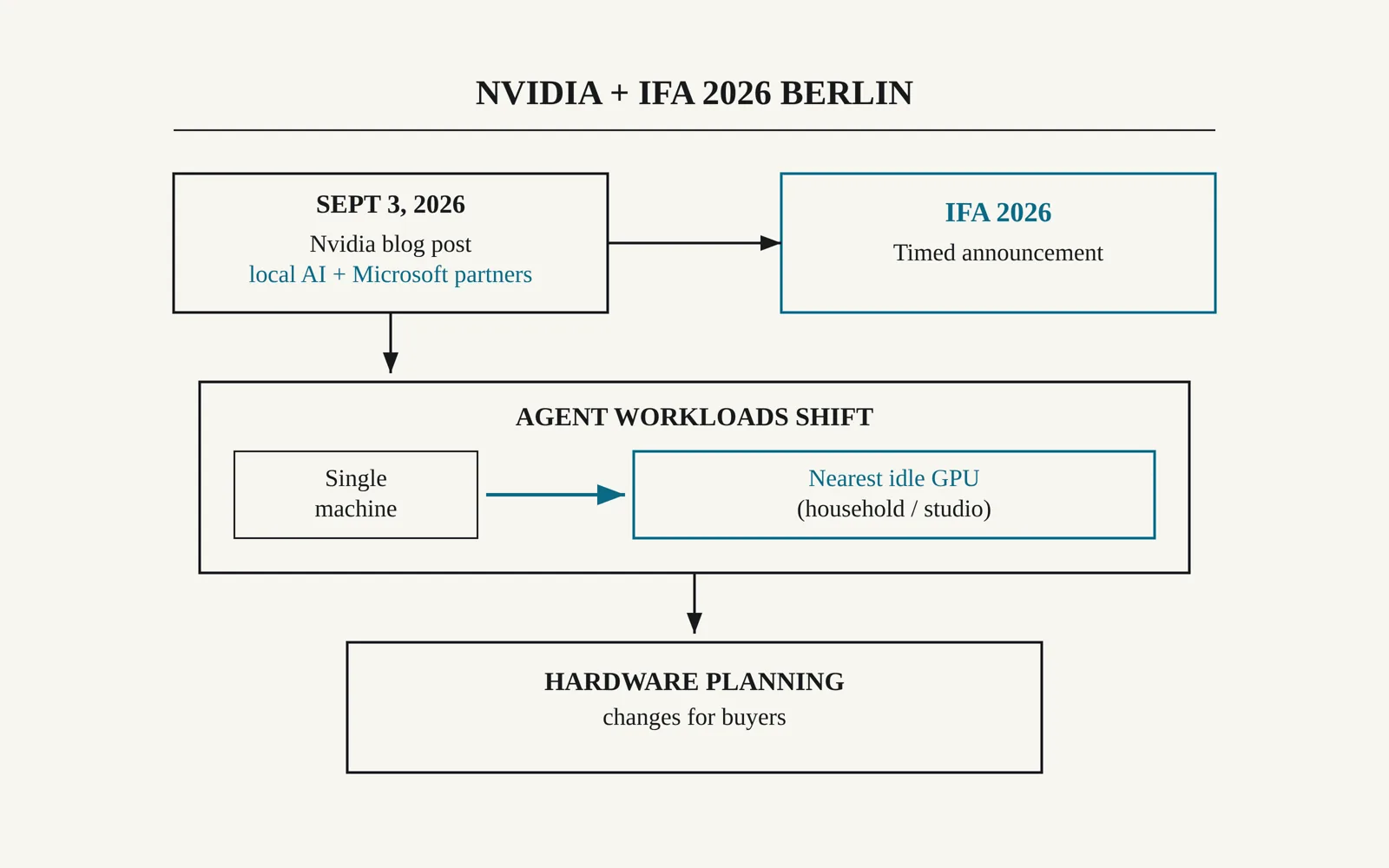
On September 3, 2026, Nvidia published a blog post timed to IFA 2026 in Berlin describing a set of local AI upgrades built with Microsoft and software partners. Hermes Agent, OpenClaw, and Perplexity Portable Computer are gaining simplified setup for local models on Nvidia GPUs, removing manual steps like picking a model, choosing an inference server, and tuning quantization. Nvidia also said llama.cpp and vLLM optimizations, available now and through LM Studio and Ollama, raise local inference throughput. A new tool called NVIDIA PAIR (Personal AI Router) distributes inference jobs across multiple PCs on a home network. Compact NVIDIA RTX Spark Windows PCs from Lenovo and Acer are set to arrive in October. (Nvidia blog post on local AI announcements at IFA 2026, September 3, 2026)
Open the photograph at full size
Photograph: Diagram: AI Journey
Read the full description of this diagram
Diagram drawn for this item: Nvidia Details Local Agent Tools and RTX Spark PCs for IFA 2026. On September 3, 2026, Nvidia published a blog post timed to IFA 2026 in Berlin describing a set of local AI upgrades built with Microsoft and software partners. The announcement pushes agent workloads off a single machine and onto whatever idle GPU is nearby, which changes how a household or small studio plans hardware purchases.
The numbers
llama.cpp throughput gain
1.9x
On a GeForce RTX 5090, via kernel and speculative decoding optimizations
vLLM gain on DGX Spark cluster
1.4x
On two DGX Spark systems clustered together
OpenClaw GitHub stars
380K
Described as the largest AI project on GitHub
Read from Nvidia blog post on local AI announcements at IFA 2026, September 3, 2026
What it means for you
The announcement pushes agent workloads off a single machine and onto whatever idle GPU is nearby, which changes how a household or small studio plans hardware purchases. Instead of buying one powerful workstation to run an agent all day, PAIR lets several existing RTX PCs share the load, and the simplified setup in Hermes Agent and OpenClaw lowers the technical bar for running models locally rather than through a cloud subscription. That combination matters for anyone weighing a local RTX Spark purchase against continued reliance on hosted inference, since it shifts part of the cost and privacy calculation toward hardware already sitting idle in a home network.
In more detail
The numbers
Nvidia’s post ties its throughput claims to specific hardware rather than general marketing language. The llama.cpp backend gets up to a 1.9x speedup on a GeForce RTX 5090 through kernel changes, better speculative decoding, and faster prefill. The vLLM backend gets 1.2x on an RTX PRO 6000 Blackwell Workstation Edition card and up to 1.4x across two clustered DGX Spark systems, helped by new XQA attention kernels in FlashInfer. Both backends already ship the optimizations, and the gains carry through to users running models via LM Studio or Ollama rather than requiring a separate download.
The hardware side of the announcement centers on NVIDIA RTX Spark, a compact Windows PC built around what Nvidia calls a 1 Petaflop RTX Blackwell GPU paired with a 20-core Grace CPU and up to 128GB of unified memory. Lenovo and Acer are building machines around it, joining OEMs that committed earlier in the year, and the first units are due in October alongside a Windows Agent framework meant to let agents run in the background under OS-level control.
PAIR itself is free and open source, distributed as a beta for Windows, macOS, and Linux, and works across GeForce RTX 20-series GPUs and newer, RTX PRO workstation cards from the Turing generation on, DGX Spark, and Apple M4 or newer silicon. It only routes jobs between machines already running Ollama or LM Studio, so it adds no new inference engine of its own, just a scheduler that notices when a task’s home GPU is busy and points it at whichever machine on the network has spare capacity.
None of this is priced or licensed separately from the hardware it runs on, so the practical effect for now is limited to owners of recent Nvidia silicon willing to run the beta software. Nvidia’s post does not disclose adoption figures for PAIR or say how many households the router has actually reached since release, leaving open how much of the “idle PC” capacity it describes gets used in practice.
Sources
Sources read
Nvidia blog post on local AI announcements at IFA 2026, September 3, 2026 (blogs.nvidia.com)
Newsroom read
Cite this
AI Journey, "Nvidia Details Local Agent Tools and RTX Spark PCs for IFA 2026", 16 Sep 2026, https://aijourney.space/updates/2026-09-16-sparks-fly-nvidia-accelerates-local-ai-at-ifa-2026/ (source: Nvidia, verified 16 Sep 2026)
Next in the stream
GPT-6 Astra reaches general availability in Microsoft Foundry
Microsoft has put OpenAI's GPT-6 Astra into general availability in Foundry, with published token prices that double for long context and rise again in the US Data Zone.
Previous
Paper Tests Polynomial Shortcuts For Nvidia GPU Transcendentals
A new paper tests short polynomial programs as a faster substitute for sigmoid, tanh and SiLU operations on Nvidia's Blackwell and GB200 GPUs.
Next
More in Nvidia
Nvidia RTX Spark Laptops Add Transcription Model and New Game Support
Nvidia detailed new RTX Spark laptop updates, including a transcription model from its Nemotron line and support for Liquid AI's LFM3 models.
Nvidia Launches Minerva Platform for AI Factory Observability
Nvidia introduced Minerva, an AIOps platform that merges infrastructure and workload telemetry to flag problems across AI factories before they spread.
Nvidia Expands Agent Toolkit With Data Grounding Tools
Nvidia expanded its open source Agent Toolkit on October 21, 2026, adding an Agent Knowledge Foundation that grounds enterprise agents in company data without moving it.