What happened
Published here
On September 3, 2026, researcher Robert Hu submitted a paper to arXiv testing whether short polynomial programs can replace native sigmoid, tanh and SiLU functions on Nvidia Blackwell and GB200 hardware, following the special-function imbalance that FlashAttention-4 exposed on the same chips. (arXiv paper, Fast Polynomial Transcendentals for LLMs, submitted September 3, 2026)
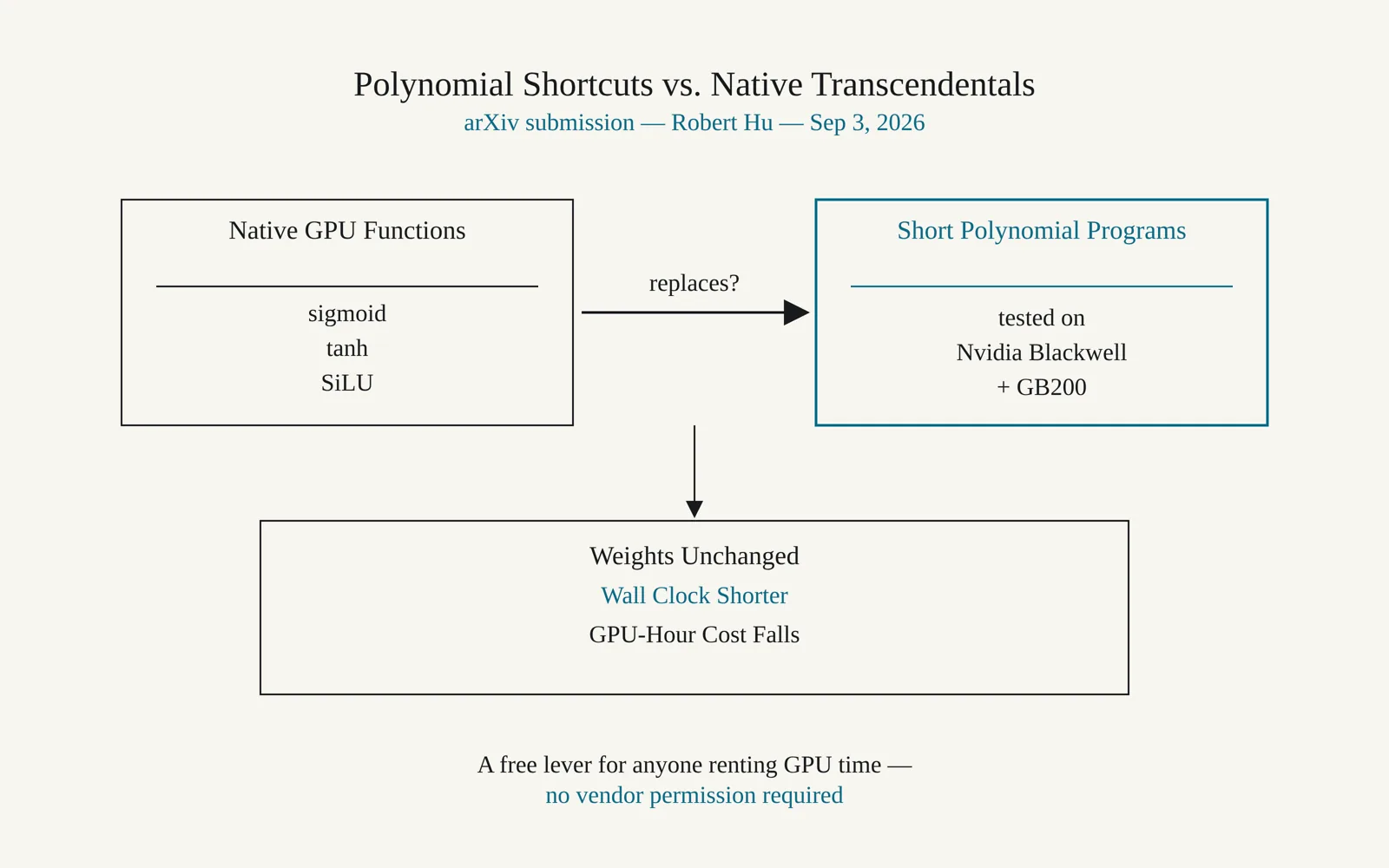
Open the photograph at full size
Photograph: Diagram: AI Journey
Read the full description of this diagram
Diagram drawn for this item: Paper Tests Polynomial Shortcuts For Nvidia GPU Transcendentals. On September 3, 2026, researcher Robert Hu submitted a paper to arXiv testing whether short polynomial programs can replace native sigmoid, tanh and SiLU functions on Nvidia Blackwell and GB200 hardware, following the special-function... For teams renting Nvidia GPU time by the hour, a kernel trick that trims a training step's wall clock without touching model weights is a cost lever nobody has to ask a vendor to grant, and it arrives for free the moment somebody publishes...
What it means for you
For teams renting Nvidia GPU time by the hour, a kernel trick that trims a training step's wall clock without touching model weights is a cost lever nobody has to ask a vendor to grant, and it arrives for free the moment somebody publishes the recipe rather than waits for a driver update.
In more detail
A paper posted to arXiv on September 3, 2026 asks a narrow question about Nvidia’s newest training hardware: can a short polynomial formula, hand tuned and packed into fused multiply add instructions, do the job of the native sigmoid, tanh and SiLU functions faster than the chip’s own special-function unit. The author, Robert Hu, frames the work as a follow-on to FlashAttention-4, which had already shown that attention kernels on Blackwell hit a special-function bottleneck rather than a matrix-math one as GPU generations scale their pipelines at different rates.
The testing ran in two stages. First came an isolated sweep in FP16, comparing native PyTorch evaluation against the packed polynomial programs across working sets that fit in L2 cache and working sets that spill to high-bandwidth memory. Then came integration: the polynomial substitutes, written in BF16 at degree 3 or degree 4, were dropped into four real GB200 training tasks, dense SiLU, tanh-softcapped attention, sigmoid attention and routed-expert SwiGLU, the layer type used inside mixture-of-experts models.
The paper does not stop at speed. It also ran same-checkpoint ablations and one paired pre-training comparison for each of the four tasks, tracking whether swapping the math changes what the model learns. At a common horizon near 100 billion tokens, the smoothed training-loss difference between the polynomial and native versions ranged from a small negative shift to a small positive one across the four tasks, which the author reads as the substitution leaving model behavior effectively unchanged while the clock keeps moving faster.
The numbers
In the isolated FP16 sweep, the polynomial path improved performance between 1.19 and 2.19 times in L2-resident cases and between 1.00 and 1.70 times when the working set lived in high-bandwidth memory. Inside full GB200 training runs, the routed-expert SwiGLU substitution gave the largest complete training-step throughput gain, 8.0%, ahead of tanh-softcapped attention at 2.9% and dense SiLU at 2.7%. The sigmoid-attention swap raised complete-attention forward throughput by 7.4%, though that narrowed to 0.3% once measured across the whole GPU step rather than attention alone.
None of this changes a price list or a quota a reader of this site tracks directly. What it points to is that gains on fixed Nvidia hardware are still being found in software, through kernel-level substitutions rather than new silicon, which matters for anyone deciding whether the next speed-up in their training bill comes from a newer GPU generation or from a library update on the one they already rent.
Sources
Sources read
arXiv paper, Fast Polynomial Transcendentals for LLMs, submitted September 3, 2026 (arxiv.org)
Paper read
Cite this
AI Journey, "Paper Tests Polynomial Shortcuts For Nvidia GPU Transcendentals", 4 Oct 2026, https://aijourney.space/updates/2026-10-04-fast-polynomial-transcendentals-for-llms/ (source: arXiv, verified 4 Oct 2026)
Next in the stream
Nvidia Details Local Agent Tools and RTX Spark PCs for IFA 2026
Nvidia used IFA 2026 to detail faster local inference, a network-wide AI router, and RTX Spark PCs shipping in October.
Previous
Google puts Lyria 3.5 music generation in the Gemini app at no charge
Google has added Lyria 3.5 music generation to the free Gemini app and its API, but the launch announcement gives users no published usage limit.
Next
More in Nvidia
Nvidia RTX Spark Laptops Add Transcription Model and New Game Support
Nvidia detailed new RTX Spark laptop updates, including a transcription model from its Nemotron line and support for Liquid AI's LFM3 models.
Nvidia Launches Minerva Platform for AI Factory Observability
Nvidia introduced Minerva, an AIOps platform that merges infrastructure and workload telemetry to flag problems across AI factories before they spread.
Nvidia Expands Agent Toolkit With Data Grounding Tools
Nvidia expanded its open source Agent Toolkit on October 21, 2026, adding an Agent Knowledge Foundation that grounds enterprise agents in company data without moving it.