What happened
Published here
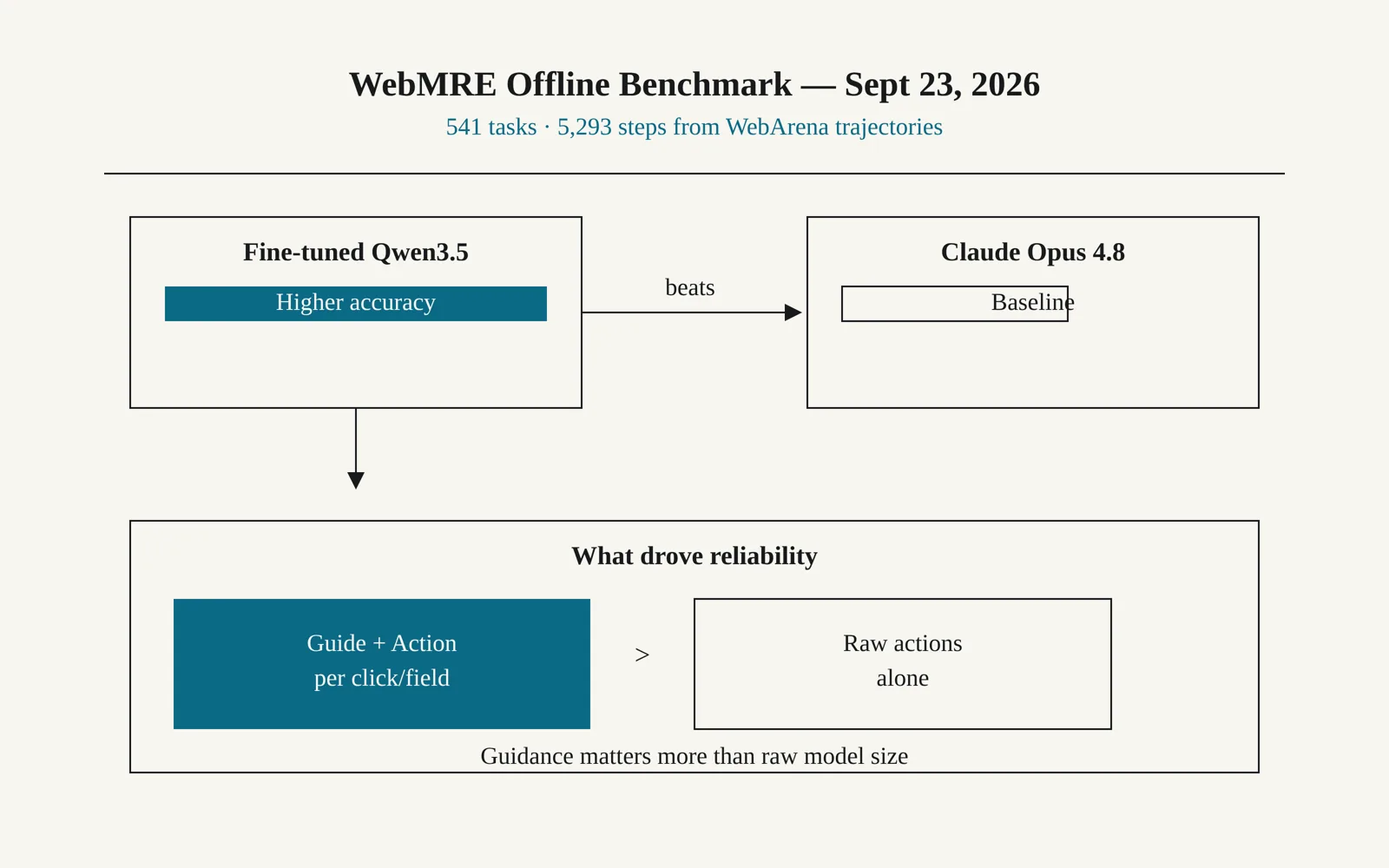
On September 23, 2026, researchers released a paper introducing WebMRE, an offline benchmark of 541 tasks and 5,293 steps drawn from successful WebArena trajectories, reporting that a fine-tuned Qwen3.5 model outperformed Claude Opus 4.8, GPT-5.5 and Gemini 3.5 Flash, each run zero shot, on every offline metric the study measured. (arXiv paper 2609.27353, Guides That Cause Actions, submitted September 23, 2026)
Open the photograph at full size
Photograph: Diagram: AI Journey
Read the full description of this diagram
Diagram drawn for this item: New Offline Benchmark Study Shows Fine-Tuned Model Beating Claude Opus 4.8. On September 23, 2026, researchers released a paper introducing WebMRE, an offline benchmark of 541 tasks and 5,293 steps drawn from successful WebArena trajectories, reporting that a fine-tuned Qwen3.5 model outperformed Claude Opus 4.8... For teams building browser automation, the result suggests that pairing a short natural language guide with each click or field entry, rather than training on raw actions alone, can matter more for reliability than simply reaching for a...
The numbers
Benchmark tasks
541
Tasks in the WebMRE offline benchmark
Benchmark steps
5,293
Steps derived from WebArena trajectories
Accuracy without gold guide
.422
Action accuracy before the gold guide was forced as a decoding prefix
Accuracy with gold guide
.684
Action accuracy after the gold guide was forced as a decoding prefix
Read from arXiv paper 2609.27353, Guides That Cause Actions, submitted September 23, 2026
What it means for you
For teams building browser automation, the result suggests that pairing a short natural language guide with each click or field entry, rather than training on raw actions alone, can matter more for reliability than simply reaching for a larger paid API model, since a smaller fine-tuned system beat three widely used commercial systems here, a finding worth weighing before a team defaults to the priciest model on a workflow.
In more detail
A group of researchers, Chengguang Gan, Yunhao Liang, QingHao Zhang and Shiwen Ni, published a paper on September 23, 2026, describing a new way to test web browsing agents without the drift that live environments introduce. Their argument is that scoring agents in a live browser is unreliable because the page state and the judge model change between runs, so the same checkpoint can score differently each time it is tested. Their fix, called WebMRE, replays 541 tasks and 5,293 steps taken from successful WebArena trajectories offline, with labels checked by hand, so a checkpoint gets the identical score on every run.
Each step in the benchmark pairs a plain language guide sentence, the kind a person would write to explain what to click next, with the grounded action a model actually needs to take. That pairing let the team study what they call a mutual reinforcement effect between the instruction and the action. Decoding a guide alongside the action raised element selection accuracy over an action-only baseline, and the size of that lift grew with model scale, from small gains on a 4 billion parameter Qwen3.5 model to larger gains on a 9 billion parameter version.
A follow-up test went further: forcing the correct guide sentence as a decoding prefix raised action accuracy sharply, while forcing a mismatched guide from a different step collapsed it near zero, and a reworded version of the correct guide still recovered about half the gain. That pattern is the paper’s evidence that the guide text carries real instruction meaning rather than just repeating the name of the target element.
The authors also report that models they fine-tuned using these findings beat GPT-5.5, Claude Opus 4.8 and Gemini 3.5 Flash, all tested zero shot with no extra tuning, across every metric the offline benchmark measures.
The numbers
The benchmark totals 541 tasks and 5,293 steps. On the mediation test, forcing the correct guide sentence as a decoding prefix raised action accuracy from .422 to .684, while swapping in another step’s guide dragged accuracy down to .055, showing how much of the model’s performance rests on reading the instruction rather than guessing from the screen alone.
Sources
Sources read
arXiv paper 2609.27353, Guides That Cause Actions, submitted September 23, 2026 (arxiv.org)
Paper read
Cite this
AI Journey, "New Offline Benchmark Study Shows Fine-Tuned Model Beating Claude Opus 4.8", 25 Sep 2026, https://aijourney.space/updates/2026-09-25-guides-that-cause-actions-an-offline-study-of-guide-action-mutual-reinfo/ (source: arXiv, verified 25 Sep 2026)
Next in the stream
Gemini Adds Connected Apps From Adobe, Airtable and Peloton
Google began rolling out a new wave of Connected Apps inside Gemini, letting the assistant reach into productivity, creative and lifestyle tools without switching tabs.
Previous
Google Adds Live Avatar to Gemini 3.8 Live for Enterprise
Google added Live Avatar to Gemini 3.8 Live, giving its conversational AI a real-time animated face for enterprise customer service and support tasks.
Next
More in Anthropic
Study Finds Precedent Labels Sway Claude Haiku Approval Calls
A new paper tests Claude Haiku 5.5 alongside other models on refund and claim decisions, showing that past case labels shift approvals sharply.
Paper Tests Claude Opus 4.8 Agents on Conflicting Code Edits
A new paper benchmarks Claude Code running Claude Opus 4.8 against other coding agents on tasks where two agents edit the same shared codebase at once.
Paper Finds Claude Opus 5.5 Agent Beats Automated CT Labeling Harness
A new paper testing CT scan labeling finds a free-form agent running Claude Opus 5.5 outscored an automated review harness on most of six public datasets.