Event Published Models and productsGoogle
Google Adds Live Avatar to Gemini 3.8 Live for Enterprise
Google added Live Avatar to Gemini 3.8 Live, giving its conversational AI a real-time animated face for enterprise customer service and support tasks.
What happened
Published here
On September 24, 2026, Google introduced Gemini 3.8 Live with Live Avatar, a feature that pairs its native live dialogue model with near real-time video generation so the assistant listens, sees and speaks through an animated visual persona, available now in Gemini Enterprise. (Google newsroom post introducing Gemini 3.8 Live with Live Avatar, published September 24, 2026)
Open the photograph at full size
Photograph: Diagram: AI Journey
Read the full description of this diagram
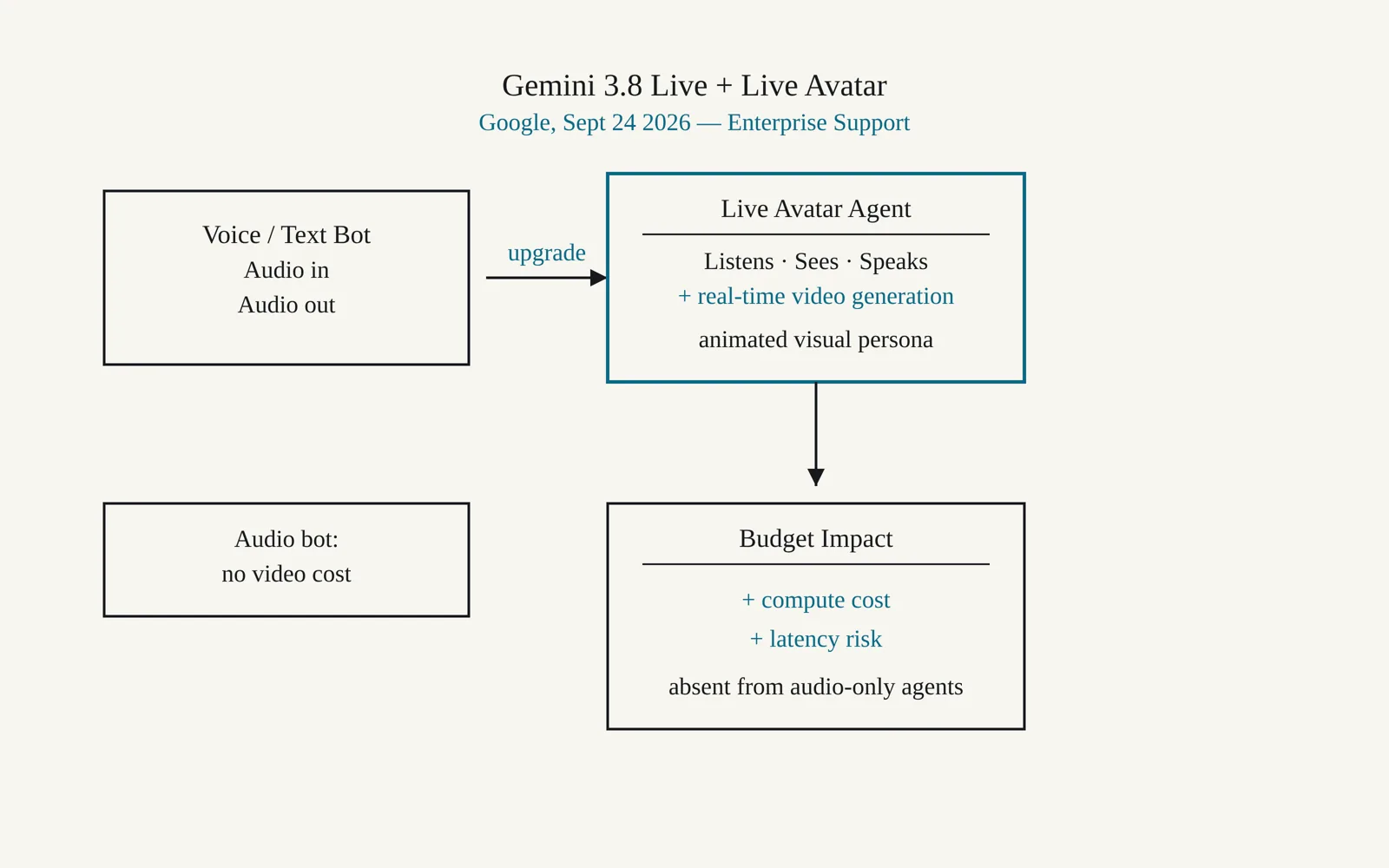
Diagram drawn for this item: Google Adds Live Avatar to Gemini 3.8 Live for Enterprise. On September 24, 2026, Google introduced Gemini 3.8 Live with Live Avatar, a feature that pairs its native live dialogue model with near real-time video generation so the assistant listens, sees and speaks through an animated visual... A support desk that swaps a text or voice bot for an animated face changes what a buyer has to budget for: video generation adds compute cost and latency risk that a plain audio agent never carried, so an enterprise choosing this over the...
What it means for you
A support desk that swaps a text or voice bot for an animated face changes what a buyer has to budget for: video generation adds compute cost and latency risk that a plain audio agent never carried, so an enterprise choosing this over the week-old Gemini 3.8 Live has to weigh a richer interaction against a slower or pricier one, especially at the scale a customer service queue demands.
In more detail
Google has extended its live conversational AI model with a visual layer. Gemini 3.8 Live with Live Avatar, announced on September 24, 2026, builds on the Gemini 3.8 Live launch from the previous week by adding near real-time video generation alongside the existing speech capability. The result, according to the company, is an assistant that listens, sees and speaks through an animated persona rather than through audio alone.
The feature is aimed squarely at enterprise deployments rather than the consumer Gemini app. Google positions it for customer service and interactive walkthroughs, citing lip-syncing, expression and turn-taking as the qualities meant to make the exchange feel closer to a conversation with a person than a scripted bot response. The company also says the underlying model can call tools in the background while a conversation continues, so a task such as checking in a hotel guest can trigger a data lookup without visibly pausing the dialogue.
Multilingual support is built in: Google states the avatar can switch between languages mid-conversation across 97 languages while keeping lip-sync and expression consistent. Businesses can draw on a library of preset avatars or, through enterprise allowlisting, submit a reference image to generate a custom animated avatar that keeps brand styling or character likeness. Google says every output carries a SynthID watermark woven into the audio and video, intended to keep AI-generated content identifiable.
The numbers
- Languages: 97, the count Google says the avatar can switch between mid-conversation while keeping lip-sync intact, from the newsroom post.
Live Avatar is available now inside Gemini Enterprise, with API documentation published alongside the announcement. Google frames it as a natural extension of the Live model line rather than a separate product, following the Gemini 3.8 Live and Live Extended Thinking release the week before and the Gemini 3.8 Flash and Flash Cyber launches earlier in the cycle. Custom avatar creation remains gated behind enterprise allowlisting rather than opening to every customer immediately, which keeps the rollout narrower than the base Live Avatar feature itself.
For a company already paying for Gemini Enterprise, the practical question is not whether the avatar looks convincing in a demo video but whether video generation holds up under the volume a real support queue produces, and whether the SynthID watermark satisfies the disclosure rules a given industry or region already requires of synthetic media in customer-facing settings.
Sources
Sources read
Google newsroom post introducing Gemini 3.8 Live with Live Avatar, published September 24, 2026 (blog.google)
Newsroom read
Cite this
AI Journey, "Google Adds Live Avatar to Gemini 3.8 Live for Enterprise", 25 Sep 2026, https://aijourney.space/updates/2026-09-25-introducing-gemini-3-8-live-with-live-avatar/ (source: Google, verified 25 Sep 2026)
Next in the stream
New Offline Benchmark Study Shows Fine-Tuned Model Beating Claude Opus 4.8
A new paper reports that a fine-tuned smaller model outscored Anthropic's Claude Opus 4.8 on every metric of a new offline web agent benchmark.
Previous
Paper Prices Enterprise Cost of Locking Coding Agents to One Harness
A new paper argues that the harness running a coding agent, not the model alone, sets what enterprises pay Anthropic and other vendors for tools like Claude Code.
Next
More in Google
Google.org Funds Five Groups Building AI Tools For Teachers
Google.org is funding five organizations building AI tools for teachers, pairing Google DeepMind's model work with grants aimed at classroom use.
Gemini Negotiation Paper Finds Persona Effects Shift By Language
A new paper testing Google's Gemini model in buyer-seller negotiations found that the same persona instruction produced different deal outcomes in English and Korean.
Paper Finds Gemini Monitor Beats Small Models At Spotting Reward Hacking
A new paper tests whether Google's Gemini 3.1 Flash-Lite can tell real reward hacking apart from honest failure better than small local monitors.