What happened
Published here
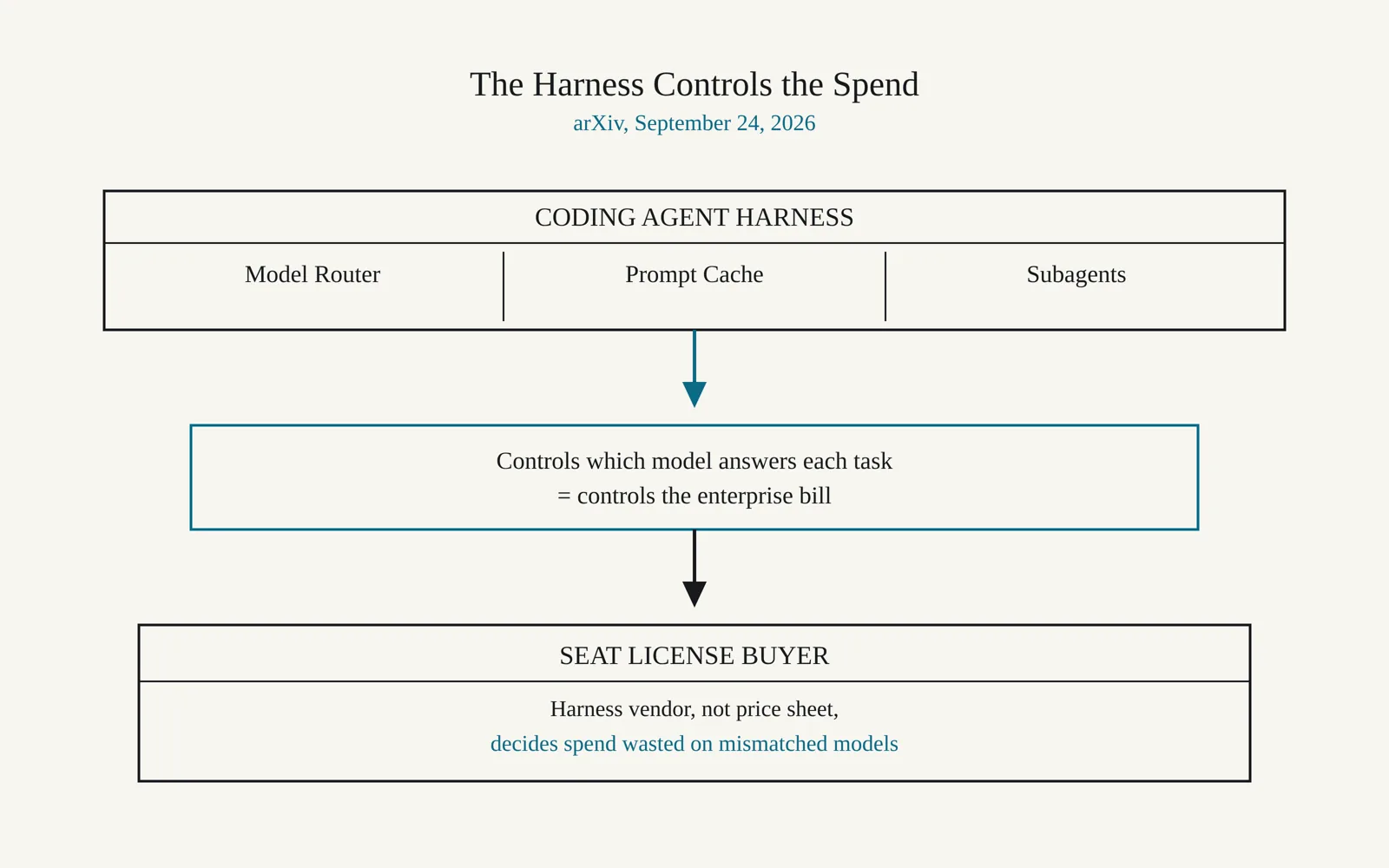
On September 24, 2026, researchers posted a paper to arXiv arguing that the harness running an AI coding agent, the product deciding which model answers, what it reads, how the prompt cache is used and which subagents run, controls an enterprise's bill as much as the model choice does. The authors build a router that classifies every prompt with a calibrated classifier called Jev and moves work between models only at points where a running conversation's prompt cache would not need to be rebuilt. (arXiv preprint, Control the Harness, Control the Cost, submitted 24 September 2026)
Open the photograph at full size
Photograph: Diagram: AI Journey
Read the full description of this diagram
Diagram drawn for this item: Paper Prices Enterprise Cost of Locking Coding Agents to One Harness. On September 24, 2026, researchers posted a paper to arXiv arguing that the harness running an AI coding agent, the product deciding which model answers, what it reads, how the prompt cache is used and which subagents run, controls an enter For a buyer signing a Claude Code seat license, the finding reframes the negotiation: the harness vendor, not just the model price sheet, decides how much of that spend is wasted on a mismatched model for a given task.
The numbers
Spend recovered
14 to 21%
Share of model spend the router recovers in a 10,000-seat emulation
Sessions repriced
10,000
Real sessions from public datasets repriced to find the crossover
Read from arXiv preprint, Control the Harness, Control the Cost, submitted 24 September 2026
What it means for you
For a buyer signing a Claude Code seat license, the finding reframes the negotiation: the harness vendor, not just the model price sheet, decides how much of that spend is wasted on a mismatched model for a given task. A team stuck on a proprietary harness at its defaults is effectively accepting whatever routing choices that vendor baked in, with no lever to pull when a long, tool-heavy session would have been cheaper on a pricier model than on the next tier down.
In more detail
A paper posted to arXiv on September 24, 2026 by Arian Abbasi, Alan Aqrawi and Ted Kwartler takes aim at a detail enterprises buying AI coding agents tend to overlook: the harness, the software wrapper that actually runs the agent, decides more of the bill than the underlying model price. Harnesses choose which model answers a given prompt, what context it reads, how the prompt cache gets reused and which subagents fire, so the harness effectively sets the rate on the price sheet and the volume bought at that rate. Most enterprises do not build their own harness. They buy one, commonly Anthropic’s Claude Code or OpenAI’s Codex, and if they leave it at its defaults they inherit every routing decision the vendor made, along with the invoice that follows.
The authors’ response is a router built around a classifier they call Jev, which assigns calibrated probabilities to every incoming prompt against a taxonomy of coding-agent request types that a buyer can define. Because a single user turn can generate many requests running over one model’s prompt cache, the router only shifts work at three points, session start, side lanes, and subagent launch, where no active conversation would need its cache rebuilt from scratch. The paper also works out, from published price sheets, when switching models mid-task actually pays off, and finds a crossover: on sessions that run long and lean heavily on tools, the most expensive model on the price list can end up cheaper than the next tier down, once cache costs are counted in.
The numbers
Testing the approach against roughly 10,000 real sessions drawn from public datasets, the authors confirm that crossover holds in practice. Applied to an emulated enterprise of 10,000 seats, with user behavior drawn from the same datasets, the router recovers 14 to 21% of model spend at Anthropic’s list prices as of September 21, 2026, which the paper translates to $3.3 million to $5.0 million a year for that size of deployment.
Beyond the router itself, the paper maps risk across twenty different harnesses and prices out what it costs an enterprise to depend on a single vendor’s models. It closes with a control plane enterprises can run themselves starting now, plus a staged plan for deciding later whether to build and own a harness outright rather than keep renting one.
Sources
Sources read
arXiv preprint, Control the Harness, Control the Cost, submitted 24 September 2026 (arxiv.org)
Paper read
Cite this
AI Journey, "Paper Prices Enterprise Cost of Locking Coding Agents to One Harness", 25 Sep 2026, https://aijourney.space/updates/2026-09-25-control-the-harness-control-the-cost-routing-and-governing-ai-coding-age/ (source: arXiv, verified 25 Sep 2026)
Next in the stream
Google Adds Live Avatar to Gemini 3.8 Live for Enterprise
Google added Live Avatar to Gemini 3.8 Live, giving its conversational AI a real-time animated face for enterprise customer service and support tasks.
Previous
Cancer Registry Chatbot Study Tests Gemini Against GPT Baselines
Researchers built CRISS, a retrieval-augmented chatbot for cancer registrars, and tested it using Google's Gemini models alongside GPT baselines on registry coding questions.
Next
More in Anthropic
Study Finds Precedent Labels Sway Claude Haiku Approval Calls
A new paper tests Claude Haiku 5.5 alongside other models on refund and claim decisions, showing that past case labels shift approvals sharply.
Paper Tests Claude Opus 4.8 Agents on Conflicting Code Edits
A new paper benchmarks Claude Code running Claude Opus 4.8 against other coding agents on tasks where two agents edit the same shared codebase at once.
Paper Finds Claude Opus 5.5 Agent Beats Automated CT Labeling Harness
A new paper testing CT scan labeling finds a free-form agent running Claude Opus 5.5 outscored an automated review harness on most of six public datasets.