What happened
Published here
On September 24, 2026, researchers posted a paper on arXiv describing CRISS, the Cancer Registry Intelligent Support System, a retrieval-augmented generation chatbot built to help cancer registrars and Oncology Data Specialists interpret coding and staging standards, tested across open-weight, proprietary, and non-RAG baseline models drawn from the Gemini and GPT families. (CRISS: A Retrieval-Augmented AI Chatbot for Assisting Cancer Registrars, arXiv:2609.29075, submitted 24 September 2026)
Open the photograph at full size
Photograph: Diagram: AI Journey
Read the full description of this diagram
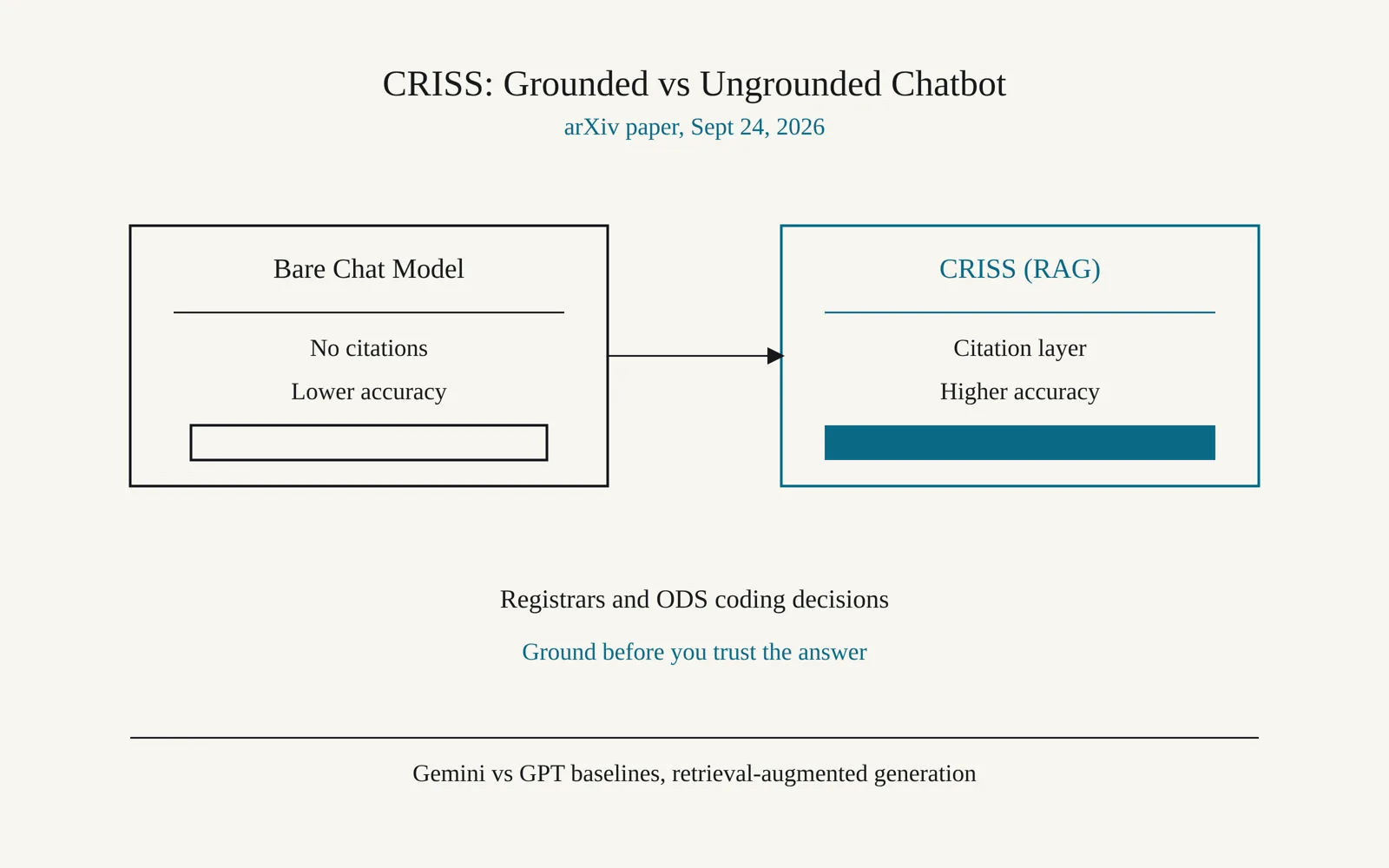
Diagram drawn for this item: Cancer Registry Chatbot Study Tests Gemini Against GPT Baselines. On September 24, 2026, researchers posted a paper on arXiv describing CRISS, the Cancer Registry Intelligent Support System, a retrieval-augmented generation chatbot built to help cancer registrars and Oncology Data Specialists interpret... For anyone weighing a retrieval-augmented deployment over a bare chat model, the reported gap between grounded and ungrounded scores is a concrete argument for building a citation layer before trusting an assistant with a coding decision...
The numbers
RAG grounding scores
0.62/0.56/0.59
Mean grounding scores for RAG across easy, medium and hard question tiers
Non-RAG grounding scores
0.29/0.26/0.29
Mean grounding scores for non-RAG baselines across the same tiers
Paper length
21 pages
Length of the submitted arXiv paper, with 13 figures and 7 tables
What it means for you
For anyone weighing a retrieval-augmented deployment over a bare chat model, the reported gap between grounded and ungrounded scores is a concrete argument for building a citation layer before trusting an assistant with a coding decision, and the finding that local models led on the hardest questions while hosted models stayed more cautious suggests the cheapest API tier is not automatically the safest choice for a regulated workflow.
In more detail
A team from the University of Missouri and collaborators has published a paper describing CRISS, the Cancer Registry Intelligent Support System, a chatbot meant to help cancer registrars and Oncology Data Specialists work through coding and staging rules that change often and are hard to interpret quickly by hand. The system is built as a retrieval-augmented generation, or RAG, assistant: it draws from a knowledge base built out of national cancer registry standards, splits that material into tagged passages, indexes them as dense embeddings, and then generates answers grounded in the passages it retrieves, with citations attached so a registrar can check the source before acting on it.
The researchers tested several kinds of models against this setup, including open-weight systems, proprietary systems, and plain non-RAG baselines, spanning both the Gemini and GPT model families. Every model answered easy, medium and hard registry questions, and an LLM-as-a-Judge protocol scored the answers on grounding and semantic similarity. Across every difficulty tier, the RAG-equipped versions of the models outperformed the same models running without retrieval, and the gap widened as the questions got harder, which the paper reads as evidence that retrieval matters more precisely when a registrar is facing the trickiest coding edge cases.
The paper also draws a split between how proprietary and open-weight models handled difficulty. Proprietary RAG models did best on easy and medium questions, but local, open-weight RAG models actually ranked highest on the hardest questions, and the paper notes proprietary models tended to answer more cautiously overall. The authors frame CRISS as a way to support training and helpdesk use for registrars while keeping a human making the final abstraction call, rather than as a system meant to replace that judgment.
The numbers
- RAG configurations scored a mean of 0.62, 0.56 and 0.59 across the easy, medium and hard tiers.
- Non-RAG baselines scored a mean of just 0.29, 0.26 and 0.29 on the same three tiers.
- The paper runs 21 pages, with 13 figures and 7 tables backing the evaluation.
The work is framed as a proof of concept rather than a finished clinical tool, and the authors are explicit that final coding decisions should stay with a human registrar. For a field where documentation standards shift year over year, a citation-supported assistant that shows its sources, rather than one that simply answers, is the design choice the paper argues actually moved the accuracy numbers.
Sources
Sources read
Cite this
AI Journey, "Cancer Registry Chatbot Study Tests Gemini Against GPT Baselines", 26 Sep 2026, https://aijourney.space/updates/2026-09-26-criss-a-retrieval-augmented-ai-chatbot-for-assisting-cancer-registrars/ (source: arXiv, verified 26 Sep 2026)
Next in the stream
Paper Prices Enterprise Cost of Locking Coding Agents to One Harness
A new paper argues that the harness running a coding agent, not the model alone, sets what enterprises pay Anthropic and other vendors for tools like Claude Code.
Previous
New Framework Tests Whether LLMs Truly Understand Context
A new knowledge graph based evaluation framework tests whether large language models genuinely understand context, a question that bears directly on answer engines such as Perplexity.
Next
More in Google
Google.org Funds Five Groups Building AI Tools For Teachers
Google.org is funding five organizations building AI tools for teachers, pairing Google DeepMind's model work with grants aimed at classroom use.
Gemini Negotiation Paper Finds Persona Effects Shift By Language
A new paper testing Google's Gemini model in buyer-seller negotiations found that the same persona instruction produced different deal outcomes in English and Korean.
Paper Finds Gemini Monitor Beats Small Models At Spotting Reward Hacking
A new paper tests whether Google's Gemini 3.1 Flash-Lite can tell real reward hacking apart from honest failure better than small local monitors.