Event Published ResearchPerplexity AI
New Framework Tests Whether LLMs Truly Understand Context
A new knowledge graph based evaluation framework tests whether large language models genuinely understand context, a question that bears directly on answer engines such as Perplexity.
What happened
Published here
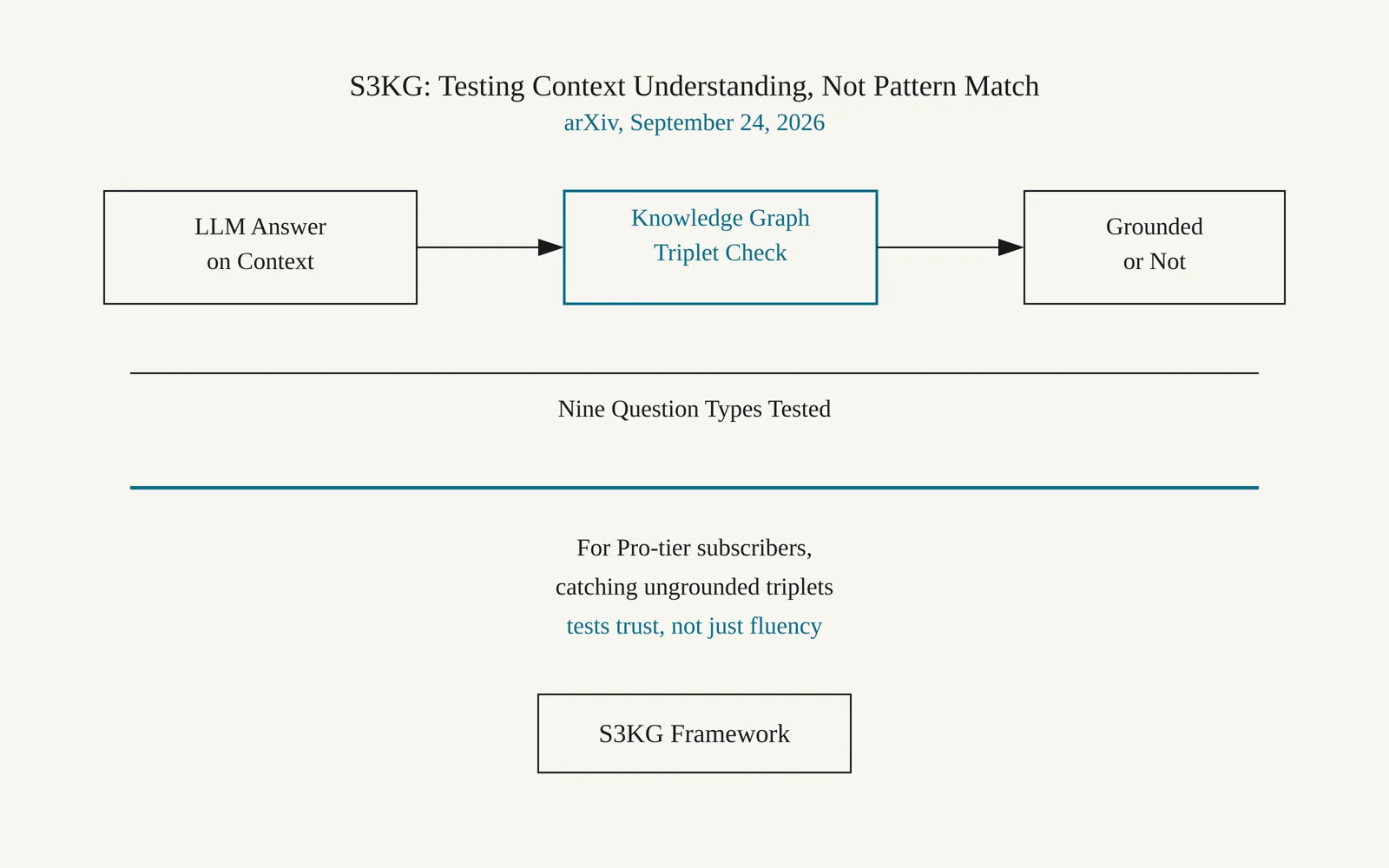
On September 24, 2026, researchers posted a paper on arXiv proposing a knowledge graph based framework, called S3KG, to evaluate whether large language models understand context rather than simply pattern match, tested across nine question answering benchmarks. (arXiv preprint, Do LLMs Understand Context? A Knowledge Graph-Based Evaluation Framework, posted September 24, 2026)
Open the photograph at full size
Photograph: Diagram: AI Journey
Read the full description of this diagram
Diagram drawn for this item: New Framework Tests Whether LLMs Truly Understand Context. On September 24, 2026, researchers posted a paper on arXiv proposing a knowledge graph based framework, called S3KG, to evaluate whether large language models understand context rather than simply pattern match, tested across nine question... For a reader who pays for an answer engine such as Perplexity's Pro plan, a metric that catches ungrounded triplet level errors offers a sharper way to judge whether a subscription's answers are trustworthy rather than merely fluent, since...
The numbers
F1 gain
+7.6
Points over the strongest baseline, measured across nine benchmarks
AUROC
0.973
Peak AUROC S3KG reached at separating correct from incorrect answers
What it means for you
For a reader who pays for an answer engine such as Perplexity's Pro plan, a metric that catches ungrounded triplet level errors offers a sharper way to judge whether a subscription's answers are trustworthy rather than merely fluent, since surface metrics like BLEU have historically hidden this gap.
In more detail
A team of seven researchers posted a paper on arXiv on September 24, 2026, arguing that standard benchmarks such as BLEU and perplexity only measure how fluent a language model’s output sounds, not whether the model actually understood the passage it was given. Their proposed answer is a knowledge graph based scoring method called Semantic Structural Similarity for KGs, or S3KG, which turns both a model’s answer and the reference context into knowledge graphs and then compares them on structure and meaning at once, rather than on word overlap.
The paper also introduces a diagnostic layer that inspects individual triplets, the subject, predicate and object units that make up a knowledge graph, so a researcher can see exactly where a model’s reasoning broke: whether it invented a relationship, dropped an entity, or reversed a fact drawn from the source text. Tested across nine question answering benchmarks, the authors report that S3KG beats the strongest prior baseline by a wide margin and separates correct from incorrect answers more reliably than existing methods.
Why this matters for a company like Perplexity AI, whose entire product is answering a query in prose with citations rather than serving a list of links, is that a grounding metric this granular gives outside evaluators a way to test whether a Perplexity answer actually reflects what the retrieved pages say or merely reads as though it does. The paper was not built with Perplexity’s own data and Perplexity did not fund or co-author it, so nothing here confirms how the company’s own answer engine currently scores. What it offers instead is a sharper public yardstick that a subscriber, a journalist or a rival lab could later apply to any answer engine’s output, Perplexity included, to check grounding rather than take fluency as a stand-in for it.
The numbers
- F1 gain: +7.6 points over the strongest baseline, measured across nine benchmarks.
- AUROC: 0.973, the peak score S3KG reached at separating correct from incorrect model answers.
The work is set to appear at AACL-IJCNLP 2026, a peer reviewed venue for natural language processing research, which gives the framework a formal review pass before wider use. For now it exists as a preprint, and the authors have not published an open leaderboard or named which commercial answer engines, if any, they plan to test with it next.
Sources
Sources read
Cite this
AI Journey, "New Framework Tests Whether LLMs Truly Understand Context", 30 Sep 2026, https://aijourney.space/updates/2026-09-30-do-llms-understand-context-a-knowledge-graph-based-evaluation-framework/ (source: arXiv, verified 30 Sep 2026)
Next in the stream
Cancer Registry Chatbot Study Tests Gemini Against GPT Baselines
Researchers built CRISS, a retrieval-augmented chatbot for cancer registrars, and tested it using Google's Gemini models alongside GPT baselines on registry coding questions.
Previous
Paper Edits Attention With B-Spline Surfaces To Steer Model Output
A new paper describes attention manifolds, a technique that edits how transformer models route information, with relevance for answer engines like Perplexity.
Next
More in Perplexity AI
Perplexity AI Researchers Detail LoRA Recipe For Converting Four Language Models To Diffusion
A paper associated with Perplexity AI describes BYOD, a LoRA-only method that converts standard autoregressive language models into diffusion language models without full retraining.
Paper Proposes Message-Passing Method For Compressing LLM Weights
A new arXiv paper proposes a message-passing method for compressing large language model weights, the kind of efficiency work that underlies answer engines like Perplexity AI.
Researchers Publish S-SALAAD Framework For Sparse Large Model Inference
A new paper on compressing large models for edge devices matters to Perplexity AI and any company whose answer engine has to run inference away from a data center.