Event Published ResearchPerplexity AI
Paper Edits Attention With B-Spline Surfaces To Steer Model Output
A new paper describes attention manifolds, a technique that edits how transformer models route information, with relevance for answer engines like Perplexity.
What happened
Published here
On September 24, 2026, researcher Naveen Mysore posted a paper on arXiv describing attention manifolds, learned B-spline surfaces that modulate what each attention head extracts rather than only how much it attends, tested on LLaMA 3.2-1B-Instruct and 3B-Instruct. (arXiv paper 2610.00257, Attention Manifolds, submitted September 24, 2026)
Open the photograph at full size
Photograph: Diagram: AI Journey
Read the full description of this diagram
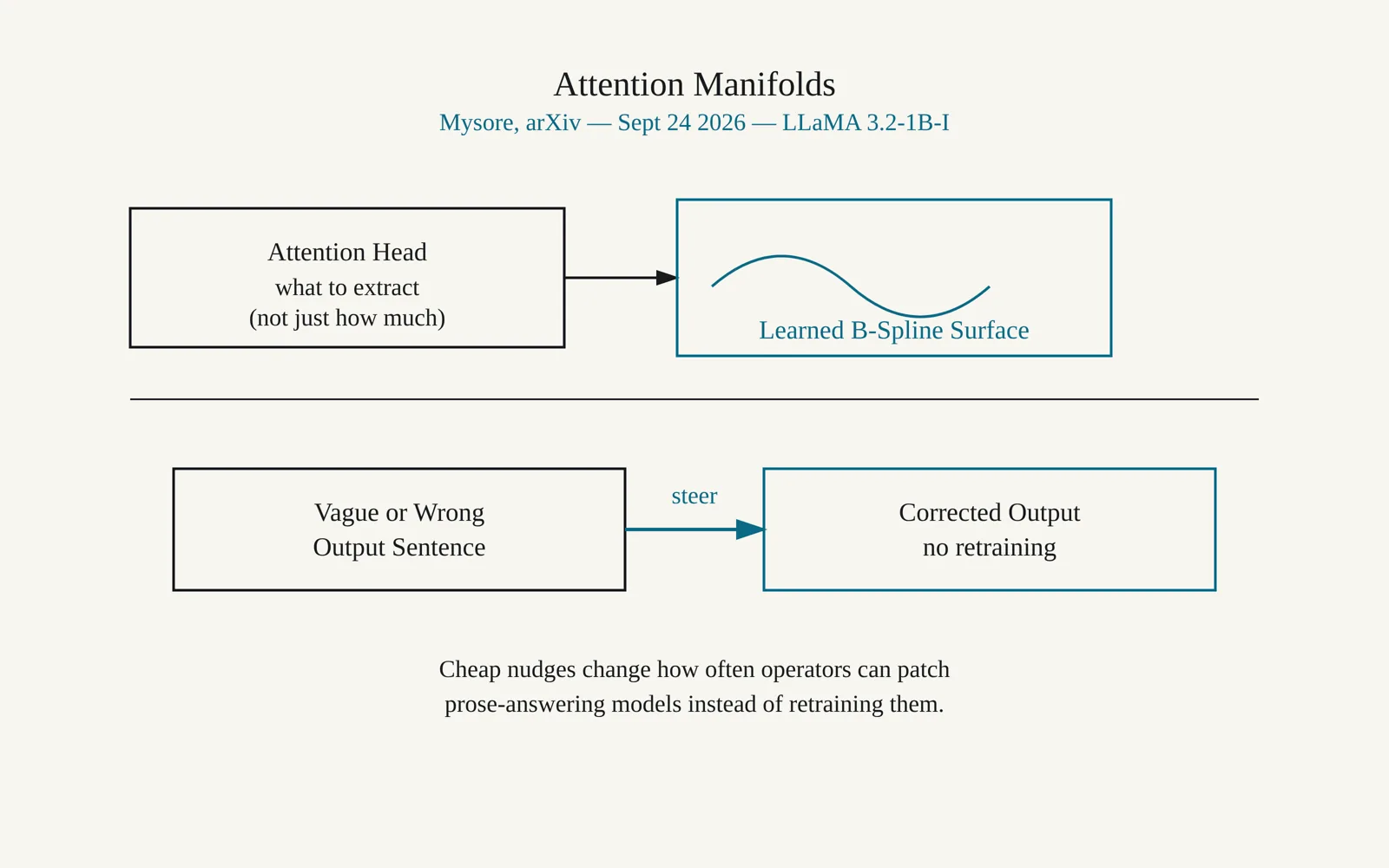
Diagram drawn for this item: Paper Edits Attention With B-Spline Surfaces To Steer Model Output. On September 24, 2026, researcher Naveen Mysore posted a paper on arXiv describing attention manifolds, learned B-spline surfaces that modulate what each attention head extracts rather than only how much it attends, tested on LLaMA... For a product built around answering questions in prose rather than returning links, a cheap way to nudge a model away from a wrong or vague sentence without retraining it changes the calculus on how often an operator can afford to patch...
What it means for you
For a product built around answering questions in prose rather than returning links, a cheap way to nudge a model away from a wrong or vague sentence without retraining it changes the calculus on how often an operator can afford to patch output quality before shipping an answer.
In more detail
The paper’s starting observation is a plain limit of standard transformer attention: a source token sends the identical value vector to every receiver, so the query can decide how much weight a token gets but not what gets pulled out of it. The author’s fix is to attach a learned two-dimensional B-spline surface to each value dimension, a small curved lookup table shaped by the query-key pair, initialised at zero so a freshly added model behaves exactly like the original until the surface is trained.
Applied to LLaMA 3.2 at 1B and 3B parameters, the surfaces cut WikiText-2 validation perplexity while adding a small fraction of extra parameters, and the paper reports that greedy-decoded output changed for a majority of a set of varied test prompts, with the change rate higher on the larger model and highest of all on prompts the author calls ambiguous or polysemous. The examples given include a corrected statement about the CAP theorem and a vague answer about quantum mechanics turned into a specific one naming position and momentum.
The second half of the paper treats the surfaces as a steering handle rather than just a quality fix. Inverting a layer’s coefficients changed output for nearly all of ten sampled prompts, and setting coefficients to negative one builds what the author calls an attention wall, blocking value flow through chosen dimensions. In one preliminary test, a layer-wide wall redirected a prompt asking for explosive-device instructions toward general educational content instead.
The numbers
The method adds a small parameter overhead, is evaluated on a set of 112 varied prompts, and produces a higher share of changed greedy outputs on the larger of the two tested models than on the smaller one, a gap the paper attributes to the larger model having more attention heads for the surfaces to attach to.
None of this is deployed anywhere yet. It is a single-author paper with experiments confined to two small open models, and the safety redirection result is described as preliminary rather than evaluated at scale. For any service whose whole product is a generated prose answer rather than a ranked list, a technique that edits specific factual errors after training, at this parameter cost and without retraining the whole model, is the kind of lever worth watching before it reaches a shipped system.
Sources
Sources read
arXiv paper 2610.00257, Attention Manifolds, submitted September 24, 2026 (arxiv.org)
Paper read
Cite this
AI Journey, "Paper Edits Attention With B-Spline Surfaces To Steer Model Output", 3 Oct 2026, https://aijourney.space/updates/2026-10-03-attention-manifolds-steering-or-blocking-language-models-by-editing-lear/ (source: arXiv, verified 3 Oct 2026)
Next in the stream
New Framework Tests Whether LLMs Truly Understand Context
A new knowledge graph based evaluation framework tests whether large language models genuinely understand context, a question that bears directly on answer engines such as Perplexity.
Previous
xAI Changes Grok Pricing Page at grok.com
xAI's public site at grok.com now shows a pricing page that differs from the version this site last recorded, though the vendor has not detailed the change.
Next
More in Perplexity AI
Perplexity AI Researchers Detail LoRA Recipe For Converting Four Language Models To Diffusion
A paper associated with Perplexity AI describes BYOD, a LoRA-only method that converts standard autoregressive language models into diffusion language models without full retraining.
Paper Proposes Message-Passing Method For Compressing LLM Weights
A new arXiv paper proposes a message-passing method for compressing large language model weights, the kind of efficiency work that underlies answer engines like Perplexity AI.
Researchers Publish S-SALAAD Framework For Sparse Large Model Inference
A new paper on compressing large models for edge devices matters to Perplexity AI and any company whose answer engine has to run inference away from a data center.