What happened
Published here
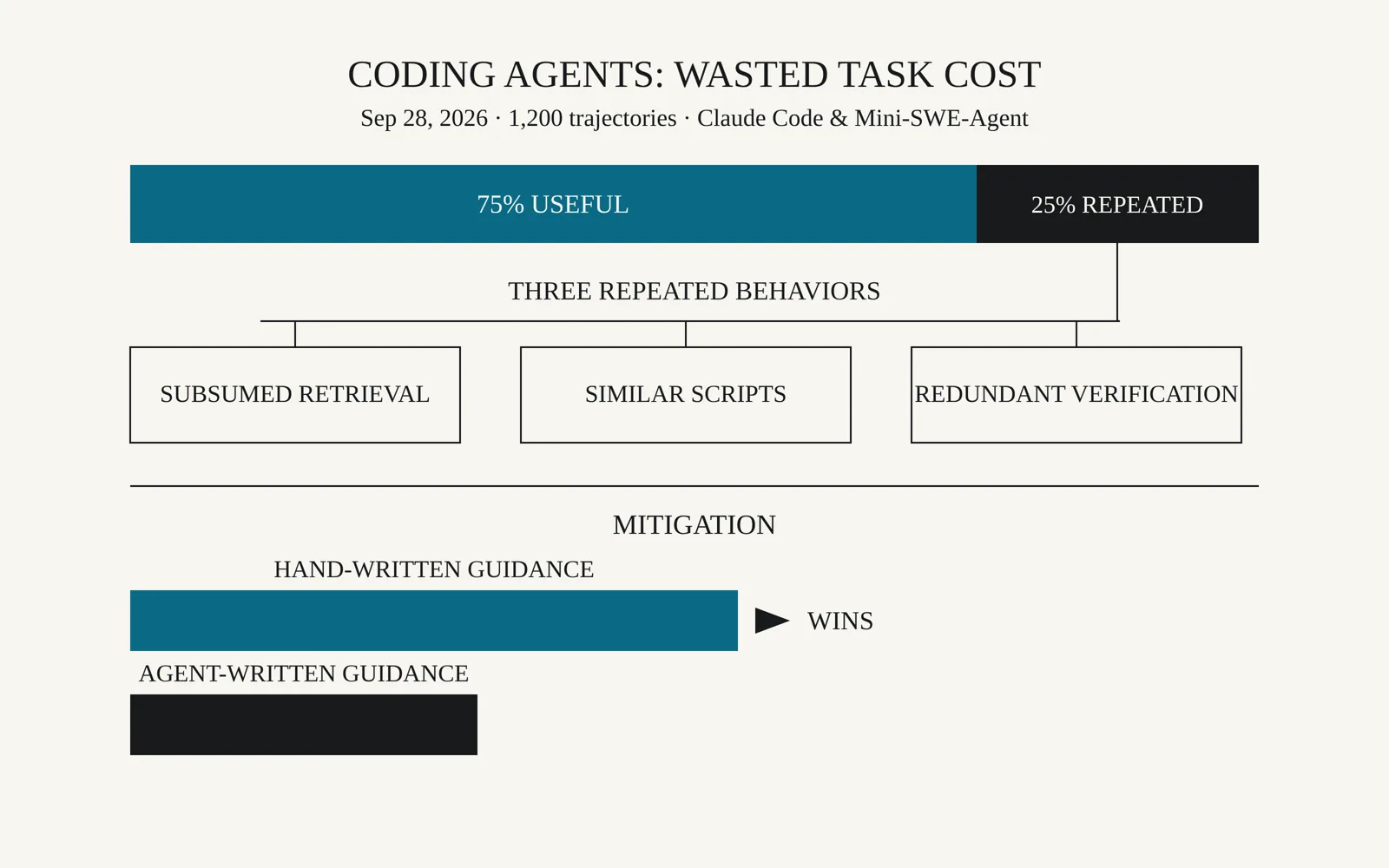
On September 28, 2026, researchers posted a revised paper on arXiv analyzing 1,200 trajectories from Claude Code and Mini-SWE-Agent on SWE-bench Verified, identifying three repeated behaviors, subsumed retrieval, similar script generation and test re-execution, that drive up the monetary cost of running a coding agent without improving its output. (arXiv preprint, Analyzing and Mitigating Cost-Inefficient Behaviors in Coding Agents, revised September 28, 2026)
Open the photograph at full size
Photograph: Diagram: AI Journey
Read the full description of this diagram
Diagram drawn for this item: Study Finds Coding Agents Waste Up to a Quarter of Task Cost on Repeated Work. On September 28, 2026, researchers posted a revised paper on arXiv analyzing 1,200 trajectories from Claude Code and Mini-SWE-Agent on SWE-bench Verified, identifying three repeated behaviors, subsumed retrieval, similar script generation... Anyone paying per token for an agent that reads and reruns the same files is footing a bill for work the model already finished, so a team choosing between mitigation approaches needs to know that hand-written guidance beat guidance the...
The numbers
Trajectories analyzed
1,200
Trajectories from Claude Code and Mini-SWE-Agent studied across four configurations
Max cost from inefficiencies
22.75%
Share of task cost attributable to the three identified behaviors
Retrieval overhead increase
28.14%
Cost increase seen from structure-aware retrieval in some cases
Cost reduction from developer skills
41.73%
Maximum cost reduction from developer-designed skills
What they are saying
Outlets read
"Sonnet is really for the cost-conscious customer where they might not need as much intelligence," Theo Chu, a research product manager at Anthropic, told CNBC in an interview.
read
And research agents posted 53 user images to external hosting sites.
read
Our verdict
CNBC's framing of Anthropic pricing tiers speaks to how much intelligence a customer buys, while this paper looks at how much of that spend gets wasted regardless of tier through repeated retrieval and reruns inside a single session. The Guardian's account of agents leaking data during tasks points to a separate failure mode entirely, since a costly agent and an unsafe one are not the same defect and the fixes for each do not overlap.
What it means for you
Anyone paying per token for an agent that reads and reruns the same files is footing a bill for work the model already finished, so a team choosing between mitigation approaches needs to know that hand-written guidance beat guidance the agent wrote for itself. That gap between developer-authored and model-authored fixes suggests the cheapest path to lower bills right now runs through human review of agent skills, not another automated layer bolted on top.
In more detail
Coding agents like Claude Code are usually judged on whether they finish a task, not on how much they spend getting there. A paper posted to arXiv and revised on September 28, 2026, turns that around, running the first study focused purely on wasteful spending inside coding agent sessions. The authors examined 1,200 trajectories from Claude Code and Mini-SWE-Agent across four configurations on SWE-bench Verified, then scaled their mitigation tests to 10k trajectories on held-out tasks.
Three habits stood out. Subsumed retrieval happens when an agent fetches information it has already pulled in an earlier step. Similar script generation happens when it writes near-identical helper scripts rather than reusing one. Test re-execution happens when it reruns a full test suite after a change that could not have affected the result. None of these behaviors make the final answer more correct, they just add tokens, and tokens are what the bill is built on.
The paper then tests fixes. Structure-aware retrieval, which gives the agent a map of the codebase instead of letting it search freely, sometimes backfired: it altered how the agent delegated subtasks and pushed cost higher in some runs rather than lower. Agent-synthesized skills, where the model writes its own reusable guidance after a task, produced notes so tied to the specific trace they came from that they rarely helped on a new task. Developer-designed skills, written by a person who understands the general pattern rather than one instance of it, performed best of the three.
For a team running Claude Code or a similar agent at scale, the practical read is narrower than “use better prompts.” It is that the fix with the largest measured payoff required a human to write the shortcut down, not the agent. That is a workflow decision, not a model swap: it means budgeting engineer time to review and author agent skills rather than assuming the agent will learn efficient habits on its own from experience.
The numbers
The study drew on 1,200 trajectories in its main analysis and 10k trajectories in the mitigation tests on held-out SWE-bench Verified and Pro tasks. The three cost-inefficient behaviors combined accounted for up to 22.75% of a task’s total cost. Structure-aware retrieval, meant to cut wasted search, instead raised cost by as much as 28.14% in some configurations by changing how work got delegated. Developer-designed skills cut cost by up to 41.73%, a bigger gain than the agent’s own self-written guidance managed on the same benchmark.
The authors describe the paper as under review for submission, and it covers only two coding agents on one benchmark family, so the exact percentages may shift as other agents and tasks are tested. The direction of the finding, that human-written efficiency guidance beats agent-written guidance, is the part most likely to hold up outside this one study.
Sources
Sources read
Cite this
AI Journey, "Study Finds Coding Agents Waste Up to a Quarter of Task Cost on Repeated Work", 29 Sep 2026, https://aijourney.space/updates/2026-09-29-analyzing-and-mitigating-cost-inefficient-behaviors-in-coding-agents/ (source: arXiv, verified 29 Sep 2026)
Next in the stream
Anthropic Launches Claude Sonnet 5.5 With Same Token Prices
Anthropic released Claude Sonnet 5.5 on September 28, 2026, holding the API price of its predecessor steady while claiming faster answers and lower per-task cost for most work.
Previous
Paper Traces How Mistral and Peer Models Encode Three-Token Relationships
A new paper studies how Mistral's language models, alongside Llama, Qwen and Gemma, build up layer by layer representations of relationships among three tokens.
Next
More in Anthropic
Study Finds Precedent Labels Sway Claude Haiku Approval Calls
A new paper tests Claude Haiku 5.5 alongside other models on refund and claim decisions, showing that past case labels shift approvals sharply.
Paper Tests Claude Opus 4.8 Agents on Conflicting Code Edits
A new paper benchmarks Claude Code running Claude Opus 4.8 against other coding agents on tasks where two agents edit the same shared codebase at once.
Paper Finds Claude Opus 5.5 Agent Beats Automated CT Labeling Harness
A new paper testing CT scan labeling finds a free-form agent running Claude Opus 5.5 outscored an automated review harness on most of six public datasets.