What happened
Published here
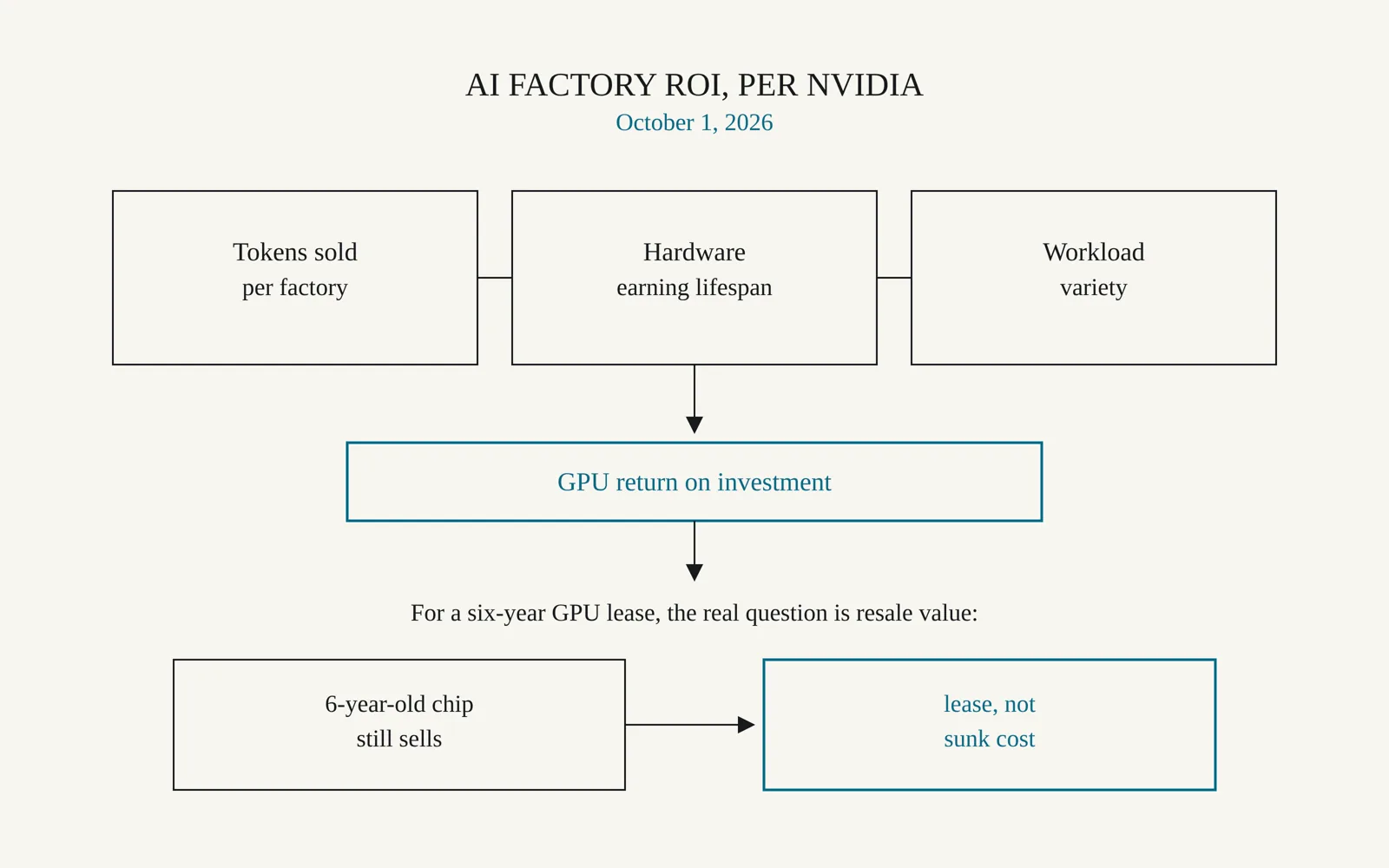
On October 1, 2026, Nvidia published a blog post arguing that AI factory returns on investment hinge on three factors: how many tokens a factory can sell, how long its hardware keeps earning, and how many kinds of workloads it can run, citing SemiAnalysis AgentX benchmarks showing its Vera Rubin NVL72 systems deliver far higher throughput per megawatt than the prior GB300 NVL72 generation. (Nvidia newsroom post on AI factory returns, published October 1, 2026)
Open the photograph at full size
Photograph: Diagram: AI Journey
Read the full description of this diagram
Diagram drawn for this item: Nvidia Lays Out Its Return-on-Investment Case for AI Factories. On October 1, 2026, Nvidia published a blog post arguing that AI factory returns on investment hinge on three factors: how many tokens a factory can sell, how long its hardware keeps earning, and how many kinds of workloads it can run... For a buyer weighing a multi-year GPU lease, the argument is really about resale risk: if a six-year-old Nvidia chip still fetches real money on the secondhand market, the monthly bill looks less like a sunk cost and more like a lease on...
The numbers
Throughput per megawatt
30x
Vera Rubin NVL72 advantage over GB300 NVL72, per SemiAnalysis AgentX data cited in the post
Cost per million tokens
45x
lower on Vera Rubin NVL72 for the DeepSeek V4 Pro model
Factory build cost
$60 million
approximate cost per megawatt of AI factory capacity
Supercomputer utilization
95-98%
Texas A&M utilization across 26 projects and seven institutions
Read from Nvidia newsroom post on AI factory returns, published October 1, 2026
What it means for you
For a buyer weighing a multi-year GPU lease, the argument is really about resale risk: if a six-year-old Nvidia chip still fetches real money on the secondhand market, the monthly bill looks less like a sunk cost and more like a lease on an asset that keeps some value. A factory operator choosing between committing capital to one generation or waiting for the next has to weigh Nvidia's own claim that nothing already installed gets stranded, since that claim shapes how fast a buyer can justify refreshing hardware versus running older systems longer.
In more detail
Nvidia used an October 1, 2026 blog post to make an investment case for AI factories, the gigawatt-scale data centers its chips power. The company says operators will only commit capital at that scale with confidence in three variables: how much a factory can earn by selling every token it produces, how long its hardware keeps earning before it is retired, and how broad a range of workloads it can serve. Nvidia frames its own platform as strong on all three, citing outside benchmarking firm SemiAnalysis for performance claims and several market research shops for secondhand pricing evidence.
On earning capacity, Nvidia points to SemiAnalysis AgentX figures showing its newer Vera Rubin NVL72 systems produce far more tokens per megawatt than the outgoing GB300 NVL72 generation, with a steep cut in cost per million tokens on the DeepSeek V4 Pro model. On durability, the post argues that older Nvidia hardware keeps working for operators long after a newer chip ships. It cites CoreWeave extending bookings on systems introduced in 2020 out to 2029, and research firms pricing used GPUs well above zero years past their original depreciation schedules. On versatility, Nvidia lists customers including Lilly, Pinterest, Revolut, Runway and Texas A&M running everything from drug discovery to vision models and simulation on the same underlying architecture.
The post is Nvidia’s own framing of a question investors have been asking with more urgency as capital spending on AI data centers keeps climbing: whether chips bought today will still be earning their keep in five or ten years. Nvidia’s answer rests on software continuity, since CUDA runs across chip generations, meaning a system does not become useless the day a faster one ships.
The numbers
- Throughput per megawatt: 30x higher on Vera Rubin NVL72 than GB300 NVL72, per SemiAnalysis AgentX data cited in the post.
- Cost per million tokens: 45x lower on Vera Rubin NVL72 for the DeepSeek V4 Pro model, per the same benchmarking data.
- Factory build cost: roughly $60 million per megawatt of AI factory capacity, the figure Nvidia uses to frame why operators scrutinize returns.
- Supercomputer utilization: 95-98% across 26 projects and seven institutions, the rate Texas A&M reports running molecular simulation and AI drug discovery workloads.
For a buyer weighing a multi-year GPU lease, the argument is really about resale risk: if a six-year-old Nvidia chip still fetches real money on the secondhand market, the monthly bill looks less like a sunk cost and more like a lease on an asset that keeps some value. A factory operator choosing between committing capital to one generation or waiting for the next has to weigh Nvidia’s own claim that nothing already installed gets stranded, since that claim shapes how fast a buyer can justify refreshing hardware versus running older systems longer.
Sources
Sources read
Nvidia newsroom post on AI factory returns, published October 1, 2026 (blogs.nvidia.com)
Newsroom read
Cite this
AI Journey, "Nvidia Lays Out Its Return-on-Investment Case for AI Factories", 1 Oct 2026, https://aijourney.space/updates/2026-10-01-productive-durable-fungible-how-nvidia-ai-factories-maximize-return-on-i/ (source: Nvidia, verified 1 Oct 2026)
Next in the stream
Perplexity AI Researchers Publish Jacobian-Lens Method For Model Pruning
Researchers at Perplexity AI published a paper describing J-BI, a Jacobian-Lens weighting method that raises depth-pruning accuracy for large language models.
Previous
Barclays Expands Claude Deployment Across Global Operations
Barclays is widening its use of Claude, Anthropic's AI model, targeting half its developer population on Claude Code by the end of 2026.
Next
More in Nvidia
Nvidia RTX Spark Laptops Add Transcription Model and New Game Support
Nvidia detailed new RTX Spark laptop updates, including a transcription model from its Nemotron line and support for Liquid AI's LFM3 models.
Nvidia Launches Minerva Platform for AI Factory Observability
Nvidia introduced Minerva, an AIOps platform that merges infrastructure and workload telemetry to flag problems across AI factories before they spread.
Nvidia Expands Agent Toolkit With Data Grounding Tools
Nvidia expanded its open source Agent Toolkit on October 21, 2026, adding an Agent Knowledge Foundation that grounds enterprise agents in company data without moving it.