Event Published ResearchPerplexity AI
Perplexity AI Researchers Publish Jacobian-Lens Method For Model Pruning
Researchers at Perplexity AI published a paper describing J-BI, a Jacobian-Lens weighting method that raises depth-pruning accuracy for large language models.
What happened
Published here
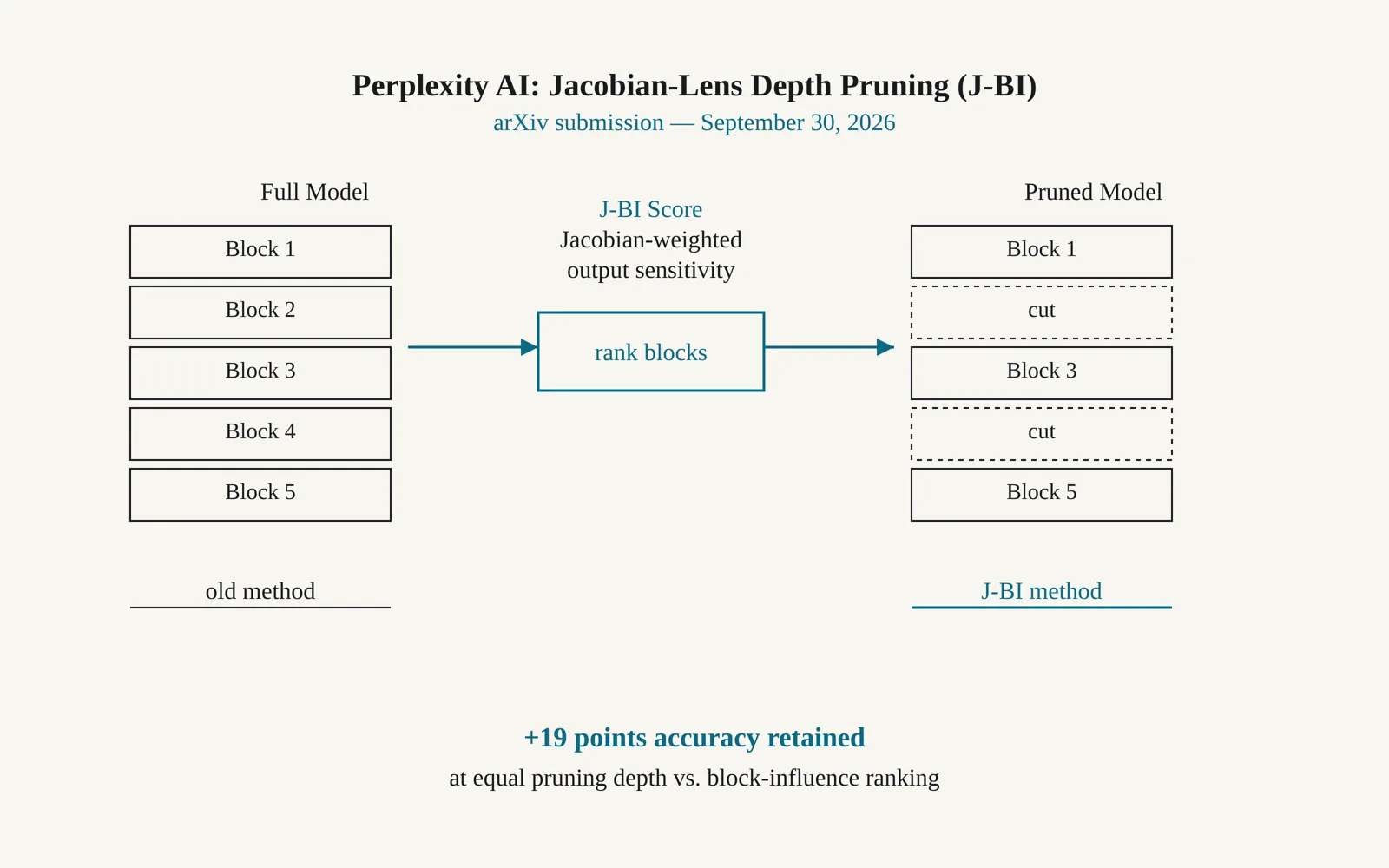
On September 30, 2026, researchers affiliated with Perplexity AI submitted a paper to arXiv titled Output-Aware Block Influence: Jacobian-Lens Weighting for Depth Pruning, introducing a scoring method called J-BI that reweights Block Influence pruning scores using a Jacobian Lens transport map, tested on Qwen3-8B, Llama-3.1-8B-IT, and Gemma-3-12B-IT. (arXiv abstract page for arXiv:2611.00015, submitted 30 September 2026)
Open the photograph at full size
Photograph: Diagram: AI Journey
Read the full description of this diagram
Diagram drawn for this item: Perplexity AI Researchers Publish Jacobian-Lens Method For Model Pruning. On September 30, 2026, researchers affiliated with Perplexity AI submitted a paper to arXiv titled Output-Aware Block Influence: Jacobian-Lens Weighting for Depth Pruning, introducing a scoring method called J-BI that reweights Block... For teams running large models on tight hardware budgets, a pruning method that holds onto 19 more points of accuracy than the older block-influence ranking changes how much of a model can be cut before an answer engine's replies start to...
The numbers
Accuracy gain
19
Points of post-pruning accuracy J-BI gained over Block Influence at a common sparsity level
Paper length
11
Pages in the submitted NeurIPS 2026 AXIOM Workshop paper
Read from arXiv abstract page for arXiv:2611.00015, submitted 30 September 2026
What it means for you
For teams running large models on tight hardware budgets, a pruning method that holds onto 19 more points of accuracy than the older block-influence ranking changes how much of a model can be cut before an answer engine's replies start to degrade in ways a user would notice. Perplexity AI's own product depends on calling several underlying models quickly, so cheaper inference work like this could eventually widen the gap between what a free tier and a paid tier of its answer engine can afford to run, though this paper is exploratory research rather than a shipped change to the service.
In more detail
Depth pruning cuts whole transformer blocks out of a large language model to make it cheaper to run, but the method only works if the system can tell which blocks are safe to remove. The existing approach, Block Influence, ranks blocks by how little they rotate the hidden state as data passes through, on the assumption that a block that barely changes the signal locally is not doing much work. The paper argues that assumption is often wrong: a block can look locally quiet while still shaping the final output in ways Block Influence cannot see.
The authors’ fix, called J-BI, borrows a tool they term the Jacobian Lens, which traces how a small change at any one layer eventually reaches the model’s final residual stream. Applying that transport map to the existing Block Influence score produces a ranking that accounts for a block’s downstream effect rather than only its local behaviour. Tested at a common sparsity level across three open models, Qwen3-8B, Llama-3.1-8B-IT, and Gemma-3-12B-IT, the reweighted score kept more accuracy after pruning than the unweighted version, while doing less damage to perplexity, a standard measure of how well a model predicts text. The team also ran a single-block ablation study and used the Jacobian Lens to probe why the reweighted scores performed better, rather than just reporting the headline numbers.
The numbers
- J-BI improved post-pruning accuracy by up to 19 points over plain Block Influence at a common sparsity level, the paper’s own stated figure.
- The paper runs 11 pages with 7 figures and was accepted to the NeurIPS 2026 AXIOM workshop track.
- Three open models anchor the comparison: Qwen3-8B, Llama-3.1-8B-IT, and Gemma-3-12B-IT.
The work is framed as workshop research rather than a production change, and nothing here says Perplexity AI is pruning the models behind its answer engine today. But any company whose product depends on fast, cheap calls to underlying models has a direct stake in pruning methods that lose less accuracy for the same size reduction, since that trade-off sits between what a service can afford to serve for free and what it reserves for a paid tier.
Sources
Sources read
arXiv abstract page for arXiv:2611.00015, submitted 30 September 2026 (arxiv.org)
Paper read
Cite this
AI Journey, "Perplexity AI Researchers Publish Jacobian-Lens Method For Model Pruning", 4 Nov 2026, https://aijourney.space/updates/2026-11-04-output-aware-block-influence-jacobian-lens-weighting-for-depth-pruning/ (source: arXiv, verified 4 Nov 2026)
Next in the stream
Paper Pairs LLaMA-3 With Gemini Vision For Medical Reports
A new paper describes MeddeX, a medical report analyzer that pairs a fine-tuned LLaMA-3 model with Google's Gemini Vision for reading scanned and radiological images.
Previous
Nvidia Lays Out Its Return-on-Investment Case for AI Factories
Nvidia published an argument on October 1, 2026 that AI factory returns on investment depend on throughput, hardware durability and workload versatility.
Next
More in Perplexity AI
Perplexity AI Researchers Detail LoRA Recipe For Converting Four Language Models To Diffusion
A paper associated with Perplexity AI describes BYOD, a LoRA-only method that converts standard autoregressive language models into diffusion language models without full retraining.
Paper Proposes Message-Passing Method For Compressing LLM Weights
A new arXiv paper proposes a message-passing method for compressing large language model weights, the kind of efficiency work that underlies answer engines like Perplexity AI.
Researchers Publish S-SALAAD Framework For Sparse Large Model Inference
A new paper on compressing large models for edge devices matters to Perplexity AI and any company whose answer engine has to run inference away from a data center.