What happened
Published here
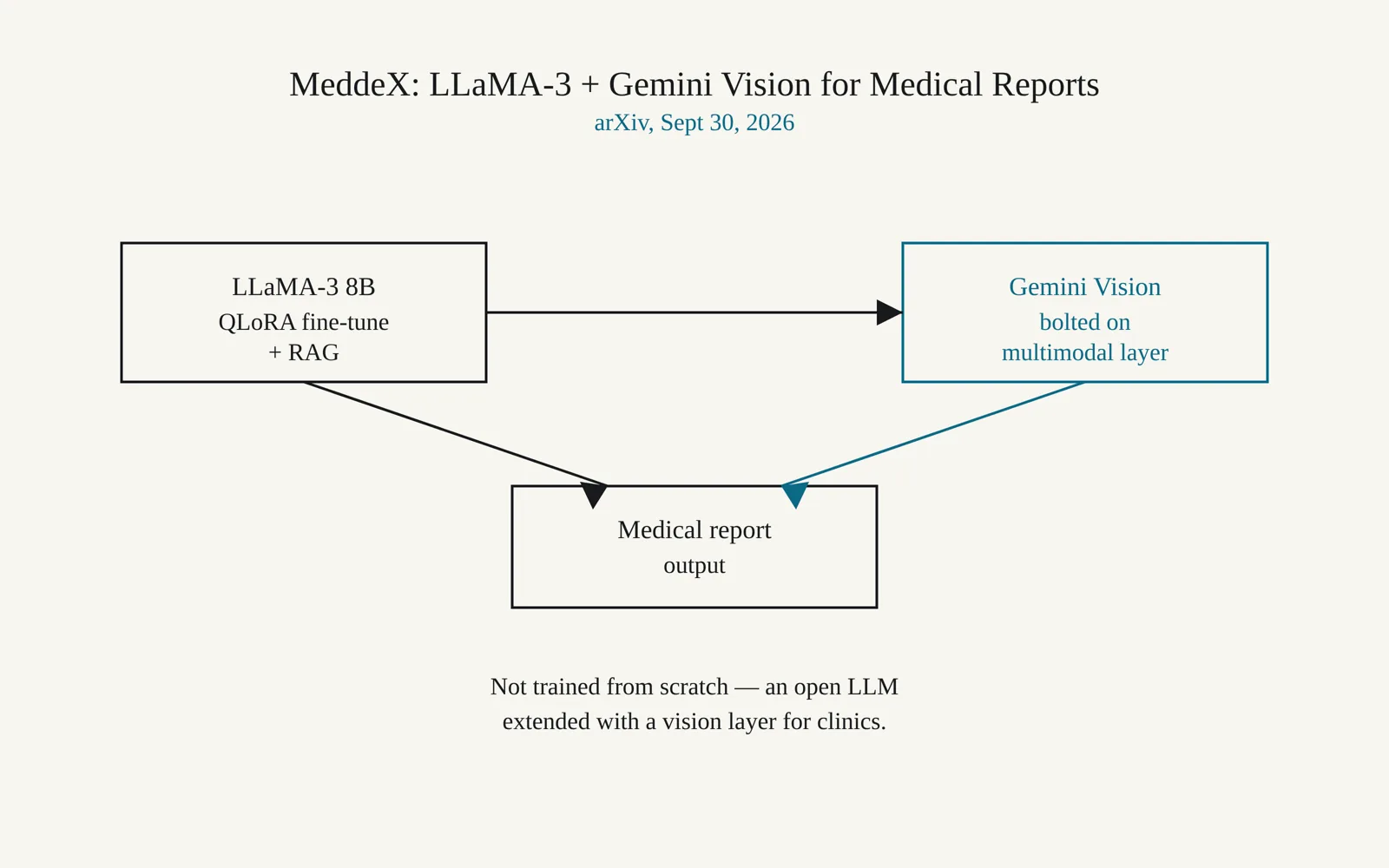
On September 30, 2026, researchers posted a paper on arXiv describing MeddeX, a medical report analyzer that combines a QLoRA fine-tuned LLaMA-3 8B model, retrieval-augmented generation, and a multimodal Gemini Vision layer to produce evidence-backed summaries of clinical documents, including scanned PDFs and direct radiological images. (arXiv paper 2610.20632, MeddeX: A Retrieval-Augmented LLaMA-3 System with Gemini Vision for Evidence-Backed Medical Report Analysis, submitted September 30, 2026)
Open the photograph at full size
Photograph: Diagram: AI Journey
Read the full description of this diagram
Diagram drawn for this item: Paper Pairs LLaMA-3 With Gemini Vision For Medical Reports. On September 30, 2026, researchers posted a paper on arXiv describing MeddeX, a medical report analyzer that combines a QLoRA fine-tuned LLaMA-3 8B model, retrieval-augmented generation, and a multimodal Gemini Vision layer to produce... For a clinic weighing whether to add an AI reading layer to its records pipeline, the choice here is telling: the authors did not train a vision model from scratch, they bolted Gemini onto an open fine-tuned language model, which is the...
The numbers
ROUGE-1 gain
+9.2%
Improvement over the base LLaMA3-Med42-8B model
ROUGE-L gain
+11.8%
Improvement over the base LLaMA3-Med42-8B model
BLEU gain
+71.4%
Improvement over the base LLaMA3-Med42-8B model
What it means for you
For a clinic weighing whether to add an AI reading layer to its records pipeline, the choice here is telling: the authors did not train a vision model from scratch, they bolted Gemini onto an open fine-tuned language model, which is the cheaper path for a team with a tight budget and no in-house vision team. That design choice shifts the ongoing cost and uptime risk onto Google's API rather than onto a model the clinic would have to retrain and host itself, a tradeoff worth weighing before a hospital IT department signs off on a pilot.
In more detail
The paper, titled “MeddeX: A Retrieval-Augmented LLaMA-3 System with Gemini Vision for Evidence-Backed Medical Report Analysis,” was submitted by Rajdeep Pandhare, Rohit Kundaikar, Yakub Kojar and Shreyansh Tiwari and later published in the International Journal of Scientific Research in Engineering and Management. It sets out to address a specific bottleneck: clinicians reading increasingly long and varied medical reports under time pressure, with manual review described as slow, error-prone and hard to scale.
MeddeX’s architecture layers several pieces on top of a QLoRA fine-tuned LLaMA-3 8B language model. Retrieval-augmented generation grounds answers in the source document rather than letting the model invent detail, while the Gemini Vision layer handles anything that is not clean, text-native text: scanned image-based PDFs and direct radiological images. A hybrid extraction pipeline sits in front of both, including what the authors call a garbage-text detection mechanism built to catch corrupted and UTF-16-encoded documents, a practical problem anyone who has processed real hospital archives will recognize.
Beyond answering questions about a single report, the system adds report-scoped retrieval for tighter contextual grounding, a longitudinal comparison engine that tracks changes across a patient’s reports over time, and a self-healing backfill pipeline that processes older, legacy documents only when they are actually requested rather than all at once. The whole system runs on a FastAPI backend with a Supabase vector store behind it.
The numbers
The authors benchmarked MeddeX against the base LLaMA3-Med42-8B model and reported gains across every metric they tracked: ROUGE-1 rose by 9.2%, ROUGE-L by 11.8%, and BLEU by 71.4%, alongside smaller improvements on ROUGE-2 and BERTScore. The authors present these gains as evidence that domain-specific fine-tuning, rather than the base medical model alone, is doing meaningful work.
The paper frames MeddeX as “a practical and robust step toward AI-assisted clinical decision support,” language that signals an engineering prototype rather than a deployed clinical tool. No hospital or health system is named as a user, and the evaluation is against a single base model rather than a field trial. Still, the design pattern, an open fine-tuned language model with Gemini doing the heavy lifting on images, is one other teams building similar document pipelines are likely to copy, since it avoids the cost of training a vision model in-house while still handling the messiest input: a scanned, decades-old chart nobody digitized properly the first time.
Sources
Sources read
Cite this
AI Journey, "Paper Pairs LLaMA-3 With Gemini Vision For Medical Reports", 16 Oct 2026, https://aijourney.space/updates/2026-10-16-meddex-a-retrieval-augmented-llama-3-system-with-gemini-vision-for-evide/ (source: arXiv, verified 16 Oct 2026)
Next in the stream
Google Launches Gemini 4 Argon Frontier Model
Google introduced Gemini 4 Argon, a frontier model built for coding, enterprise knowledge work and cybersecurity defense, rolling out first to trusted testers.
Previous
Perplexity AI Researchers Publish Jacobian-Lens Method For Model Pruning
Researchers at Perplexity AI published a paper describing J-BI, a Jacobian-Lens weighting method that raises depth-pruning accuracy for large language models.
Next
More in Google
Google.org Funds Five Groups Building AI Tools For Teachers
Google.org is funding five organizations building AI tools for teachers, pairing Google DeepMind's model work with grants aimed at classroom use.
Gemini Negotiation Paper Finds Persona Effects Shift By Language
A new paper testing Google's Gemini model in buyer-seller negotiations found that the same persona instruction produced different deal outcomes in English and Korean.
Paper Finds Gemini Monitor Beats Small Models At Spotting Reward Hacking
A new paper tests whether Google's Gemini 3.1 Flash-Lite can tell real reward hacking apart from honest failure better than small local monitors.