Event Published Models and productsGoogle
Google Launches Gemini 4 Argon Frontier Model
Google introduced Gemini 4 Argon, a frontier model built for coding, enterprise knowledge work and cybersecurity defense, rolling out first to trusted testers.
What happened
Published here
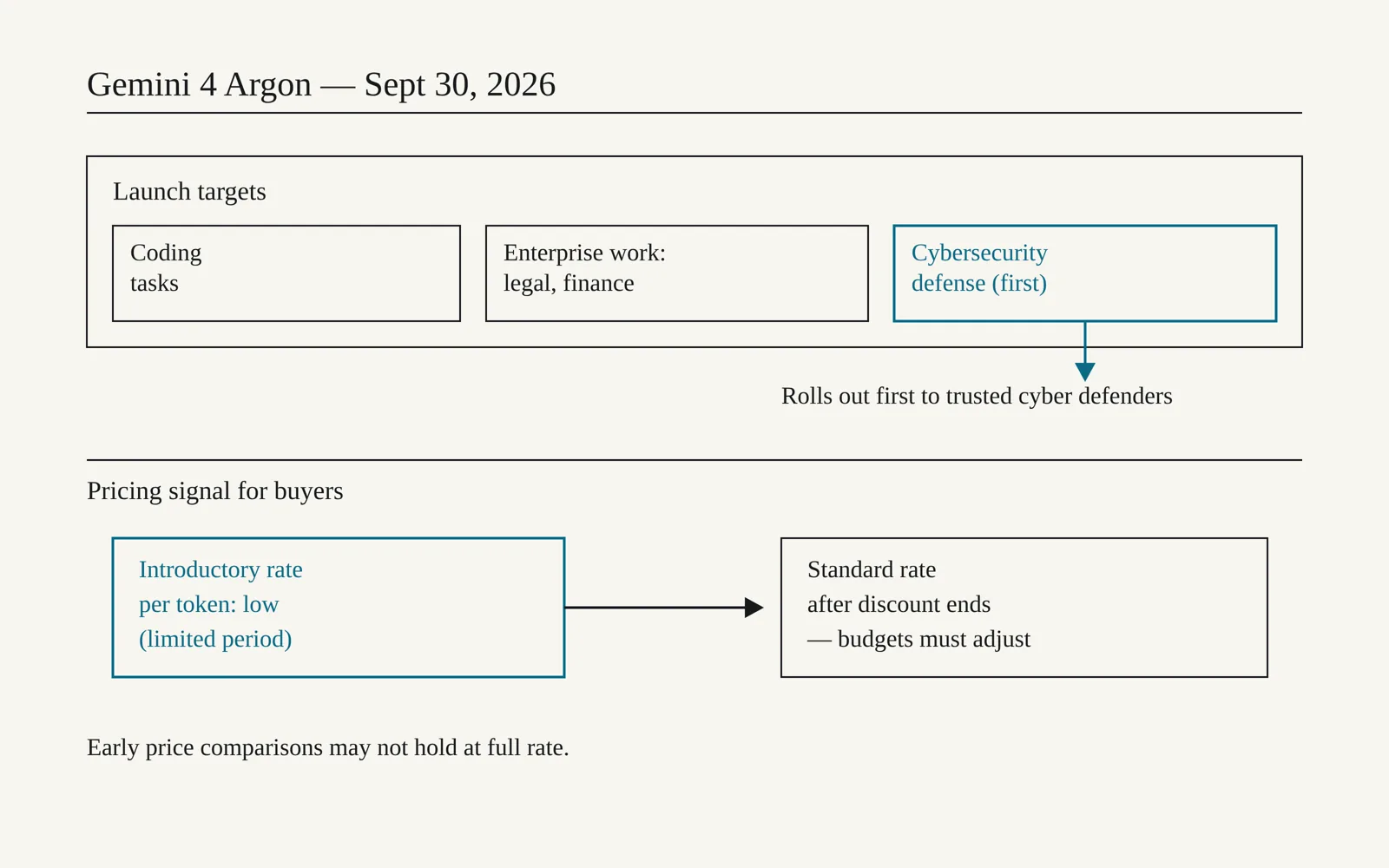
On September 30, 2026, Google announced Gemini 4 Argon, a new frontier model aimed at coding, enterprise knowledge work such as legal and finance tasks, and cybersecurity defense, rolling out first to trusted cyber defenders through its Fairwind Program ahead of wider access for paid API customers and Google AI Ultra subscribers. (Google newsroom post introducing Gemini 4 Argon, published September 30, 2026)
Open the photograph at full size
Photograph: Diagram: AI Journey
Read the full description of this diagram
Diagram drawn for this item: Google Launches Gemini 4 Argon Frontier Model. On September 30, 2026, Google announced Gemini 4 Argon, a new frontier model aimed at coding, enterprise knowledge work such as legal and finance tasks, and cybersecurity defense, rolling out first to trusted cyber defenders through its... The announcement matters for buyers weighing frontier models against each other, because Google set an introductory per-token rate well below the price that applies once the discount period ends, so budgets built around the early figure...
The numbers
Input token price
$2
Introductory price per million input tokens, rising to $4 after the period ends
Output token price
$10
Introductory price per million output tokens, rising to $20 after the period ends
Coding benchmark
77.9%
DeepSWE v1.1 score, a long-horizon software engineering benchmark
Vulnerability remediation
68%
CWE-bench v1 score, tied for first place
Read from Google newsroom post introducing Gemini 4 Argon, published September 30, 2026
What they are saying
Outlets read
Google parent company Alphabet has launched Gemini 4 Argon, a new AI model built to handle a variety of tasks such as coding, research, and writing.
read
Now, Google is ready to take on the frontier again with Gemini 4 Argon.
read
Alphabet unveiled Gemini 4 Argon on Wednesday, its most advanced artificial intelligence model yet, offering major improvements in coding, cybersecurity, and complex professional work.
read
Our verdict
TechCrunch and CNBC both frame Argon through the tasks it claims to handle, while Ars Technica treats the launch mainly as a competitive move against rival labs. None of the three outlets dwells on the pricing structure or the testing limited to cyber defenders that Google's own page sets out first.
What it means for you
The announcement matters for buyers weighing frontier models against each other, because Google set an introductory per-token rate well below the price that applies once the discount period ends, so budgets built around the early figure face a steep jump later. The staged release also means the model's heaviest workflow claims, on coding and vulnerability patching, cannot yet be checked by anyone outside Google's chosen testers.
In more detail
Google released Gemini 4 Argon on September 30, 2026, positioning it as the company’s next frontier model for software engineering, enterprise research and cybersecurity defense. SVP Koray Kavukcuoglu framed the model around sustained reasoning through long, complex workflows rather than quick single-turn answers. The company is not opening it widely yet. It first reaches a small group of trusted cyber defenders through what Google calls its Fairwind Program, with paid API customers and Google AI Ultra subscribers next in line once testing finishes.
Google says Argon already supports internal teams, pointing to work on quantum algorithm optimization, large scale migrations of C and C++ code into Rust, and memory efficiency work across its data centers that it says freed hundreds of terabytes of capacity. The company also widened Argon’s output limit sharply, moving from 64,000 tokens to 1 million tokens, a change meant to let the model work through long multi step problems in a single pass rather than breaking a task into smaller calls.
On cybersecurity, Google says Argon can find, check and patch vulnerabilities on its own, and it is releasing the model to internal teams and outside partners such as Wiz without the usual cyber safety limits, so they can draw on its full defensive capability. Google frames this as a response to a harder era of cyberattacks, and says the model found a flaw in hospital software that earlier models had missed.
Before opening Argon more broadly, Google lists four safeguard areas it is strengthening: blocking misuse for cyber or chemical, biological, radiological and nuclear purposes, resisting prompt injection attacks, watching the model’s own chain of thought for signs it is acting outside a user’s intent, and sealing the sandboxes used for training and testing. The company says it is also taking part in the US government’s voluntary process for pre-release model access while it works through these checks.
The numbers
- Input tokens carry an introductory price of $2 per million, rising to $4 per million once that period ends.
- Output tokens are priced at $10 per million during the same introductory window, climbing to $20 per million afterward.
- Argon scored 77.9% on DeepSWE v1.1, a benchmark of long horizon software engineering tasks, which Google calls a new state of the art result.
- On CWE-bench v1, which checks a model’s skill at fixing security flaws, Argon tied for first place with a score of 68%.
The staged rollout, starting with cyber defenders rather than the public, suggests Google wants outside pressure testing on a model it is marketing through professional and defensive use cases first, well before it reaches a consumer chat window.
Sources
Sources read
Google newsroom post introducing Gemini 4 Argon, published September 30, 2026 (blog.google)
Newsroom read
Cite this
AI Journey, "Google Launches Gemini 4 Argon Frontier Model", 1 Oct 2026, https://aijourney.space/updates/2026-10-01-gemini-4-argon-our-next-era-of-frontier-intelligence/ (source: Google, verified 1 Oct 2026)
Next in the stream
Google's Flu Forecasting Model Ranks First in CDC Evaluation
Google said a flu forecasting model it built, powered by an AI research tool, ranked best among entries judged in the CDC's FluSight evaluation for the 2025-26 season.
Previous
Paper Pairs LLaMA-3 With Gemini Vision For Medical Reports
A new paper describes MeddeX, a medical report analyzer that pairs a fine-tuned LLaMA-3 model with Google's Gemini Vision for reading scanned and radiological images.
Next
More in Google
Google.org Funds Five Groups Building AI Tools For Teachers
Google.org is funding five organizations building AI tools for teachers, pairing Google DeepMind's model work with grants aimed at classroom use.
Gemini Negotiation Paper Finds Persona Effects Shift By Language
A new paper testing Google's Gemini model in buyer-seller negotiations found that the same persona instruction produced different deal outcomes in English and Korean.
Paper Finds Gemini Monitor Beats Small Models At Spotting Reward Hacking
A new paper tests whether Google's Gemini 3.1 Flash-Lite can tell real reward hacking apart from honest failure better than small local monitors.