Event Published Models and productsGoogle
Google's Flu Forecasting Model Ranks First in CDC Evaluation
Google said a flu forecasting model it built, powered by an AI research tool, ranked best among entries judged in the CDC's FluSight evaluation for the 2025-26 season.
What happened
Published here
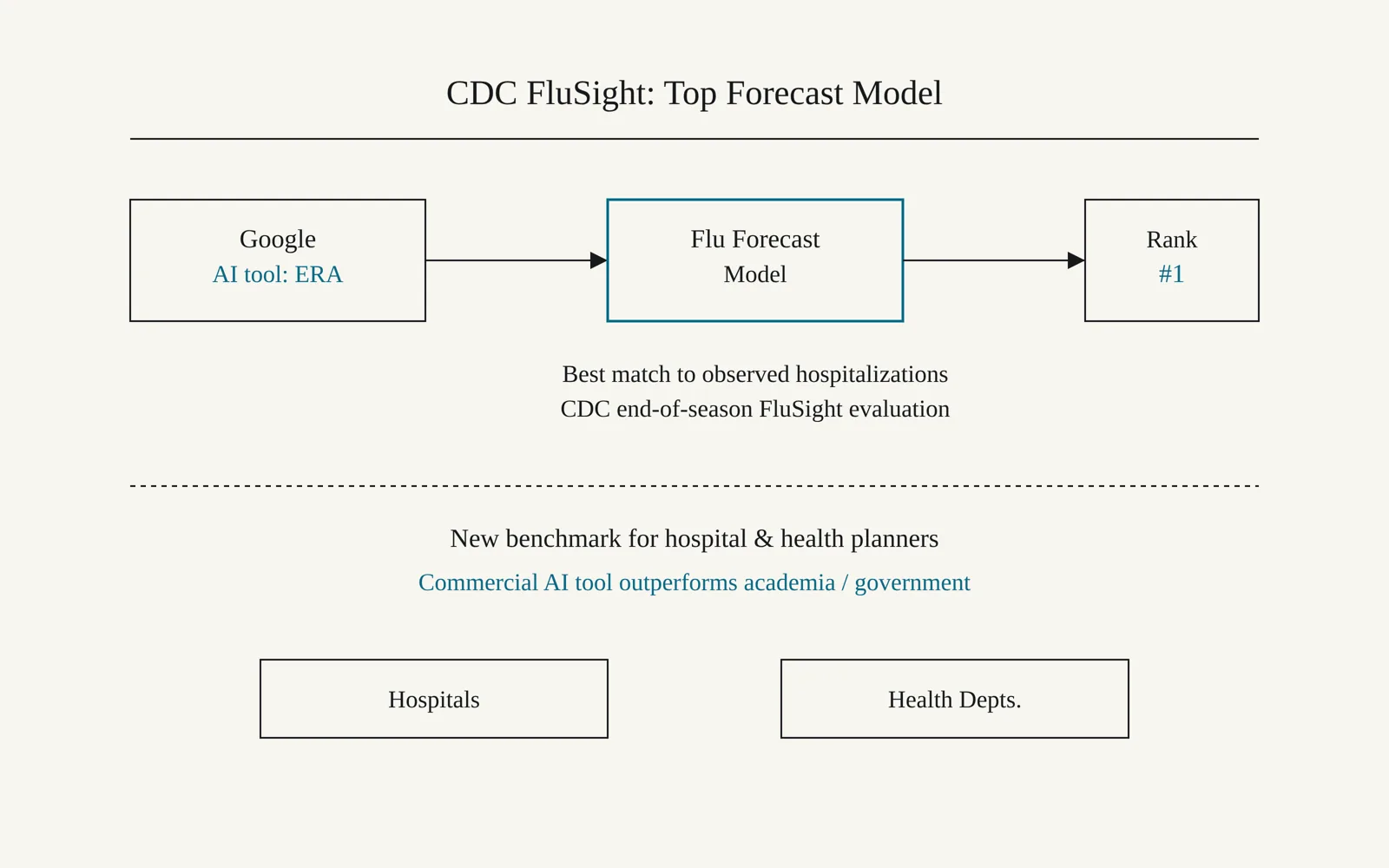
On September 30, 2026, Google said the Centers for Disease Control and Prevention's end of season FluSight analysis found that a flu forecasting model it built, using an AI tool called Empirical Research Assistance, best matched observed hospital admissions among 39 eligible models submitted for the 2025-26 season. (Google Research newsroom post on the CDC FluSight evaluation, published September 30, 2026)
Open the photograph at full size
Photograph: Diagram: AI Journey
Read the full description of this diagram
Diagram drawn for this item: Google's Flu Forecasting Model Ranks First in CDC Evaluation. On September 30, 2026, Google said the Centers for Disease Control and Prevention's end of season FluSight analysis found that a flu forecasting model it built, using an AI tool called Empirical Research Assistance, best matched observed... For hospital planners and local health departments, the result means a model trained with a commercial AI company's optimization tool, not a university lab or a government agency alone, now sets the published benchmark used to anticipate...
What it means for you
For hospital planners and local health departments, the result means a model trained with a commercial AI company's optimization tool, not a university lab or a government agency alone, now sets the published benchmark used to anticipate emergency room demand, which raises the question of how much weight officials should give a single vendor's forecast against the combined pool before changing staffing or supply decisions next flu season.
In more detail
Google said this week that a flu forecasting model it built outperformed every other entry judged in the Centers for Disease Control and Prevention’s FluSight evaluation for the 2025-26 flu season. The CDC runs FluSight from October through May each year, combining weekly submissions from government, industry and academic teams that predict United States hospital admissions for the current week and three weeks ahead. The agency uses the combined forecast to tell states and hospitals what demand for care to expect.
The end of season analysis, published this week, measured 39 eligible models against the season’s actual recorded hospital admissions. Google’s submission matched those figures more closely than any of the others. The company built its forecast using a tool it calls Empirical Research Assistance, described as software that generates optimization algorithms across scientific fields rather than a single purpose epidemiology model. Google said the underlying technology behind that tool was recently described in a paper published in the journal Nature, and that it is now available to a limited group of outside testers through its experimental science program.
Google framed the result as evidence that combining AI systems with researchers’ judgment can improve disease forecasting generally, a claim the company has also made about other science applications it has pursued this year, including work on materials design and space infrastructure.
The numbers
The CDC’s FluSight programme drew submissions from 39 eligible models for the 2025-26 season, spanning government, industry and academic teams. Google’s entry, built on its Empirical Research Assistance tool, was the one the CDC’s end of season review found closest to the season’s actual hospital admission counts. The evaluation ran across the full October to May flu season, scoring each submission on both the current week’s predicted admissions and a three week forward outlook, which is the window hospitals use to plan staffing.
No pricing or availability details accompanied the announcement. Google has not said whether the forecasting model itself, as opposed to the underlying research tool, will be offered to health agencies outside the CDC pilot, or whether future seasons will see it submit again under the same evaluation rules. For now the claim rests on one season’s results judged by a single federal programme, not on a published independent audit of the model’s code or training data.
Sources
Sources read
Google Research newsroom post on the CDC FluSight evaluation, published September 30, 2026 (blog.google)
Newsroom read
Cite this
AI Journey, "Google's Flu Forecasting Model Ranks First in CDC Evaluation", 1 Oct 2026, https://aijourney.space/updates/2026-10-01-google-s-ai-ranks-1-for-predicting-flu-hospitalizations/ (source: Google, verified 1 Oct 2026)
Next in the stream
Preprint Releases 160,000 Article Brazilian Portuguese Financial Dataset
A new preprint presents a 160,000 article Brazilian Portuguese financial news corpus and tests weak supervision methods for sorting it by topic.
Previous
Google Launches Gemini 4 Argon Frontier Model
Google introduced Gemini 4 Argon, a frontier model built for coding, enterprise knowledge work and cybersecurity defense, rolling out first to trusted testers.
Next
More in Google
Google.org Funds Five Groups Building AI Tools For Teachers
Google.org is funding five organizations building AI tools for teachers, pairing Google DeepMind's model work with grants aimed at classroom use.
Gemini Negotiation Paper Finds Persona Effects Shift By Language
A new paper testing Google's Gemini model in buyer-seller negotiations found that the same persona instruction produced different deal outcomes in English and Korean.
Paper Finds Gemini Monitor Beats Small Models At Spotting Reward Hacking
A new paper tests whether Google's Gemini 3.1 Flash-Lite can tell real reward hacking apart from honest failure better than small local monitors.