Event Published ResearchResearch
Preprint Releases 160,000 Article Brazilian Portuguese Financial Dataset
A new preprint presents a 160,000 article Brazilian Portuguese financial news corpus and tests weak supervision methods for sorting it by topic.
What happened
Published here
On September 29, 2026, researchers posted a preprint on arXiv describing a corpus of roughly 160,000 Brazilian Portuguese financial news articles gathered from web sources, along with benchmark tests of three similarity based methods for sorting the articles into classes without full manual labeling. (arXiv preprint 2610.20630, submitted September 29, 2026)
Open the photograph at full size
Photograph: Diagram: AI Journey
Read the full description of this diagram
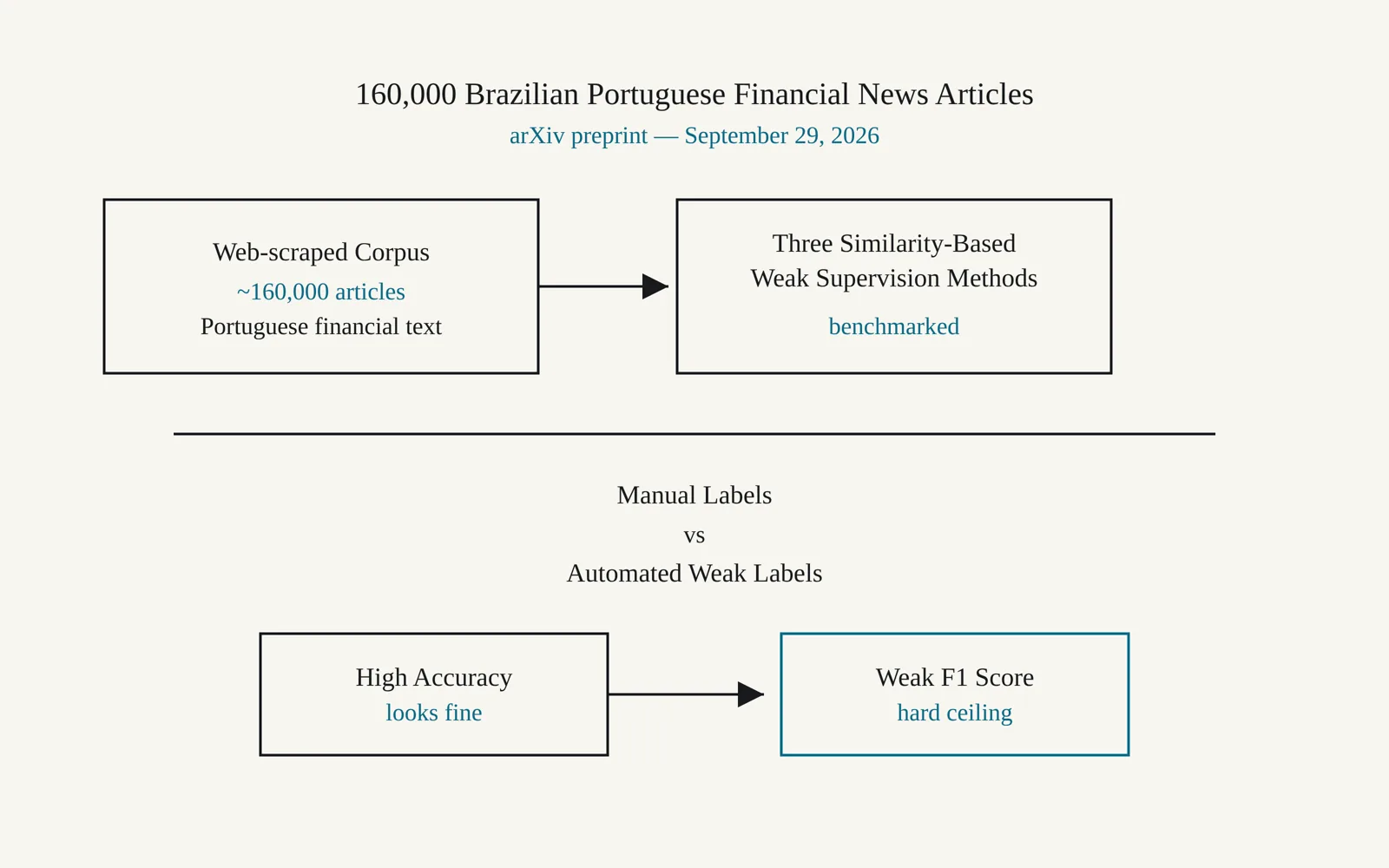
Diagram drawn for this item: Preprint Releases 160,000 Article Brazilian Portuguese Financial Dataset. On September 29, 2026, researchers posted a preprint on arXiv describing a corpus of roughly 160,000 Brazilian Portuguese financial news articles gathered from web sources, along with benchmark tests of three similarity based methods for... For anyone building a Portuguese language financial monitoring tool, the gap between manual and automated labeling sets a hard ceiling on what a weak supervision shortcut can deliver: a pipeline can look fine on raw accuracy while its F1...
The numbers
Corpus size
160,000
Brazilian Portuguese financial news articles collected
KNN accuracy
47.3%
On the manually labeled subset
KNN F1-score
31.9%
On the manually labeled subset
LLM-labeled accuracy
50%
Approximately, on the LLM-annotated subset
Read from arXiv preprint 2610.20630, submitted September 29, 2026
What it means for you
For anyone building a Portuguese language financial monitoring tool, the gap between manual and automated labeling sets a hard ceiling on what a weak supervision shortcut can deliver: a pipeline can look fine on raw accuracy while its F1 score falls apart, so a team choosing between paying for human annotation and trusting an LLM to tag training data is choosing between a slower build and a system that reads financial news less reliably than the headline number suggests.
In more detail
Researchers working on financial natural language processing for Brazilian Portuguese have published a dataset meant to close a gap in the field: most financial text classification work targets English, leaving Portuguese language systems with little domain specific data to train on. The team, led by Leomax Bandeira and six co-authors, built a corpus of roughly 160,000 financial news articles scraped from web sources and then set out to test whether the articles could be sorted into categories without paying for full manual annotation of the whole set.
To test that, the authors annotated subsets of the corpus two ways: by hand, and by asking a large language model to assign labels automatically. They then ran three similarity based classification methods, cosine similarity, K-Nearest Neighbors, and FAISS based nearest-neighbor search, using multilingual semantic embeddings, and compared how each performed depending on which labeling approach fed it.
The results split sharply by label source. On the manually labeled subset, KNN was the strongest method, and FAISS trailed closely behind it. On the LLM-annotated subset, accuracy held up reasonably well, but F1-score, the measure that balances precision against recall and punishes a classifier that leans on the most common category, fell far short. The authors attribute that drop to label imbalance and noise introduced by the automated weak annotations, and they conclude that high quality manual annotation remains necessary for this kind of task, at least with current weak supervision methods.
The numbers
- The corpus runs to approximately 160,000 Brazilian Portuguese financial news articles.
- KNN reached 47.3% accuracy and a 31.9% F1-score on the manually labeled subset, the best result the authors recorded.
- On the LLM-annotated subset, accuracy reached approximately 50% while F1-scores dropped to near 20%, the clearest sign in the paper that an accuracy number alone can hide a weak classifier.
The paper, accepted for presentation at SMC 2026, frames its results as a baseline rather than a finished system, and the authors say the dataset itself is the more lasting contribution: a reference point other groups working on Brazilian Portuguese financial text can build against, rather than a method anyone should deploy as is.
Sources
Sources read
arXiv preprint 2610.20630, submitted September 29, 2026 (arxiv.org)
Paper read
Cite this
AI Journey, "Preprint Releases 160,000 Article Brazilian Portuguese Financial Dataset", 16 Oct 2026, https://aijourney.space/updates/2026-10-16-a-large-scale-dataset-for-multi-class-financial-news-classification-in-b/ (source: arXiv, verified 16 Oct 2026)
Next in the stream
Paper Tests Whether DeepSeek Models Earn Predictive Credit for Explanations
A new paper tests whether DeepSeek's models add real predictive value when research agents explain planned experiments, not just describe them.
Previous
Google's Flu Forecasting Model Ranks First in CDC Evaluation
Google said a flu forecasting model it built, powered by an AI research tool, ranked best among entries judged in the CDC's FluSight evaluation for the 2025-26 season.
Next
More in Research
Study Finds Precedent Labels Sway Claude Haiku Approval Calls
A new paper tests Claude Haiku 5.5 alongside other models on refund and claim decisions, showing that past case labels shift approvals sharply.
Paper Tests Claude Opus 4.8 Agents on Conflicting Code Edits
A new paper benchmarks Claude Code running Claude Opus 4.8 against other coding agents on tasks where two agents edit the same shared codebase at once.
Perplexity AI Researchers Detail LoRA Recipe For Converting Four Language Models To Diffusion
A paper associated with Perplexity AI describes BYOD, a LoRA-only method that converts standard autoregressive language models into diffusion language models without full retraining.