What happened
Published here
On October 8, 2026, researchers including Xiaolong Li posted a paper to arXiv describing GenUI-Harness, a multi-agent system that pairs a tool agent with a GUI coder agent to generate structured interfaces instead of plain text replies, tested on a new benchmark called UI-TAU Bench built from ten real world domain databases. (arXiv paper abstract page, When Interfaces Speak, submitted October 8, 2026)
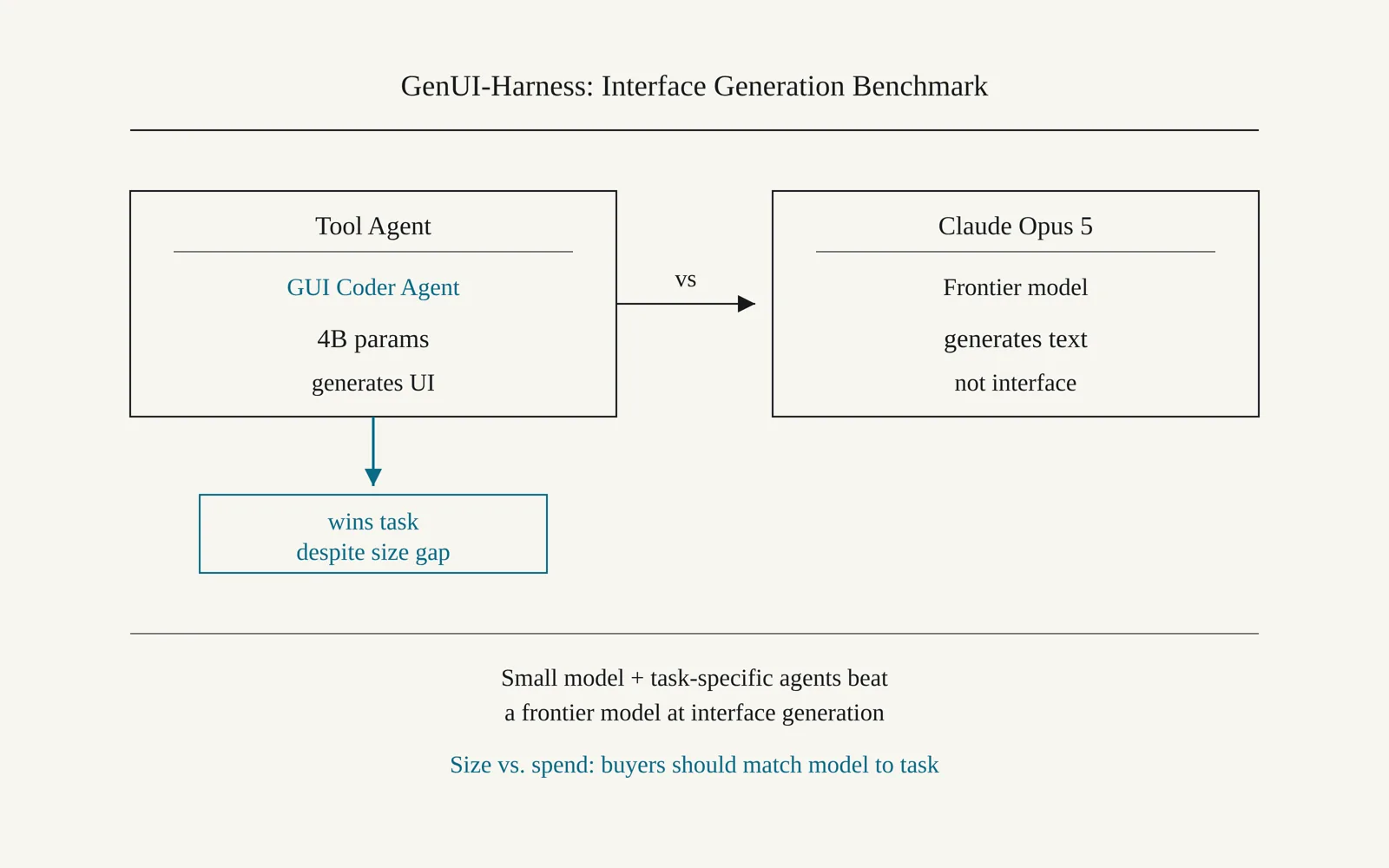
Open the photograph at full size
Photograph: Diagram: AI Journey
Read the full description of this diagram
Diagram drawn for this item: Paper Benchmarks Generative UI Agents Against Claude Opus 5. On October 8, 2026, researchers including Xiaolong Li posted a paper to arXiv describing GenUI-Harness, a multi-agent system that pairs a tool agent with a GUI coder agent to generate structured interfaces instead of plain text replies... The comparison puts a small four billion parameter model ahead of a named frontier system on a task that is not raw language generation but interface generation, which bears on how a buyer reads a model size versus task spend tradeoff when...
The numbers
Pass@3 gain over smolagents
4.48 percentage points
GenUI-Harness average gain on the Lite split
4B backbone before training
9.33%
Pass@3 score before GenUI-Harness training
4B backbone after training
58.00%
Pass@3 score after GenUI-Harness training
Claude Opus 5 score
46.67%
Pass@3 score for Claude Opus 5 on the same task
Read from arXiv paper abstract page, When Interfaces Speak, submitted October 8, 2026
What it means for you
The comparison puts a small four billion parameter model ahead of a named frontier system on a task that is not raw language generation but interface generation, which bears on how a buyer reads a model size versus task spend tradeoff when choosing a backbone for an agent product rather than a chat product.
In more detail
Most interaction with AI agents today still happens through plain text, which the paper’s authors argue creates cognitive overload and slows down complex tasks that would be easier to complete through a structured screen. The paper, posted to arXiv on October 8, 2026 by Xiaolong Li and seven co-authors, proposes GenUI-Harness, a system that pairs a tool agent handling retrieval and execution with a coder agent that writes front-end code for the interface on the fly, rather than answering purely in words.
The harder part of the work is training that coder agent. Verifiable rewards for whether a generated interface actually works require running it, which is costly, while letting another model judge the output invites reward hacking, where the judge is fooled rather than the interface improved. The authors built two pieces to handle this: Dynamic UX, a lightweight sandbox for collecting interaction and reward signals in one place, and Reward Auditor, a mechanism that watches the spread of rewards and turns recurring problems into a shared scoring rubric.
To test the approach they built UI-TAU Bench, a benchmark drawn from ten real world domain databases and based on the tool-use settings of the existing Tau-Bench, with a 300 task Lite split and a 1,000 task Full split. On Lite, GenUI-Harness lifted a small four billion parameter backbone from a 9.33% Pass@3 score to 58.00%, which the paper reports as higher than Claude Opus 5’s 46.67% on the identical setting. It also reported an average Pass@3 gain of 4.48 percentage points over the smolagents framework.
The numbers
A separate reviewer survey found that generated interfaces cut the average number of dialogue rounds needed to finish a task from 3.4 to 1.2, which is the clearest practical claim in the paper: fewer back and forth exchanges to get the same job done. The authors also note the harness held up on both ambiguous and unambiguous queries, which matters because a system that only works when the request is already clear is not solving the overload problem it was built for.
For anyone comparing model choices for agent products rather than chat products, the result is a reminder that a frontier chat model’s language fluency does not automatically translate into the best score on a workflow built around generated interfaces, and that a smaller, task-trained backbone can close or reverse that gap on a narrow benchmark.
Sources
Sources read
arXiv paper abstract page, When Interfaces Speak, submitted October 8, 2026 (arxiv.org)
Paper read
Cite this
AI Journey, "Paper Benchmarks Generative UI Agents Against Claude Opus 5", 9 Oct 2026, https://aijourney.space/updates/2026-10-09-when-interfaces-speak-data-aware-generative-ui-harness-for-active-intera/ (source: arXiv, verified 9 Oct 2026)
Next in the stream
Google Cloud Launches Gemini Agent For Work
Google Cloud introduced the Gemini agent at its Gemini at Work event, a single prompt box meant to plan tasks, pick a model and reach into a company's own systems.
Previous
Google-BIDMC AMIE Study Published in The Lancet
Google published a peer reviewed study in The Lancet describing how its AMIE research AI performed during real primary care visits at a Boston clinic.
Next
More in Anthropic
Study Finds Precedent Labels Sway Claude Haiku Approval Calls
A new paper tests Claude Haiku 5.5 alongside other models on refund and claim decisions, showing that past case labels shift approvals sharply.
Paper Tests Claude Opus 4.8 Agents on Conflicting Code Edits
A new paper benchmarks Claude Code running Claude Opus 4.8 against other coding agents on tasks where two agents edit the same shared codebase at once.
Paper Finds Claude Opus 5.5 Agent Beats Automated CT Labeling Harness
A new paper testing CT scan labeling finds a free-form agent running Claude Opus 5.5 outscored an automated review harness on most of six public datasets.