What happened
Published here
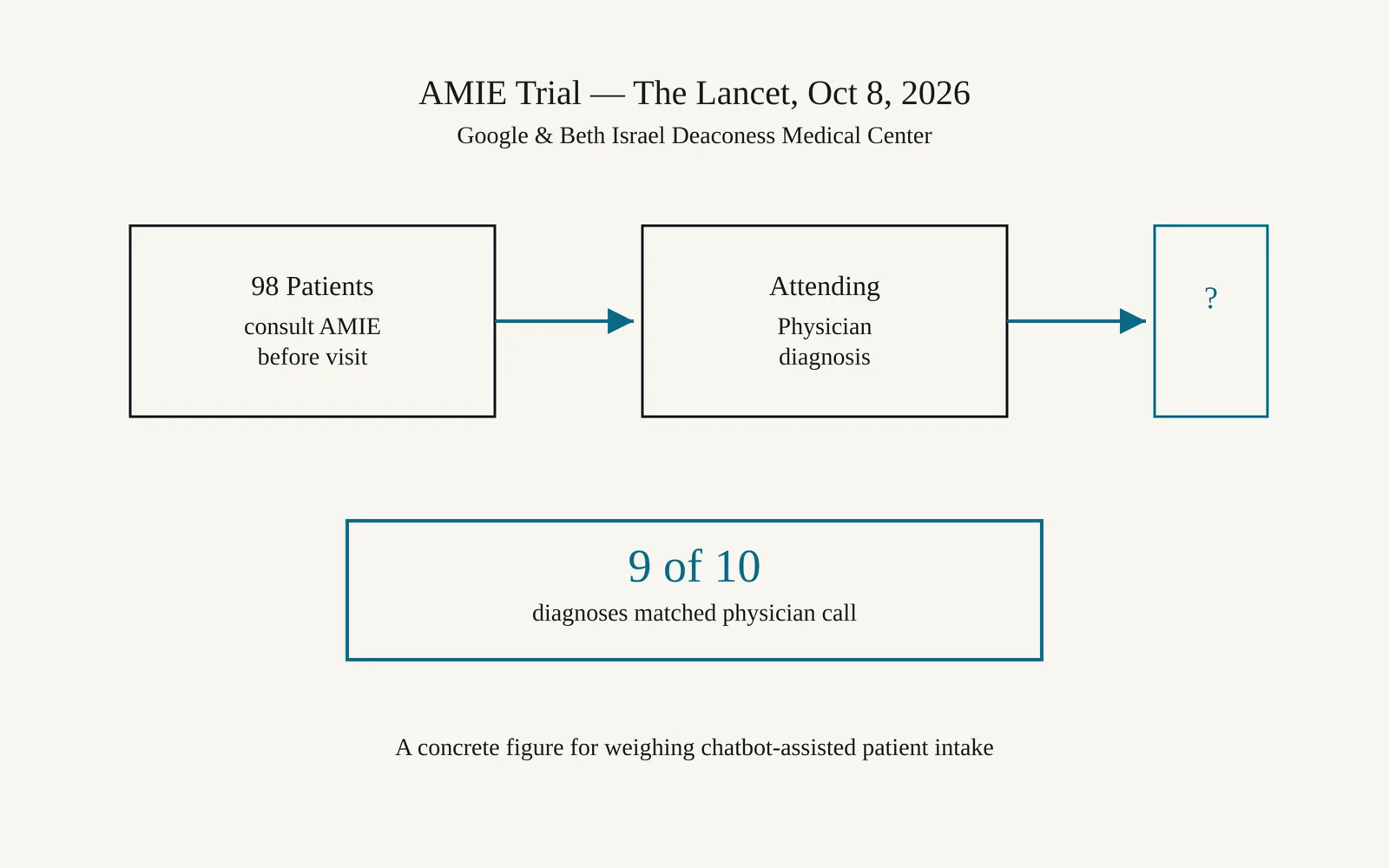
On October 8, 2026, Google and physicians at Beth Israel Deaconess Medical Center published a study in The Lancet describing a real world clinical trial in which 98 patients consulted Google's AMIE research diagnostic chatbot ahead of urgent primary care visits, with supervising physicians monitoring every conversation in real time and no conversation interrupted on safety grounds. (Google newsroom post on the AMIE clinical study published in The Lancet, October 8, 2026)
Open the photograph at full size
Photograph: Diagram: AI Journey
Read the full description of this diagram
Diagram drawn for this item: Google-BIDMC AMIE Study Published in The Lancet. On October 8, 2026, Google and physicians at Beth Israel Deaconess Medical Center published a study in The Lancet describing a real world clinical trial in which 98 patients consulted Google's AMIE research diagnostic chatbot ahead of... For a clinic weighing whether to add a chatbot to patient intake, the trial gives a concrete figure to argue from: the suggested diagnosis lined up with the attending physician's call nine times out of ten, which turns the workflow...
The numbers
Patients in trial
98
Number of patients who consulted AMIE ahead of urgent care visits
Summaries helped prep
75%
Share of cases where clinicians said AI summaries helped them prepare
Diagnosis match rate
90%
Share of cases where AMIE's differential diagnosis matched the final one
Read from Google newsroom post on the AMIE clinical study published in The Lancet, October 8, 2026
What it means for you
For a clinic weighing whether to add a chatbot to patient intake, the trial gives a concrete figure to argue from: the suggested diagnosis lined up with the attending physician's call nine times out of ten, which turns the workflow question from whether to trust the tool into how much preparation time it actually saves before a visit starts. A reader judging any vendor's clinical AI pitch now has a public benchmark to ask that vendor to beat, rather than taking a marketing claim on faith.
In more detail
Google has published its first research paper in the main journal of The Lancet, describing a real world test of AMIE, the company’s research diagnostic chatbot, inside an active primary care clinic. The study was carried out with physicians at Beth Israel Deaconess Medical Center in Boston and tracked 98 patients who spoke with AMIE before urgent ambulatory care visits, rather than in a simulated or lab setting.
Supervising physicians watched every conversation as it happened, and the paper reports that none needed to be stopped under the safety rules set out before the trial began. That detail matters because most prior AMIE research, including earlier published work, relied on actors or recorded consultations rather than people with a genuine, same day medical need. Letting the tool speak directly with real patients ahead of a live visit, with a doctor able to intervene, is a different bar from a controlled demonstration.
Clinicians involved in the study also reported practical value from the AI generated summaries that AMIE produced after each conversation. In three quarters of cases, doctors said the summary helped them prepare for the visit, and in over half it changed how they approached the patient’s care. Separately, the differential diagnoses AMIE proposed lined up with the physician’s eventual diagnosis in nine of every ten cases, a figure Google is presenting as evidence the system can reason about a patient’s symptoms with real clinical accuracy rather than just producing plausible sounding text.
Google is careful to frame this as an early signal rather than proof the approach scales, noting that larger trials are still needed before any claim about broader deployment follows. There is no mention of a product timeline, a cost estimate or a plan to offer AMIE directly to patients outside research settings.
The numbers
- 98 patients consulted AMIE ahead of urgent primary care visits, each conversation supervised live by a physician.
- Clinicians said AI generated summaries helped them prepare for the visit in 75% of cases.
- AMIE’s differential diagnosis matched the physician’s final diagnosis in 90% of cases reviewed.
For health systems and insurers watching this space, the headline is not that an AI chatbot can produce a plausible diagnosis. It is that a hospital was willing to let one speak with real patients unscripted, under live physician supervision, and report the result in a leading medical journal rather than a company blog post alone.
Sources
Sources read
Google newsroom post on the AMIE clinical study published in The Lancet, October 8, 2026 (blog.google)
Newsroom read
Cite this
AI Journey, "Google-BIDMC AMIE Study Published in The Lancet", 9 Oct 2026, https://aijourney.space/updates/2026-10-09-study-in-the-lancet-suggests-ai-could-improve-patient-physician-relation/ (source: Google, verified 9 Oct 2026)
Next in the stream
Paper Benchmarks Generative UI Agents Against Claude Opus 5
A new paper submitted on October 8, 2026 introduces GenUI-Harness, a generative interface agent that outperforms Anthropic's Claude Opus 5 on a new UI benchmark.
Previous
Paper Proposes Error Detection Benchmark For AI Peer Review
A new paper argues that testing whether language models can imitate reviewer prose misses the point, and proposes a benchmark built around catching planted errors instead.
Next
More in Google
Google.org Funds Five Groups Building AI Tools For Teachers
Google.org is funding five organizations building AI tools for teachers, pairing Google DeepMind's model work with grants aimed at classroom use.
Gemini Negotiation Paper Finds Persona Effects Shift By Language
A new paper testing Google's Gemini model in buyer-seller negotiations found that the same persona instruction produced different deal outcomes in English and Korean.
Paper Finds Gemini Monitor Beats Small Models At Spotting Reward Hacking
A new paper tests whether Google's Gemini 3.1 Flash-Lite can tell real reward hacking apart from honest failure better than small local monitors.