Event Published ResearchResearch
Paper Proposes Error Detection Benchmark For AI Peer Review
A new paper argues that testing whether language models can imitate reviewer prose misses the point, and proposes a benchmark built around catching planted errors instead.
What happened
Published here
On October 8, 2026, researchers posted a paper to arXiv titled Beyond Imitation, describing a benchmark that tests whether review systems can find logical contradictions deliberately inserted into conference papers, alongside a Multi-Layered Review framework that reads a manuscript closely before writing feedback. (arXiv preprint 2610.11087, Beyond Imitation: A Framework and Benchmark for LLM-Assisted Peer Review, submitted October 8, 2026)
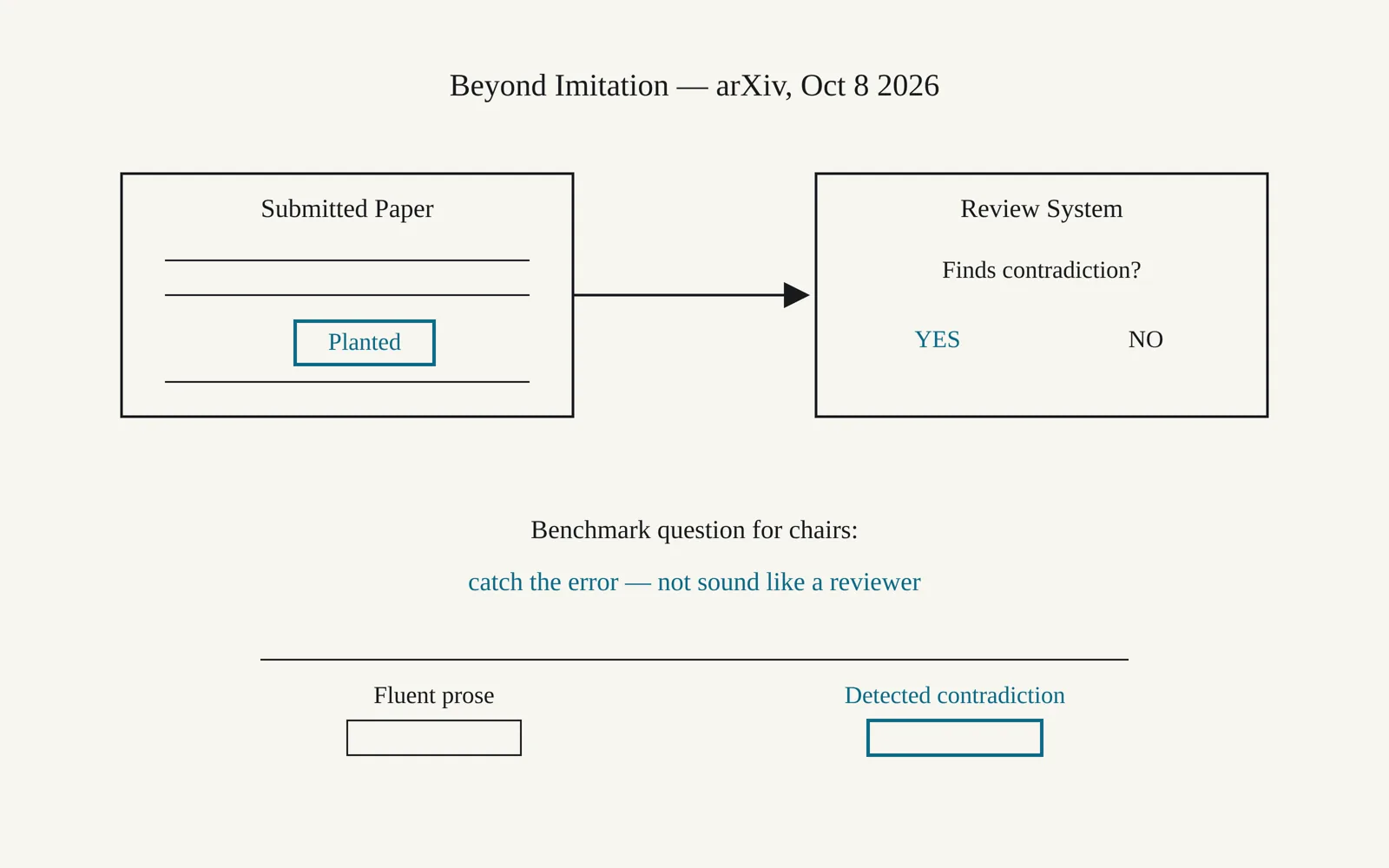
Open the photograph at full size
Photograph: Diagram: AI Journey
Read the full description of this diagram
Diagram drawn for this item: Paper Proposes Error Detection Benchmark For AI Peer Review. On October 8, 2026, researchers posted a paper to arXiv titled Beyond Imitation, describing a benchmark that tests whether review systems can find logical contradictions deliberately inserted into conference papers, alongside a... For programme chairs weighing whether to let a review assistant touch real submissions, this reframes the test: a tool should be judged on catching a planted contradiction, not on sounding like a reviewer, which changes what a lab should...
What it means for you
For programme chairs weighing whether to let a review assistant touch real submissions, this reframes the test: a tool should be judged on catching a planted contradiction, not on sounding like a reviewer, which changes what a lab should measure before it trusts the output on its own paper queue.
In more detail
Peer review in machine learning has been under strain for years, with more submissions arriving than qualified reviewers can read carefully, and conferences have begun experimenting with large language models as review assistants. Most of that work has measured success the wrong way, according to a paper posted to arXiv on October 8, 2026 by five authors including Rachel S.Y. Teo and Tarin Clanuwat. Existing evaluations, the authors write, have focused on getting a model’s output to sound like a human reviewer’s prose rather than checking whether the model actually does the job a reviewer is for: catching mistakes.
The paper’s core move is to flip the test. Instead of asking a model to write a convincing review and comparing it to a human one, the authors built a benchmark that inserts logical contradictions into real conference papers and asks a review system to find them. Because the errors are planted on purpose, there is an unambiguous answer for whether the system caught each one, which the authors argue existing imitation-style tests never provide.
Alongside the benchmark, the paper introduces a Multi-Layered Review framework that asks a model to build a detailed understanding of a manuscript before it attempts to write any review text at all, closer to how a careful human reviewer works, and claims this also uses fewer tokens along the way. The authors report that the approach aligns well with human review scores and performs strongly at spotting the planted contradictions, while also surfacing complementary points a human reviewer might focus on differently. They attribute the gains to a mix of which underlying model is used and how the review system itself is designed.
The numbers
The paper does not publish headline accuracy figures or a leaderboard in its abstract, but it does name the mechanism its results rest on: synthetic errors inserted into real conference papers, evaluated against a Multi-Layered Review framework built specifically to read before it writes. The authors are explicit that strong detection scores sit beside a weakness they call persistent, since the same systems remain vulnerable to adversarial manipulation designed to slip a contradiction past them undetected.
That caveat matters as much as the benchmark itself. A programme committee deciding whether to deploy a review assistant on live submissions is choosing a workflow, not just a tool, and a system that catches planted errors but can still be gamed by a submission written to hide one is a different risk than a system that merely writes unconvincing prose. The paper’s framing pushes future evaluation toward error-focused testing before any deployment decision, which is a narrower and more useful question than whether the writing reads like a person’s.
Sources
Sources read
Cite this
AI Journey, "Paper Proposes Error Detection Benchmark For AI Peer Review", 10 Oct 2026, https://aijourney.space/updates/2026-10-10-beyond-imitation-a-framework-and-benchmark-for-llm-assisted-peer-review/ (source: arXiv, verified 10 Oct 2026)
Next in the stream
Google-BIDMC AMIE Study Published in The Lancet
Google published a peer reviewed study in The Lancet describing how its AMIE research AI performed during real primary care visits at a Boston clinic.
Previous
Paper Proposes AliO Method to Fix Forecasting Output Drift
A new paper posted to arXiv finds that long-term time series forecasting models produce inconsistent predictions for the same timestamp and proposes a fix.
Next
More in Research
Study Finds Precedent Labels Sway Claude Haiku Approval Calls
A new paper tests Claude Haiku 5.5 alongside other models on refund and claim decisions, showing that past case labels shift approvals sharply.
Paper Tests Claude Opus 4.8 Agents on Conflicting Code Edits
A new paper benchmarks Claude Code running Claude Opus 4.8 against other coding agents on tasks where two agents edit the same shared codebase at once.
Perplexity AI Researchers Detail LoRA Recipe For Converting Four Language Models To Diffusion
A paper associated with Perplexity AI describes BYOD, a LoRA-only method that converts standard autoregressive language models into diffusion language models without full retraining.