Event Published ResearchResearch
Paper Proposes AliO Method to Fix Forecasting Output Drift
A new paper posted to arXiv finds that long-term time series forecasting models produce inconsistent predictions for the same timestamp and proposes a fix.
What happened
Published here
On October 8, 2026, researchers Kwangryeol Park, Jaeho Kim and Seulki Lee posted a paper to arXiv describing a problem in long-term time series forecasting, where state of the art models predict different values for the same future timestamp depending on which input window generated the prediction. The paper, accepted at NeurIPS 2025, proposes a method called AliO, short for Align Outputs, that reduces these discrepancies across overlapping forecasts in both the time and frequency domains, and introduces a companion metric called TAM, the Time Alignment Metric, to measure how consistent a model's outputs are rather than just how close they are to ground truth. (arXiv preprint abstract page, AliO: Output Alignment Matters in Long-Term Time Series Forecasing, submitted October 8, 2026)
Open the photograph at full size
Photograph: Diagram: AI Journey
Read the full description of this diagram
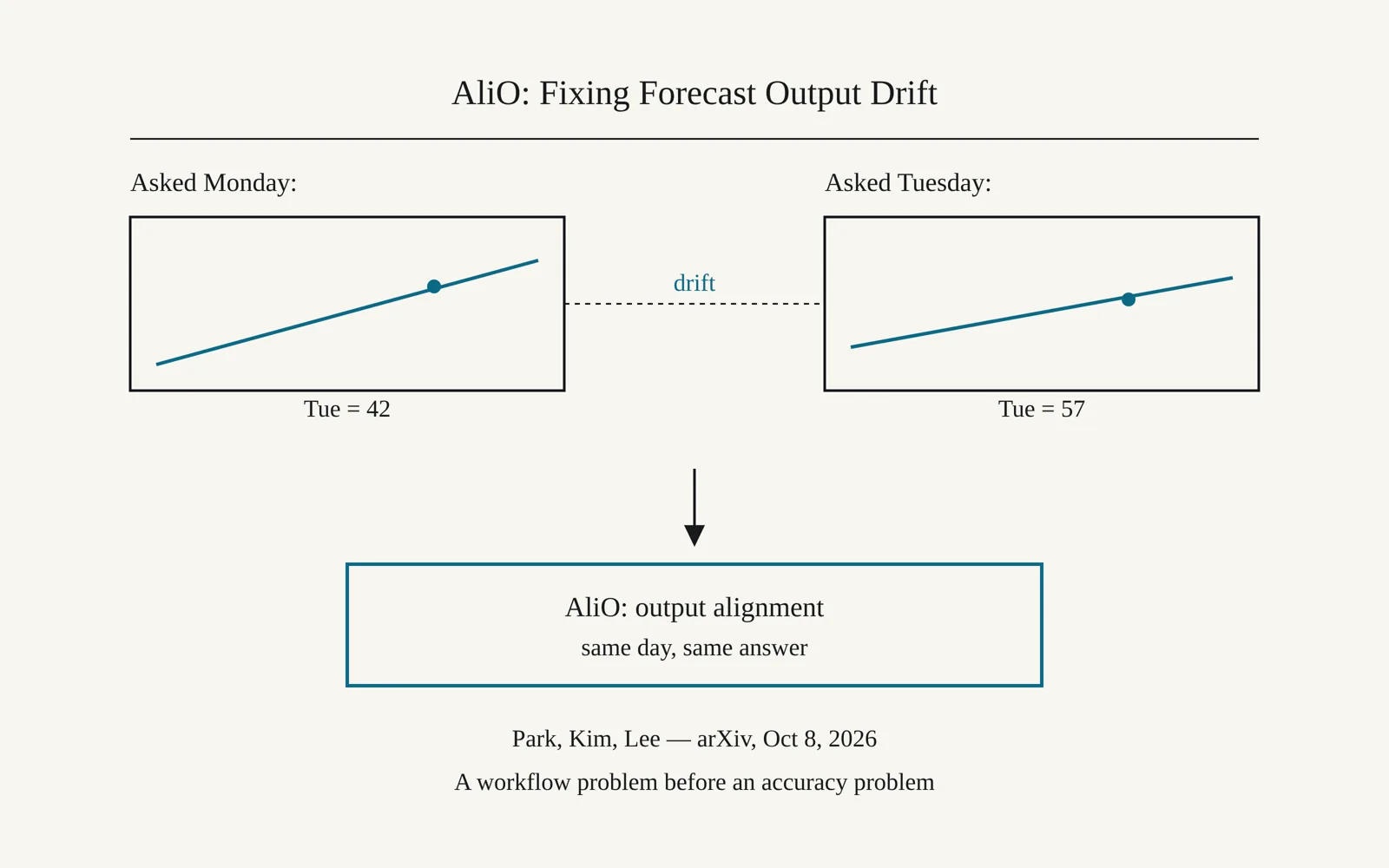
Diagram drawn for this item: Paper Proposes AliO Method to Fix Forecasting Output Drift. On October 8, 2026, researchers Kwangryeol Park, Jaeho Kim and Seulki Lee posted a paper to arXiv describing a problem in long-term time series forecasting, where state of the art models predict different values for the same future... For anyone building a forecasting pipeline that feeds a planning or trading decision, a model that predicts a different number for next Tuesday depending on when you asked it is a workflow problem long before it is an accuracy problem...
The numbers
TAM improvement
58.2%
Improvement in the paper's Time Alignment Metric reported for AliO
Forecasting performance gain
27.5%
Reported gain in forecasting performance alongside the alignment improvement
What it means for you
For anyone building a forecasting pipeline that feeds a planning or trading decision, a model that predicts a different number for next Tuesday depending on when you asked it is a workflow problem long before it is an accuracy problem, since dashboards that refresh daily will show the forecast line jumping even when the underlying model has not gotten worse by any standard error metric. A team choosing between models for electricity load planning or inventory forecasting now has a second axis, alignment, that existing error scores such as MSE do not capture at all, which changes what a buyer should ask a vendor to report.
In more detail
Long-term time series forecasting models are used to predict weeks or months ahead from a current data sequence, in settings such as weather forecasting and electricity consumption planning. A paper posted to arXiv on October 8, 2026 by Kwangryeol Park, Jaeho Kim and Seulki Lee identifies a problem in how these models behave that standard accuracy scores do not catch: when the same future timestamp is predicted from two different, overlapping input windows, the model often returns two different answers. The paper describes this as low output alignment, and argues that the fluctuation it causes undermines a model’s reliability even when its overall error rate looks fine.
The authors’ proposed fix is a method called AliO, for Align Outputs. Rather than changing how a model learns to minimize distance from ground truth, AliO works to reduce the gap between predictions for the same timestamp that come from different lagged input sequences, addressing both the time domain and the frequency domain versions of the mismatch. Because no existing metric was built to measure this kind of consistency, the paper also introduces TAM, the Time Alignment Metric, which the authors describe as scoring alignment between a model’s own outputs rather than scoring distance from the true value, the way an error metric such as MSE does.
The paper reports that AliO raises the TAM score, with the authors also stating that forecasting performance improves rather than trades off against alignment. Accepted at NeurIPS 2025 as a 46 page submission, the work sits in the growing body of forecasting research that treats reliability as a property distinct from accuracy.
The numbers
- TAM improvement: up to 58.2%, the reported gain in the paper’s alignment metric when AliO is applied.
- Forecasting performance: up to 27.5%, the reported improvement the authors say comes alongside the alignment gain, rather than at its expense.
The practical upshot for a team running a forecasting system in production is that a model can pass every standard accuracy check and still disagree with itself from one day to the next about what a given future date looks like. That gap is invisible to MSE and similar scores, so a procurement checklist built only around accuracy benchmarks will miss it entirely. Until alignment metrics such as TAM become part of standard vendor reporting, buyers evaluating forecasting tools for planning or trading decisions have no simple way to ask for this property by name, let alone compare it across providers.
Sources
Sources read
Cite this
AI Journey, "Paper Proposes AliO Method to Fix Forecasting Output Drift", 10 Oct 2026, https://aijourney.space/updates/2026-10-10-alio-output-alignment-matters-in-long-term-time-series-forecasing/ (source: arXiv, verified 10 Oct 2026)
Next in the stream
Paper Proposes Error Detection Benchmark For AI Peer Review
A new paper argues that testing whether language models can imitate reviewer prose misses the point, and proposes a benchmark built around catching planted errors instead.
Previous
Paper Introduces AgentHorizon Benchmark for AI Judges Grading Computer-Use Agents
A new paper introduces AgentHorizon, a benchmark testing whether AI judges can spot failed long computer-use tasks that merely look complete.
Next
More in Research
Study Finds Precedent Labels Sway Claude Haiku Approval Calls
A new paper tests Claude Haiku 5.5 alongside other models on refund and claim decisions, showing that past case labels shift approvals sharply.
Paper Tests Claude Opus 4.8 Agents on Conflicting Code Edits
A new paper benchmarks Claude Code running Claude Opus 4.8 against other coding agents on tasks where two agents edit the same shared codebase at once.
Perplexity AI Researchers Detail LoRA Recipe For Converting Four Language Models To Diffusion
A paper associated with Perplexity AI describes BYOD, a LoRA-only method that converts standard autoregressive language models into diffusion language models without full retraining.