Event Published ResearchResearch
Paper Introduces AgentHorizon Benchmark for AI Judges Grading Computer-Use Agents
A new paper introduces AgentHorizon, a benchmark testing whether AI judges can spot failed long computer-use tasks that merely look complete.
What happened
Published here
On October 8, 2026, researchers posted a paper on arXiv introducing AgentHorizon, a benchmark of 1,373 computer-use tasks built from 166 hours of human-recorded trajectories across three operating systems, designed to test whether automatic judges can tell a completed task from one that only looks finished. (AgentHorizon paper on arXiv, submitted October 8, 2026)
Open the photograph at full size
Photograph: Diagram: AI Journey
Read the full description of this diagram
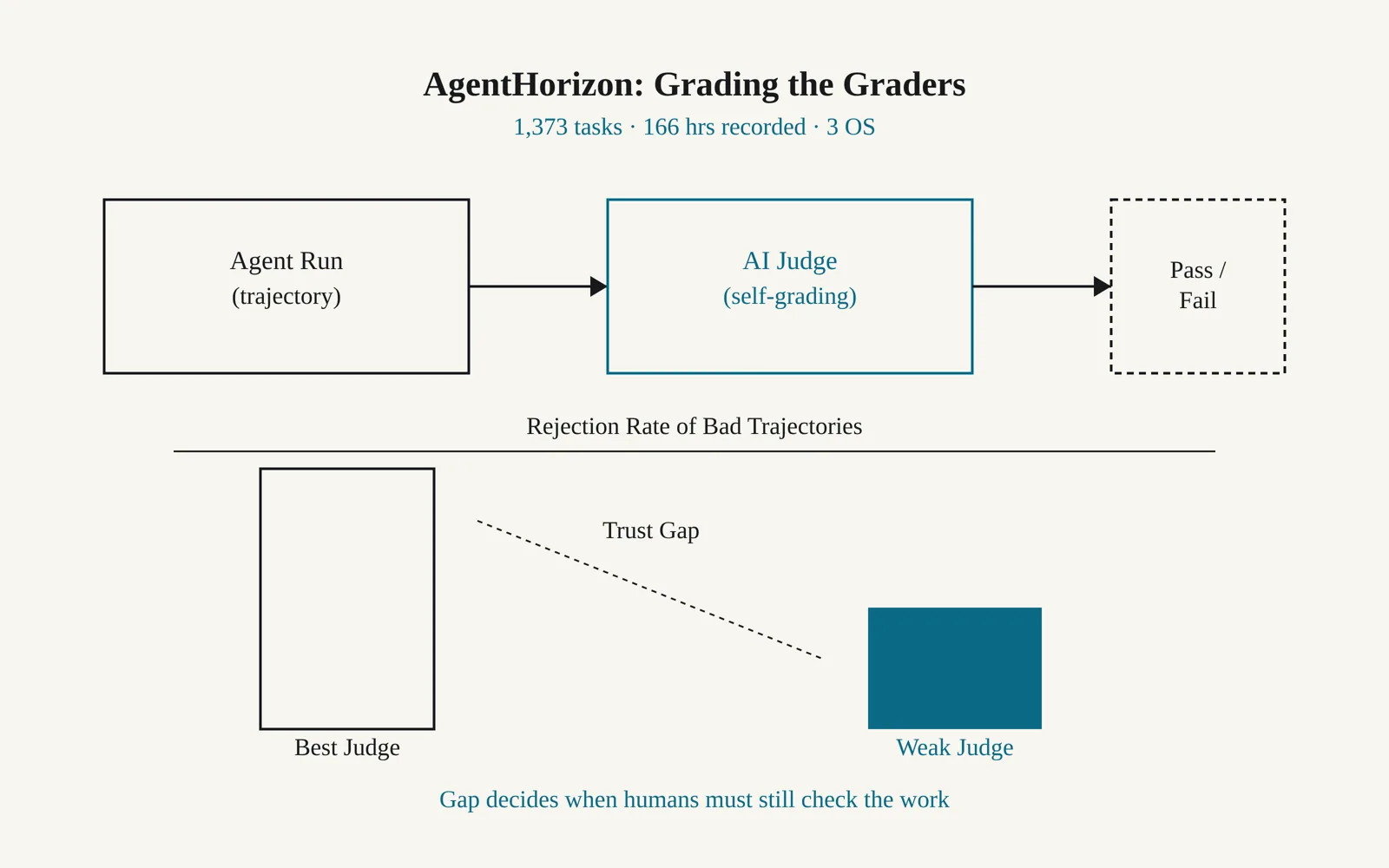
Diagram drawn for this item: Paper Introduces AgentHorizon Benchmark for AI Judges Grading Computer-Use Agents. On October 8, 2026, researchers posted a paper on arXiv introducing AgentHorizon, a benchmark of 1,373 computer-use tasks built from 166 hours of human-recorded trajectories across three operating systems, designed to test whether... For teams that let a model grade its own agent's work instead of paying a person to check every run, the paper's gap between judges on rejecting bad trajectories changes how much that automation can be trusted before a human still has to...
The numbers
Benchmark tasks
1,373
Instruction-trajectory pairs in the benchmark
Recorded hours
166 hours
Human-recorded trajectories the tasks are drawn from
Best judge accuracy
80.9%
Balanced accuracy of the best agentic judge, GPT-5.5, on the AH subset
Screenshots per trajectory
300
Maximum screenshots and actions passed directly to a judge
Read from AgentHorizon paper on arXiv, submitted October 8, 2026
What it means for you
For teams that let a model grade its own agent's work instead of paying a person to check every run, the paper's gap between judges on rejecting bad trajectories changes how much that automation can be trusted before a human still has to look. A workflow that swaps in an automatic judge without checking which model is grading it risks approving tasks that silently violated the original instruction or added a side effect nobody asked for.
In more detail
Computer-use agents, the systems that click, type and navigate across applications on a person’s behalf, are increasingly graded by other AI models rather than by humans, both during training and when checking whether a task actually succeeded. A paper posted to arXiv on October 8, 2026 argues that this shortcut is shakier than it looks once a task spans many steps and multiple applications, because a trajectory can look finished in its final screenshot while quietly breaking a constraint from the original instruction or introducing a side effect nobody wanted.
To test this, the authors built AgentHorizon, drawing on 166 hours of human-recorded trajectories across three operating systems to assemble 1,373 instruction-trajectory pairs. The design trick is pairing closely related instructions and swapping them between trajectories, which manufactures negative examples: a judge is shown a trajectory that completed a similar, but subtly incompatible, request, and has to notice the mismatch rather than reward surface completion. The benchmark ships in three splits, a frontier split, a simplified split, and a development split, so researchers can separate harder cases from easier ones.
Eleven judges were tested two ways: reading a full trajectory of up to 300 screenshots and actions directly, and acting as a coding agent across five separate agent harnesses. The strongest performer, GPT-5.5, reached 80.9% balanced accuracy on the harder AH subset, a result the paper frames as the ceiling rather than a solved problem. Giving judges tool access helped some models but made open-weight models worse, and the paper reports that judges varied sharply in how well they could both accept a genuinely successful trajectory and reject a failed one, rather than defaulting to approval.
The numbers
- 1,373 instruction-trajectory pairs make up the benchmark, drawn from 166 hours of recorded human trajectories.
- 300 screenshots and actions is the longest trajectory passed directly to a judge for evaluation.
- 80.9% balanced accuracy is the best score recorded, by GPT-5.5, on the AH subset.
- Eleven judges were tested across five agent harnesses, with tool-use improving some models and hurting open-weight ones.
The authors conclude that judges still need better ways of locating and verifying evidence hidden deep inside long interaction histories, a gap that matters for anyone deciding how much automated grading to trust before a human review step is removed from a pipeline.
Sources
Sources read
AgentHorizon paper on arXiv, submitted October 8, 2026 (arxiv.org)
Paper read
Cite this
AI Journey, "Paper Introduces AgentHorizon Benchmark for AI Judges Grading Computer-Use Agents", 10 Oct 2026, https://aijourney.space/updates/2026-10-10-agenthorizon-evaluating-agentic-judges-for-long-horizon-computer-use-tas/ (source: arXiv, verified 10 Oct 2026)
Next in the stream
Paper Proposes AliO Method to Fix Forecasting Output Drift
A new paper posted to arXiv finds that long-term time series forecasting models produce inconsistent predictions for the same timestamp and proposes a fix.
Previous
A New Paper Proposes a Unified Benchmark for AI Game Commentary
A new arXiv preprint introduces GameCommBench, a benchmark testing whether AI systems can produce usable live commentary across board games, sports and esports.
Next
More in Research
Study Finds Precedent Labels Sway Claude Haiku Approval Calls
A new paper tests Claude Haiku 5.5 alongside other models on refund and claim decisions, showing that past case labels shift approvals sharply.
Paper Tests Claude Opus 4.8 Agents on Conflicting Code Edits
A new paper benchmarks Claude Code running Claude Opus 4.8 against other coding agents on tasks where two agents edit the same shared codebase at once.
Perplexity AI Researchers Detail LoRA Recipe For Converting Four Language Models To Diffusion
A paper associated with Perplexity AI describes BYOD, a LoRA-only method that converts standard autoregressive language models into diffusion language models without full retraining.