Event Published ResearchResearch
A New Paper Proposes a Unified Benchmark for AI Game Commentary
A new arXiv preprint introduces GameCommBench, a benchmark testing whether AI systems can produce usable live commentary across board games, sports and esports.
What happened
Published here
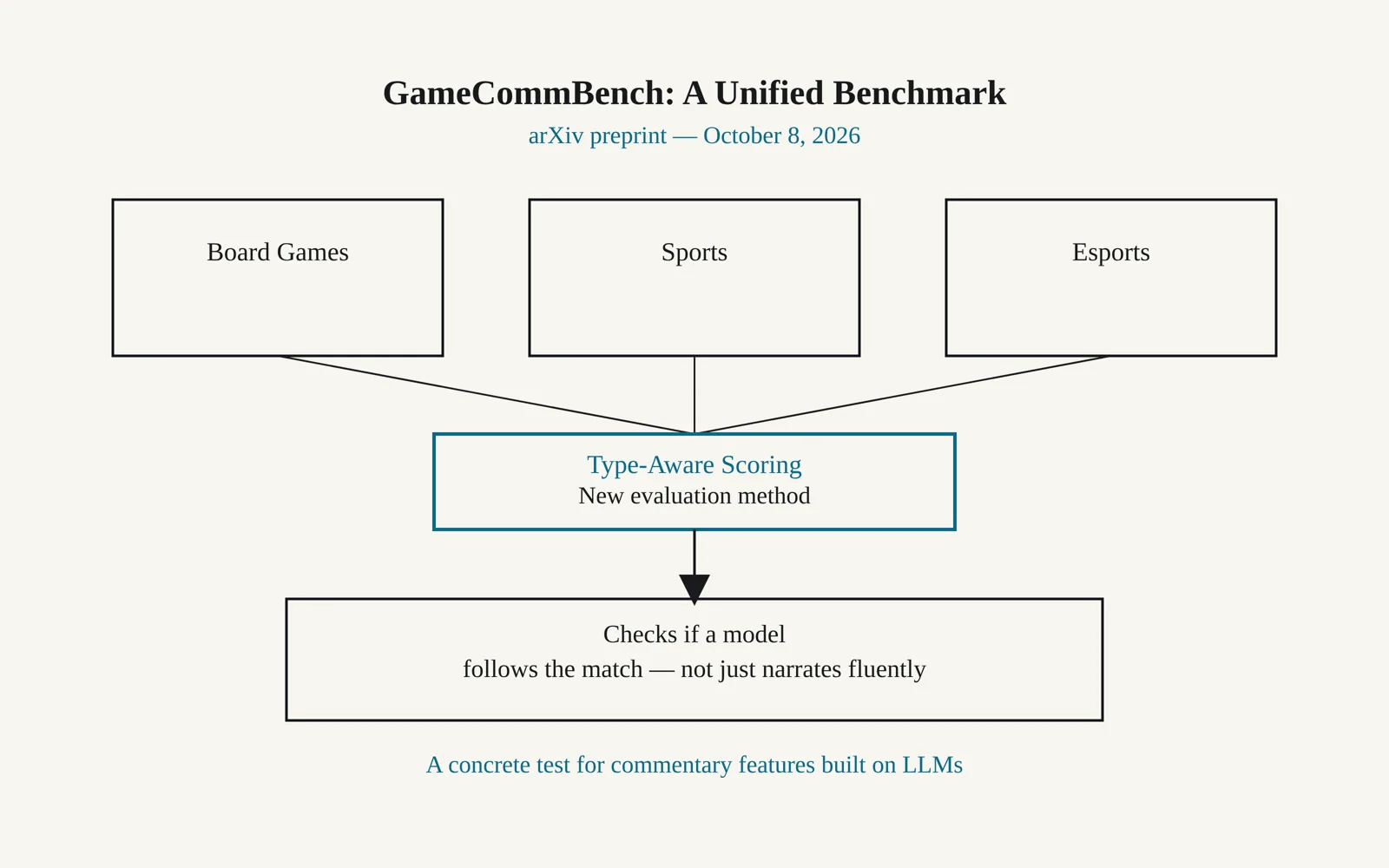
On October 8, 2026, researchers posted a preprint to arXiv introducing GameCommBench, a unified benchmark for AI-generated game commentary spanning board games, sports and esports, paired with a new scoring method called Type-Aware Commentary Evaluation, or TACE, built to judge commentary by its function rather than by surface overlap with reference text. (arXiv preprint 2610.11129, GameCommBench, submitted October 8, 2026)
Open the photograph at full size
Photograph: Diagram: AI Journey
Read the full description of this diagram
Diagram drawn for this item: A New Paper Proposes a Unified Benchmark for AI Game Commentary. On October 8, 2026, researchers posted a preprint to arXiv introducing GameCommBench, a unified benchmark for AI-generated game commentary spanning board games, sports and esports, paired with a new scoring method called Type-Aware... Anyone shipping a commentary feature on top of a language model now has a concrete way to check whether the product can actually follow a match rather than just narrate it fluently.
What it means for you
Anyone shipping a commentary feature on top of a language model now has a concrete way to check whether the product can actually follow a match rather than just narrate it fluently. A team buying or building such a tool should ask specifically how it handles tracking what just happened and explaining why a play mattered, because those are the two jobs the paper's testing shows current systems handle worst, and a smooth-sounding demo can hide exactly that gap.
In more detail
A team of ten researchers has published a preprint describing GameCommBench, a benchmark meant to settle a problem that has made AI-generated game commentary hard to study: every existing attempt tests a different game, a different data format and a different scoring method, so no one can say whether one system’s commentary is actually better than another’s. The paper argues that past evaluation tools made the problem worse by scoring commentary the way machine translation is scored, checking how closely generated text overlaps with a reference transcript, a method that cannot tell a useful tactical observation from a stylistic rewrite of the same sentence.
GameCommBench instead pulls together commentary drawn from board games, traditional sports and esports, and tags each piece of commentary by its type rather than by game alone, recognising that calling a move, describing what is visible on screen and offering strategic analysis are functionally different writing tasks even when they appear in the same broadcast. Alongside the benchmark, the authors propose Type-Aware Commentary Evaluation, TACE, a structured scoring framework built specifically to grade commentary against the job each type of line is supposed to do.
The numbers
The paper reports that it validated TACE for reliability and for agreement with human judges before using it to benchmark a set of representative AI commentary systems against the dataset. That benchmarking produced what the authors describe as non-uniform capability profiles: the tested systems did not perform evenly across commentary types, and the paper names a tendency to miss what is happening in the moment and a tendency to fall short on explaining why a move or play matters as the areas where current AI commentators struggle most consistently. The abstract does not publish a single leaderboard score, framing the release instead as a diagnostic tool meant to make future comparisons between systems possible on common ground.
The authors position GameCommBench and TACE together as infrastructure, not as a product claim. That framing matters for anyone evaluating a vendor’s commentary feature today: a system can sound fluent while still missing what just happened on the board, which is exactly the gap this benchmark is designed to expose rather than paper over with smoother prose. The preprint was submitted to arXiv’s AI and computational linguistics categories on October 8, 2026, and carries no stated company affiliation in its abstract.
Sources
Sources read
arXiv preprint 2610.11129, GameCommBench, submitted October 8, 2026 (arxiv.org)
Paper read
Cite this
AI Journey, "A New Paper Proposes a Unified Benchmark for AI Game Commentary", 11 Oct 2026, https://aijourney.space/updates/2026-10-11-gamecommbench-a-unified-benchmark-and-type-aware-evaluation-for-ai-gener/ (source: arXiv, verified 11 Oct 2026)
Next in the stream
Paper Introduces AgentHorizon Benchmark for AI Judges Grading Computer-Use Agents
A new paper introduces AgentHorizon, a benchmark testing whether AI judges can spot failed long computer-use tasks that merely look complete.
Previous
Researchers Detail Byzantine-Resilient Defense For Federated Large Language Models
A new paper proposes a hypergraph defense for federated large language models, the kind of collaborative training an answer engine like Perplexity AI could one day rely on.
Next
More in Research
Study Finds Precedent Labels Sway Claude Haiku Approval Calls
A new paper tests Claude Haiku 5.5 alongside other models on refund and claim decisions, showing that past case labels shift approvals sharply.
Paper Tests Claude Opus 4.8 Agents on Conflicting Code Edits
A new paper benchmarks Claude Code running Claude Opus 4.8 against other coding agents on tasks where two agents edit the same shared codebase at once.
Perplexity AI Researchers Detail LoRA Recipe For Converting Four Language Models To Diffusion
A paper associated with Perplexity AI describes BYOD, a LoRA-only method that converts standard autoregressive language models into diffusion language models without full retraining.